Summer Sale Limited Time 75% Discount Offer - Ends in 0d 00h 00m 00s - Coupon code = simple75

Pass the Nokia Certified Data Center Fabric Professional 4A0-D03 Questions and answers with Dumpstech

Exam 4A0-D03 Premium Access

View all detail and faqs for the 4A0-D03 exam

Practice at least 50% of the questions to maximize your chances of passing.
Viewing page 2 out of 2 pages
Viewing questions 11-20 out of questions
Questions # 11:

Which of the following statements about utilizing asymmetric routing in an L3 EVPN network is FALSE?

Options:

A.

The ingress PE performs both MAC and IP forwarding.

B.

The egress PE performs MAC forwarding only.

C.

EVPN route-type 5 must be supported by the PEs involved.

D.

Each MAC-VRF used in the L3 EVPN network must exist on each PE.

Questions # 12:

Which of the following statements about EVPN PE-CE routing, using BGP as the routing protocol, is FALSE?

Options:

A.

The PE advertises IPv4/IPv6 BGP updates to the CE based on the EVPN routes received from other PEs.

B.

The PE advertises updates received from the CE as EVPN route type 5 updates to the other PEs.

C.

iBGP is preferred between the CE and PE so that they will be in the same autonomous system.

D.

The PE and CE can utilize import and export policies to control the updates that are sent and received.

Questions # 13:

Leaf routers are configured to support Layer 2 multi-homing all-active mode.

Which of the following statements is FALSE?

Options:

A.

A LAG must be configured on the participating leaf routers.

B.

If VLAN tagging is to be used, then it must be enabled on the LAG interface.

C.

If using LACP, the system-id-mac must uniquely identify each leaf router connected to the host.

D.

The LAG interface must then be associated with the Ethernet segment.

Questions # 14:

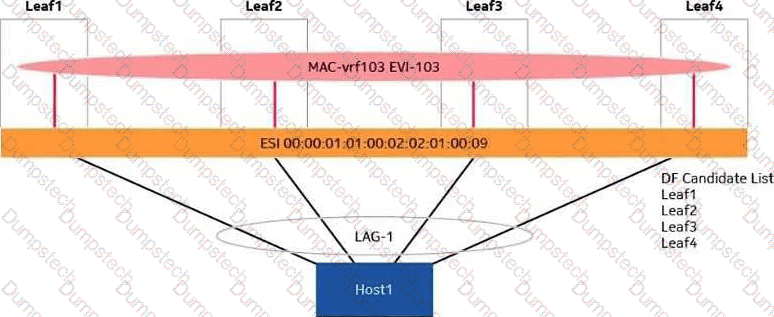
Consider the exhibit.

Question # 14

Leaf1 and Leaf2 have the Ethernet segment configured to use the default election algorithm while Leaf3 and Leaf4 are configured to use the preference-based algorithm with Leaf3 having the higher preference value. The DF candidate list is the same on all leaf routers.

Which of the following leafs is the DF for mac-vrf103?

Options:

A.

Leaf1

B.

Leaf2

C.

Leaf3

D.

Leaf4

Questions # 15:

When providing L3 multi-homing on two or more leaf routers, which of the following is FALSE?

Options:

A.

In a single-active multi-homing scenario, the DF-election is used to identify the active leaf router.

B.

In an all-active multi-homing scenario, the DF-election is used to identify the leaf router that is responsible for forwarding BUM traffic to the host.

C.

All learned 3rd party prefixes are advertised using EVPN route type 5.

D.

The Ethernet segment is associated with the next-hop for the 3rd party prefixes.

Questions # 16:

Which of the following four symmetric routing options does NOT require the use of an EVPN route-type 2?

Options:

A.

Host routing

B.

Prefix routing interface-less

C.

Prefix routing interface-ful numbered

D.

Prefix routing interface-ful unnumbered

Questions # 17:

Consider the exhibit.

Question # 17

Leaf1 and Leaf2 have the Ethernet segment configured to use the default election algorithm while Leaf3 and Leaf4 are configured to use the preference-based algorithm with Leaf3 having the higher preference value. The DF candidate list is the same on all leaf routers.

Which of the following leafs is the DF for mac-vrf103?

Options:

A.

Leaf1

B.

Leaf2

C.

Leaf3

D.

Leaf4

Questions # 18:

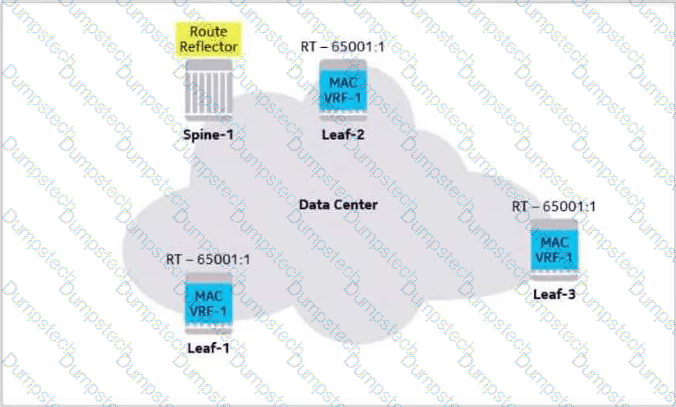
Consider the exhibit.

Question # 18

All three leafs have an EVPN MP-BGP session with the route reflector in Spine-1. Leaf-2 and Leaf-3 have existing instances of an L2 EVPN named MAC VRF-1. Leaf-1 has just enabled a new instance of MAC VRF-1.

Which of the following steps is NOT taken when this new instance is enabled?

Options:

A.

Leaf-1 generates an IMET route.

B.

Leaf-1 advertises the IMET route in a BGP EVPN update directly to Leaf-2 and Leaf-3.

C.

Leaf-2 and Leaf-3 auto-discover the new peer based on the route target in the received IMET route.

D.

Leaf-2 and Leaf-3 add Leaf-1 to their existing flooding list for BUM traffic.

Questions # 19:

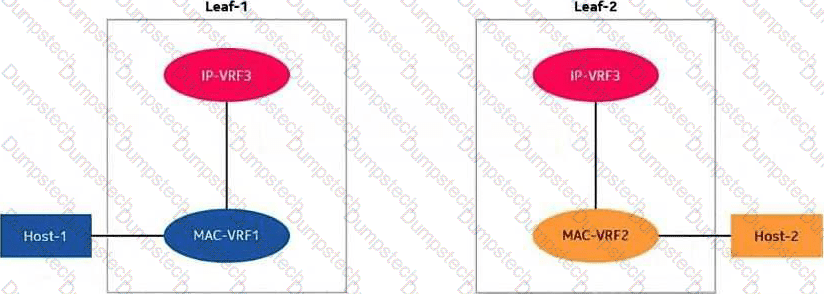
Consider the exhibit.

Question # 19

The network is going to be designed to use interface-less symmetric routing.

Which of the following statements is TRUE?

Options:

A.

An instance of each mac-vrf is required on each leaf.

B.

The ingress PE will perform layer 2 and layer 3 lookups while the egress PE will perform layer 2 lookup.

C.

The IRB configuration does not require anycast gateway configuration on the ip-vrf.

D.

Forwarding information will be exchanged between the PEs using EVPN route-type 2 updates.

Questions # 20:

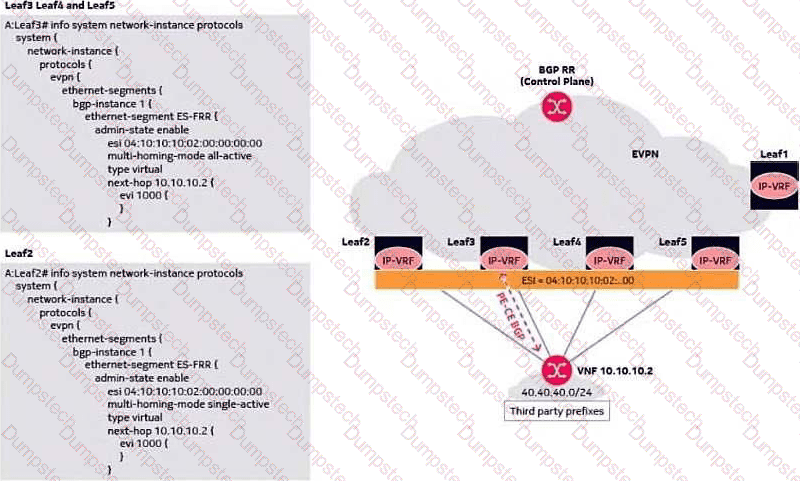
Consider the exhibit.

Question # 20

All IP-VRFs are configured properly and are operational.

Which of the following statements is FALSE?

Options:

A.

One of the connected leaf routers will be elected DF.

B.

The elected DF will use the AD per EVI update to identify itself as primary.

C.

Only the elected DF will advertise the customer IP prefix route to the BGP route reflector.

D.

All connected leaf routers will use an AD per ES update to advertise single-active redundancy.

Viewing page 2 out of 2 pages
Viewing questions 11-20 out of questions