
75only - Ends in 0d 00h 00m 00s - Coupon code = 75only

Pass the Salesforce MuleSoft Mule-Dev-301 Questions and answers with Dumpstech

Exam Mule-Dev-301 Premium Access

View all detail and faqs for the Mule-Dev-301 exam

Practice at least 50% of the questions to maximize your chances of passing.
Viewing page 1 out of 2 pages
Viewing questions 1-10 out of questions
Questions # 1:

A healthcare portal needs to validate the token that it sends to a Mule API. The developer plans to implement a custom policy using the HTTP Policy Transform Extension to match the token received in the header from the healthcare portal.

Which files does the developer need to create in order to package the custom policy?

Options:

A.

XML template file, YAML configuration file

B.

Deployable ZIP file, YAML configuration file

C.

JSON properties file, XML template file

D.

JSON properties file, YAML configuration file

Questions # 2:

An API has been developed and deployed to CloudHub. Among the policies applied to this API is an allowlist of IP addresses. A developer wants to run a test in Anypoint Studio and does not want any policies applied because their workstation is not included in the allowlist.

What must the developer do in order to run this test locally without the policies applied?

Options:

A.

Pass in the runtime parameter "-Danypoint.platform.gatekeeper=disabled"

B.

Deactivate the API in API Manager so the Autodiscovery element will not find the application when it runs in Studio

C.

Run the test as-is, with no changes, because the Studio runtime will not attempt to connect to API Manager

D.

Create a properties file specifically for local development and set the API instance ID to a value that is not used in API Manager

Questions # 3:

A company with MuleSoft Titanium support develops a Salesforce System API using MuleSoft's out-of-the-box Salesforce Connector and deploys the API to CloudHub.

Which steps provide the average number of requests and average response time of the Salesforce Connector?

Options:

A.

Access Anypoint Monitoring's built-in dashboard. Select a resource. Locate the information under the Connectors tab.

B.

Access Anypoint Monitoring's built-in dashboard. Select a resource. Locate the information under Log Management > Raw Data.

C.

Access Anypoint Monitoring's built-in dashboard. Select a resource. Create a custom dashboard to retrieve the information.

D.

Change the API implementation to capture the information in the log. Retrieve the information from the log file.

Questions # 4:

A company has been using CI/CD. Its developers use Maven to handle build and deployment activities.

What is the correct sequence of activities that takes place during the Maven build and deployment?

Options:

A.

Validate, initialize, compile, package, test, install, verify, deploy

B.

Initialize, validate, compile, test, package, verify, install, deploy

C.

Validate, initialize, compile, test, package, verify, install, deploy

D.

Validate, initialize, compile, test, package, install, verify, deploy

Questions # 5:

A Mule application uses API autodiscovery to access and enforce policies for a RESTful implementation.

What needs to be configured for the flowRef attribute of the autodiscovery global element?

Options:

A.

The name of the flow that has APIkit Console to receive all incoming RESTful operation requests

B.

Nothing because flowRef is an optional attribute which can be passed during runtime

C.

The name of the flow that has HTTP Listener to receive all incoming RESTful operation requests

D.

Any of the APIkit generated implementation flows

Questions # 6:

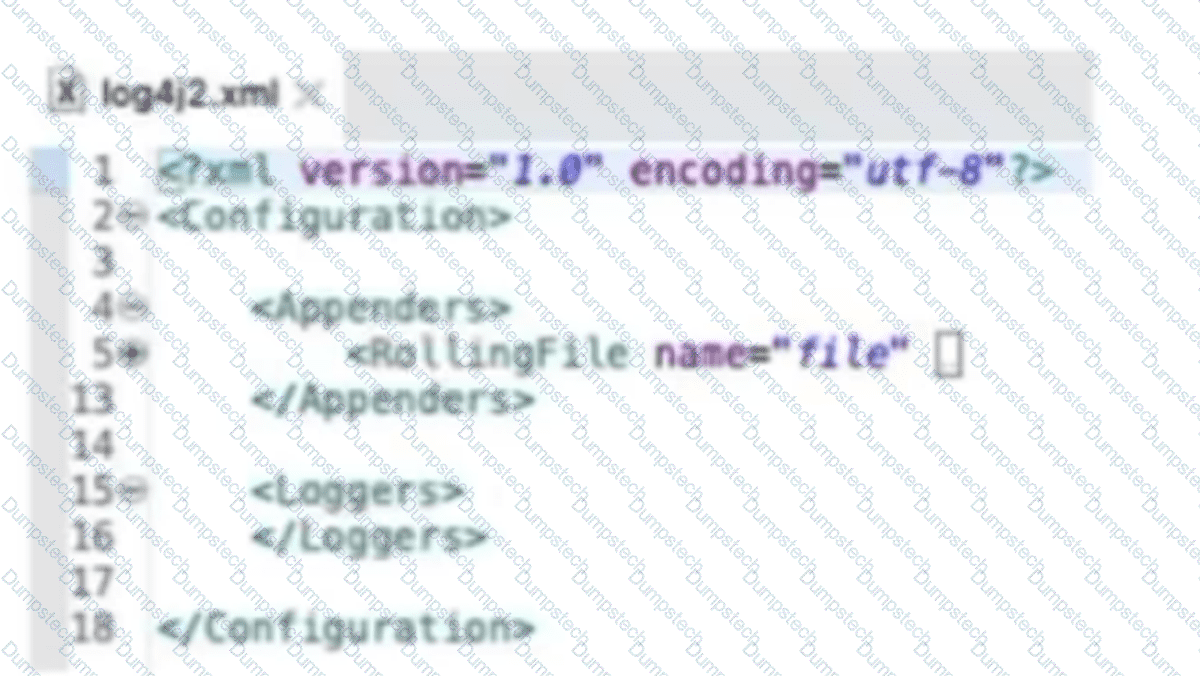
Refer to the exhibit.

What action must be performed to log all the errors raised by the VM Connector?

Exhibit:
Question # 6

Options:

A.

Nothing, as error-level events are automatically logged

B.

Add < AsyncLogger name="org.mule.extensions.vm" level="ERROR"/ > inside the Loggers tag

C.

Add < AsyncLogger name="org.mule.extensions.vm" level="ERROR"/ > inside the Appenders tag

D.

Configure < Logger level="ERROR"/ > inside the VM Connector configuration

Questions # 7:

A Mule API receives a JSON payload and updates the target system with the payload. The developer uses JSON schemas to ensure the data is valid.

How can the data be validated before posting to the target system?

Options:

A.

Add the JSON module dependency and add the validate schema operation in the flow, configured to reference the schema

B.

Using the DataWeave If Else condition, test the values of the payload against the examples included in the schema

C.

Apply the JSON Schema policy in API Manager and reference the correct schema in the policy configuration

D.

Use a DataWeave 2.0 transform operation, and at the top of the DataWeave script, add: %dw 2.0 / import json-module

Questions # 8:

A custom policy needs to be developed to intercept all outbound HTTP requests made by Mule applications.

Which XML element must be used to intercept outbound HTTP requests?

Options:

A.

http-policy:operation

B.

It is not possible to intercept outgoing HTTP requests, only inbound requests

C.

http-policy:processor

D.

http-policy:source

Questions # 9:

A new Mule project has been created in Anypoint Studio with the default settings.

Which file inside the Mule project must be modified before using Maven to successfully deploy the application?

Options:

A.

config.yaml

B.

settings.xml

C.

pom.xml

D.

mule-artifact.json

Questions # 10:

Refer to the exhibits.

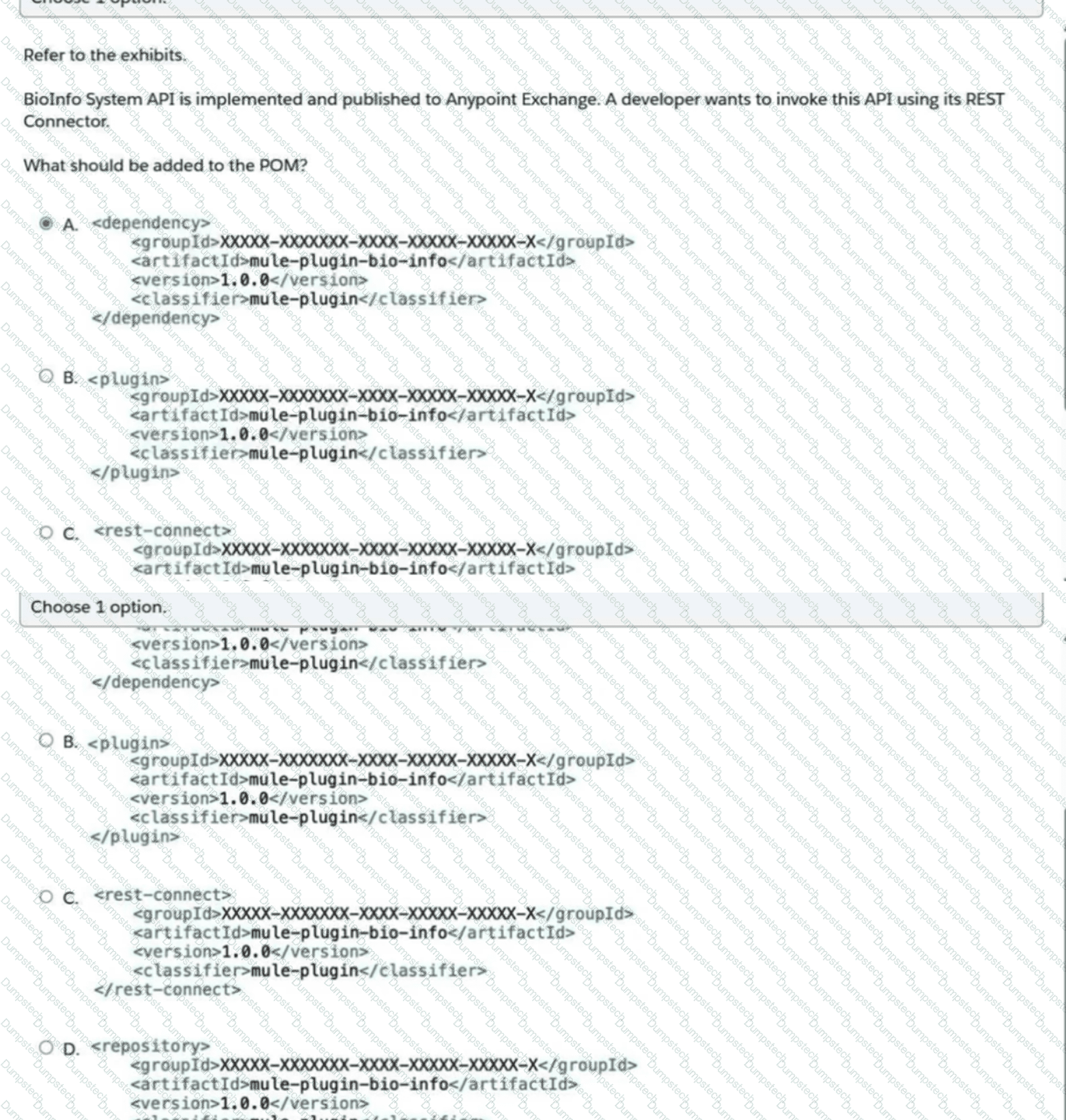
BioInfo System API is implemented and published to Anypoint Exchange. A developer wants to invoke this API using its REST Connector.

What should be added to the POM?

Exhibit / Answer Configurations:
Question # 10

Options:

A.

Add the generated asset as a Maven < dependency > with the Exchange groupId, artifactId, version, and < classifier > mule-plugin < /classifier > .

B.

Add the generated asset as a Maven < plugin > .

C.

Add the generated asset through a < rest-connect > element.

D.

Add the generated asset as a < repository > entry.

Viewing page 1 out of 2 pages
Viewing questions 1-10 out of questions