Summer Sale Limited Time 75% Discount Offer - Ends in 0d 00h 00m 00s - Coupon code = simple75

Pass the UiPath Certified Professional - Developer Track UiPath-ADPv1 Questions and answers with Dumpstech

Exam UiPath-ADPv1 Premium Access

View all detail and faqs for the UiPath-ADPv1 exam

Practice at least 50% of the questions to maximize your chances of passing.
Viewing page 6 out of 7 pages
Viewing questions 51-60 out of questions
Questions # 51:

In a UiPath coded automation, what does the DelayAsync method do?

Options:

A.

It delays the termination of the automation by a specified period of time.

B.

It delays the start of the automation by a specified period of time.

C.

It suspends execution asynchronously for a specified period of time.

D.

It adds a pause between the execution of each activity in the automation.

Questions # 52:

What is the purpose of the Invoke Code activity in UiPath?

Options:

A.

Invokes VB.NET or C# code, optionally passing il a list of input arguments.

B.

Invokes VB MET or Java code optionally passing it a list of input arguments

C.

Invokes VB MET code optionally passing it a list of input arguments

D.

Invokes Java code, optionally passing it a list of input arguments.

Questions # 53:

What Is the role of server-side event triggers In UlPalh Integration Service?

Options:

A.

To start UlPath processes only when users interact with specific Ul elements.

B.

To manage API connections and authorize usage across different security protocols.

C.

To notify users when a new connector is available In the UiPath Integration Service catalog.

D.

To start UiPalh processes by configuring events such as data updates, insertions or deletions in other systems.

Questions # 54:

In the context of a UiPath State Machine, what is the primary purpose of the Exit action in a state?

Options:

A.

To manually stop the state machine ' s execution.

B.

To execute the final actions of the current state before transitioning to the next stage.

C.

To revoke any entry actions performed when entering the current state.

D.

To define the conditions upon which a state transition should occur.

Questions # 55:

In the context of UiPath Orchestrator, what is the primary purpose of the Monitoring feature?

Options:

A.

Handling version control and collaboration among team members.

B.

Real-time tracking of Robots, Machines, Queues, and Jobs.

C.

Facilitating the design and deployment of automation workflows.

D.

Consolidating event logs and records related to executed tasks and runtime anomalies.

Questions # 56:

Given the following list of arguments:
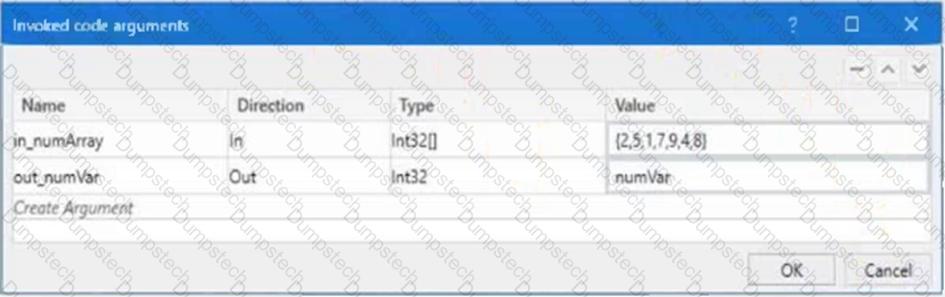
Question # 56

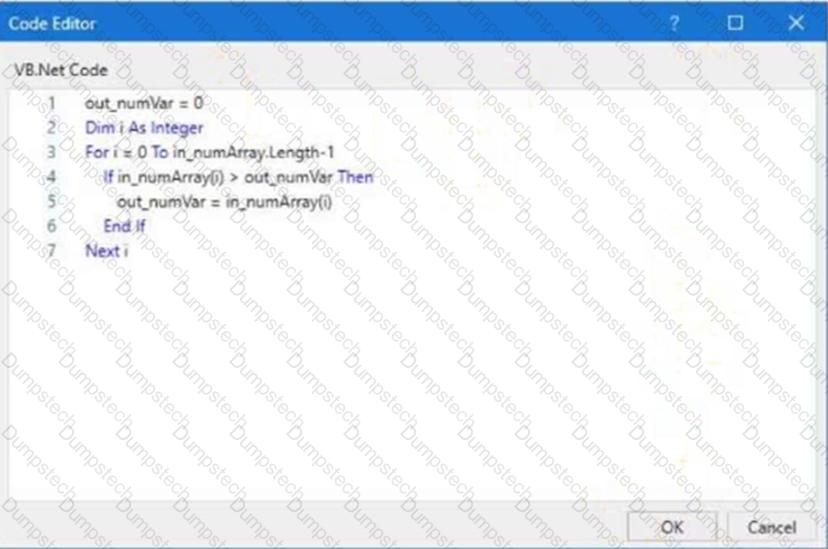
and the following code:

Question # 56

What is the value that will be displayed in the Output Panel at the end of the sequence below:
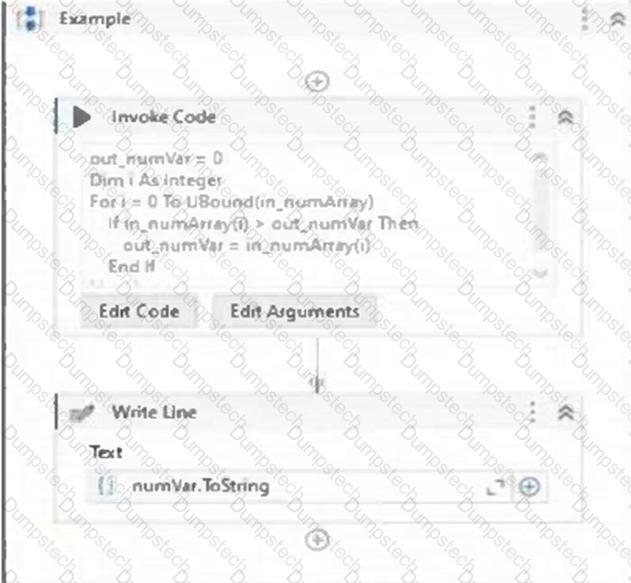
Question # 56

Options:

A.

1

B.

2

C.

7

D.

9

Questions # 57:

When a developer runs a process using the REFramework, with the process utilizing Orchestrator queues and a queue already created with the Name provided and the Auto Retry function disabled, which states will be executed without errors?

Options:

A.

Initialization - > Get Transaction Data - > Process Transaction - > End Process

B.

Initialization - > Get Transaction Data - > End Process

C.

Initialization - > Process Transaction - > End Process

D.

Initialization - > End Process

Questions # 58:

Where is the TransactionNumber incremented in the REFramework?

Options:

A.

Only in the RetryCurrentTransaction.xaml workflow.

B.

Only in the SetTransactionStatus.xaml workflow.

C.

In the New Transaction transition.

D.

In the RetryCurrentTransaction.xaml workflow and in the SetTransactionStatus.xaml workflow.

Questions # 59:

What is the purpose of credential stores in UiPath Orchestrator?

Options:

A.

To store non-sensitive data and configuration settings for UiPath Studio projects.

B.

To store Orchestrator event loos and related data for auditing purposes.

C.

To securely store sensitive data such as Robot credentials and Credential Assets for use in automation processes.

D.

To serve as a centralized location for storing pre-built automation workflows and processes.

Questions # 60:

In a UiPath development scenario, which type of process design would be the most appropriate for an automation task that executes actions in a straightforward progression without iteration or branching?

Options:

A.

Transactional Process

B.

Iterative Process

C.

Sequential Process

D.

Linear Process

Viewing page 6 out of 7 pages
Viewing questions 51-60 out of questions