NCC Certification Exams Pack
Everything from Basic, plus:
- Exam Name: Certified - Electronic Fetal Monitoring
- 125 Questions Answers with Explanation Detail
- Total Questions: 125 Q&A's
- Single Choice Questions: 125 Q&A's


Students Passed
Average Score
Questions came word for word
Years Teaching
Know how you can make it happen
If you're looking to secure C-EFM (EFM) certification, remember there's no royal path to it. It's your prep for this exam that can make the difference. Stay away from those low-quality exam PDFs and unreliable dumps that have no credibility. What you need is a simulated practice exam with practice questions that mirror the actual EFM test environment.
To save you from frustration, Dumpstech comes with a comprehensive prep system that is clear, effective, and built to help you succeed without the least chance of failure. Whether you're looking for sample test questions or full exam practice questions for the Certified - Electronic Fetal Monitoring, our system delivers.
It's overwhelmingly recommended by thousands of Dumpstech's loyal customers as practical, relevant and intuitively crafted to match the candidates' actual exam needs. Our prep questions are designed to build real confidence for the SY0-701 test.
Dumpstech's NCC exam EFM questions are designed to deliver you the essence of the entire syllabus. Each question mirrors the real exam format and comes with an accurate and verified answer. These exam questions and answers give you the clarity you need. Dumpstech's prep system is not mere cramming; it is crafted to add real information and impart deep conceptual understanding to the exam candidates. After each test, review the practice exam answers to identify your weak spots.
Dumpstech's smart testing engine generates multiple mock tests to develop familiarity with the real exam format and learn thoroughly the most significant from the perspective of NCC EFM real exam. They also support you to revise the syllabus and enhance your efficiency to answer all exam practice questions within the time limit.
Dumpstech offers you the most authentic, accurate, and current information that liberates you from the hassle of searching for any other study resource. If you're looking for a free practice test with answers to evaluate our quality before you commit, download our free demo and see for yourself. This comprehensive resource equips you perfectly to develop confidence and clarity to answer exam queries.
Dumpstech's authentic and up-to-date content guarantees you success in the Certified - Electronic Fetal Monitoring certification exam. If you perchance you lose your exam despite your reliance on Dumpstech's exam questions PDF, Dumpstech doesn't leave you alone. You have the option of taking back refund of your money or try a different exam paying no additional amount.
If you want to crack the Certified - Electronic Fetal Monitoring (EFM) exam in one go, your journey starts here. Dumpstech is your real ally that gets you certified fast with the least possibility of losing your chance.
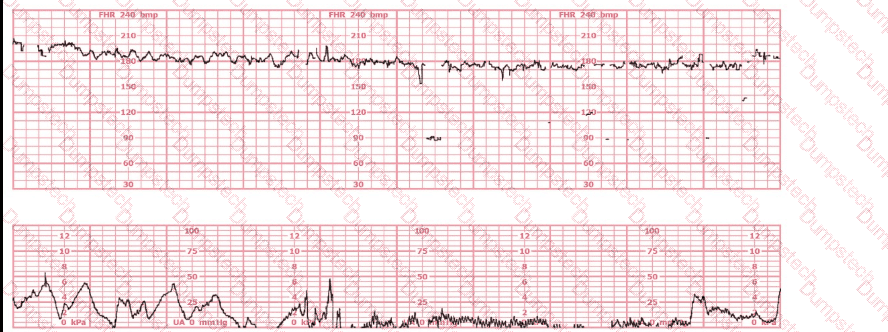
A 30-year-old woman (G2P0) is experiencing preterm labor at 26-weeks gestation. She is receiving magnesium sulfate for neuroprotection. Her external fetal monitoring tracing over the past 30 minutes is shown. The next step would be to:
|
C
|
|---|
|
Explanation
Comprehensive and Detailed Explanation From NCC-Aligned Sources: This tracing shows: Baseline ~170–175 bpm → fetal tachycardia Minimal variability No contractions of significance Maternal treatment with magnesium sulfate, which typically decreases baseline and variability—not increase it NCC and AWHONN physiology guidelines emphasize that fetal tachycardia is most commonly associated with maternal infection, including chorioamnionitis, especially in preterm labor. Magnesium sulfate does not cause tachycardia; it generally causes: ↓ baseline ↓ variability Thus, fetal tachycardia + minimal variability in a preterm patient strongly suggests maternal infection, requiring evaluation for chorioamnionitis. Why the wrong answers are incorrect: A. Acetaminophen → used after confirming fever, not before evaluating the cause. B. Discontinuing magnesium → magnesium sulfate does not cause tachycardia; discontinuing it removes fetal neuroprotection. [References:NCC C-EFM Candidate Guide; AWHONN FHMPP; Simpson & Creehan; Menihan EFM; Creasy & Resnik., ]
|
The main reason intrauterine pressure catheters are placed is to:
|
B
|
|---|
|
Explanation
Comprehensive and Detailed Explanation From Exact Extract–Based NCC C-EFM References: Intrauterine pressure catheters (IUPCs) are an internal uterine activity monitoring device used when external tocodynamometry does not provide adequate assessment of contraction strength or frequency. According to NCC, AWHONN, Miller, and Menihan, the primary indication for placing an IUPC is to obtain accurate, quantitative measurement of uterine activity. Purpose of IUPC (per NCC and AWHONN): Measures exact intrauterine pressure in mmHg Calculates Montevideo units (MVUs) to evaluate adequacy of labor Clearly differentiates: Frequency Duration Strength (intensity) Resting tone NCC explicitly lists the primary purpose as: “Accurate assessment of uterine contraction pattern and intensity.” Why the other options are incorrect: A. Define the quality of the fetal baseline – Incorrect Fetal heart rate (FHR) baseline quality is determined by fetal ECG or FSE, not IUPC. IUPCs monitor the uterus, not the fetal cardiac signal. C. Rule out artifact – Incorrect While an IUPC can reduce artifact from the toco, this is not its primary purpose. Artifact is more commonly an issue with external FHR monitoring, corrected by repositioning or placing a fetal scalp electrode—not by using an IUPC. Correct Answer: B. Determine the contraction pattern This aligns directly with NCC’s Electronic Monitoring Equipment domain: IUPCs provide the most accurate and reliable measurement of uterine activity when external monitoring is inadequate. [References:NCC C-EFM Candidate Guide (2025); NCC Content Outline; AWHONN Fetal Heart Monitoring Principles & Practices; Miller’s Fetal Monitoring Pocket Guide; Menihan Electronic Fetal Monitoring; Simpson & Creehan Perinatal Nursing; Creasy & Resnik Maternal–Fetal Medicine., ]
|
Patient safety is enhanced when alarms:
|
B
|
|---|
|
Explanation
Comprehensive and Detailed Explanation From NCC-Aligned Sources: NCC and AWHONN emphasize unit-wide shared responsibility for: Recognizing abnormal maternal or fetal findings Calling for help Triggering emergency responses (e.g., unit huddle, rapid response, safety pathways) Safety culture requires: Any staff member (RN, tech, provider) to initiate an alarm or escalate concern No hierarchy delay Rapid action when fetal compromise is suspected Why the other answers are wrong: A. Determined by unit leaders → incorrect; safety is team-wide, not hierarchical. C. Occur infrequently → false; alarms must occur whenever needed, not limited. Correct answer: B. Can be called by anyone. [References:NCC Professional Issues Domain; AWHONN Standards for Professional Practice; Perinatal Safety Bundles; Simpson & Creehan.]
|
See how DumpsTech helps candidates pass with confidence.
Stay ahead in your career with the latest certification exams from leading vendors. DumpsTech brings you newly released exams with reliable study resources to help you prepare confidently.
Find answers to the most common questions about the NCC EFM exam, including what it is, how to prepare, and how it can boost your career.