
Summer Sale Limited Time 75% Discount Offer - Ends in 0d 00h 00m 00s - Coupon code = simple75

Pass the Anthropic Claude Certified Architect CCAR-P Questions and answers with Dumpstech

Exam CCAR-P Premium Access

View all detail and faqs for the CCAR-P exam

Practice at least 50% of the questions to maximize your chances of passing.
Viewing page 2 out of 4 pages
Viewing questions 11-20 out of questions
Questions # 11:

You are responding to a stakeholder request that adds significant scope to a deployment already in flight.

Which response best aligns expectations while respecting the stakeholder’s underlying need?

Options:

A.

Hide the scope-addition request from the broader delivery team to avoid a difficult conversation, allowing the change to proceed without team awareness of its timeline implications.

B.

Decline the request outright without acknowledging the stakeholder’s underlying need or offering alternatives such as deferral, descoping, or timeline extension.

C.

Acknowledge the request, describe the scope and timeline implications transparently, and propose options—defer it, descope something else, or extend the timeline—for the stakeholder to choose.

D.

Accept the additional scope into the current release without describing the timeline or descoping implications, allowing the delivery plan to absorb unacknowledged changes until they surface as delays.

Questions # 12:

A Claude architect is implementing safety controls for a customer-facing advice assistant that must never provide regulated investment recommendations.

Which two guardrail implementations most directly enforce this constraint? (Select two.)

Options:

A.

Increase response temperature to introduce variability that reduces the likelihood of specific recommendations.

B.

Add an output classifier that detects and blocks responses containing regulated investment-recommendation language.

C.

Limit session length to reduce the volume of queries processed per user per day.

D.

Log all user queries to a SIEM for post-hoc compliance review.

E.

Define explicit out-of-scope categories in the system prompt with fixed refusal phrasing for investment advice requests.

Questions # 13:

You are evaluating model-selection claims used by a peer team.

For each statement, select yes if the statement is generally true. Otherwise, select no.
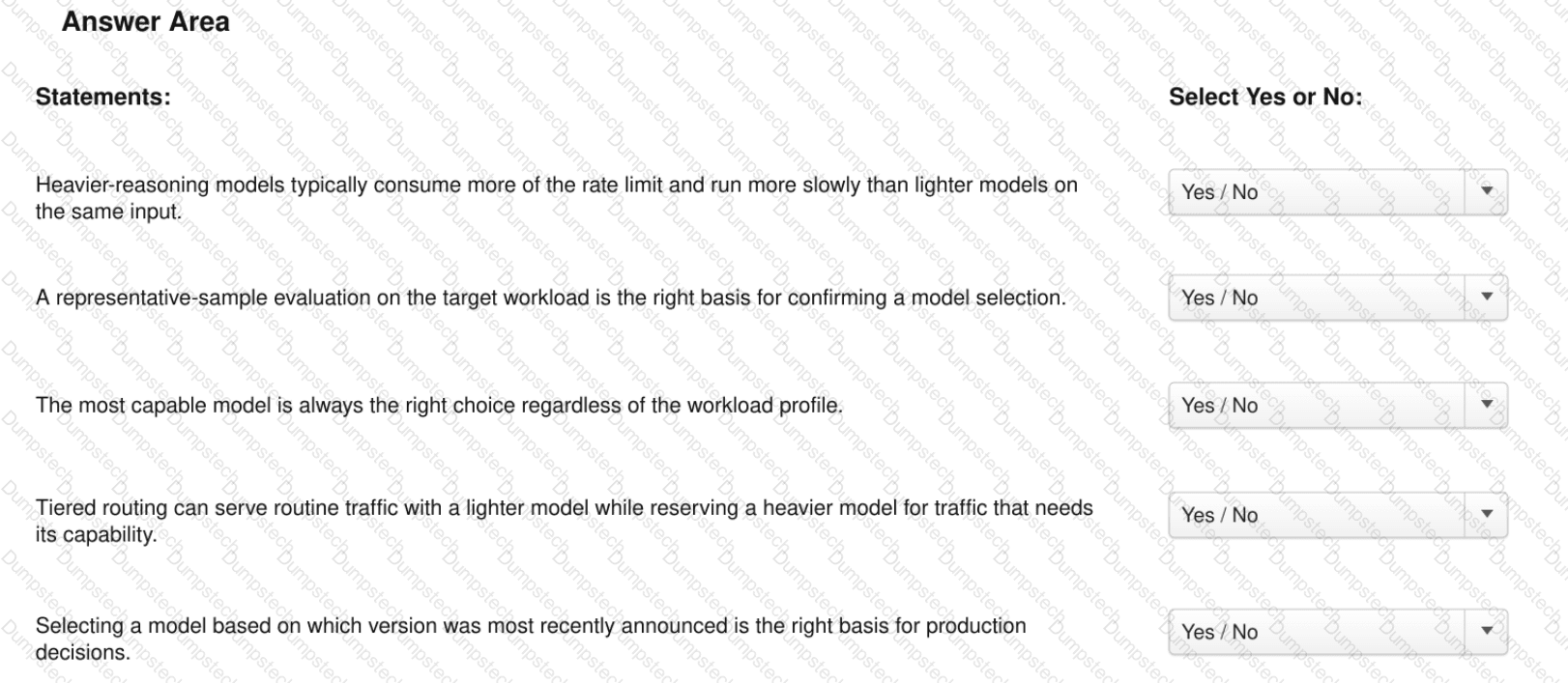
Question # 13

Options:

Questions # 14:

You are investigating an MCP server that fails on first launch but succeeds on subsequent runs. System permission dialogs appeared during the first launch.

Which response is most appropriate?

Options:

A.

Recognize the first-run permission grant as the cause, document the expected behavior in onboarding guidance, and confirm that subsequent runs succeed.

B.

Reinstall the operating system to clear all permission state without first confirming whether the one-time permission grant caused the failure.

C.

Disable operating-system permission dialogs entirely, accept the resulting security implications, and proceed without confirming whether the failure recurs.

D.

Treat the first-run failure as a permanent fault, replace the MCP server, and do not verify whether subsequent runs succeed.

Questions # 15:

A platform team operates a self-hosted multi-agent system on Kubernetes that orchestrates seven specialized agents for invoice processing. The team spends approximately 40 percent of engineering capacity on infrastructure maintenance, message bus reliability, and agent state recovery. The CFO has asked you to evaluate moving to managed agent infrastructure to reclaim engineering capacity. The security officer requires that all customer financial data remain within an approved network boundary.

Which factor should most heavily influence your recommendation?

Options:

A.

Whether the current seven agents map cleanly to the patterns supported by managed agents.

B.

Whether managed agents reduce per-invoice token costs across the existing processing volume.

C.

Whether managed agents support the current bus topology used by the platform team.

D.

Whether managed agent data handling satisfies the network boundary required by security.

Questions # 16:

A solutions architect is analyzing stakeholder feedback collected after the first quarter of a Claude-powered procurement automation deployment. The feedback includes four statements: (1) “Our procurement team is processing 3x more purchase orders per analyst per day.” (2) “We have eliminated the manual data entry role entirely and redeployed those staff to vendor relationship management.” (3) “The API integration costs are running 40% over the projected per-transaction budget.” (4) “Response latency during end-of-month batch runs is averaging 11 seconds, against our committed 5-second SLA.”

Which of the following correctly identifies the primary business value pillar each stakeholder statement represents?

Options:

A.

Statement 1: Efficiency; Statement 2: Transformation; Statement 3: Solution Cost; Statement 4: Performance SLA

B.

Statement 1: Productivity; Statement 2: Efficiency; Statement 3: Solution Cost; Statement 4: Performance SLA

C.

Statement 1: Transformation; Statement 2: Productivity; Statement 3: Solution Cost; Statement 4: Efficiency

D.

Statement 1: Efficiency; Statement 2: Productivity; Statement 3: Performance SLA; Statement 4: Solution Cost

Questions # 17:

You are supporting an EU-based deployment with GDPR obligations.

Which combination of measures best supports the deployment’s GDPR posture?

Options:

A.

enterprise-tier deployment with a signed Data Processing Addendum, defined data-retention configuration, redaction of personal data not needed for the task, and documented data-subject-rights handling

B.

disabling all data-retention configuration, redaction controls, and data-subject-rights handling to simplify day-to-day operations, accepting the resulting GDPR compliance exposure

C.

using a personal Claude account tier for processing EU personal data at scale, with no signed Data Processing Addendum and no documented data-subject-rights handling procedure

D.

pasting full EU personal data into every prompt to “give Claude complete context” without considering purpose limitation, data minimization, or the organization’s Data Processing Addendum obligations

Questions # 18:

You are designing a feedback session for a deployment in flight.

Which structure best supports productive stakeholder feedback?

Options:

A.

Hold an open-ended meeting with no pre-distributed agenda or artifacts, and rely on participants’ memory to carry decisions and follow-up owners forward.

B.

Define a focused agenda, share the artifacts in advance, capture decisions and follow-ups in writing, and confirm action owners and dates.

C.

Distribute artifacts at the session start rather than in advance, so stakeholders review materials in real time without preparation before the discussion begins.

D.

End the session without recording decisions, follow-up items, action owners, or dates, relying on participant memory to carry the session’s outcomes forward.

Questions # 19:

You are operating an interactive assistant whose dominant performance constraint is per-turn latency. Quality on routine turns is already acceptable.

Which configuration adjustment most directly improves latency without disproportionately damaging quality?

Options:

A.

Disable prompt caching entirely to ensure fresh context processing on every request, preventing stale prefix content from affecting latency-sensitive interactions.

B.

Reduce retrieval depth to the top-k passages that historically cover the answer, and cache stable system-prompt content.

C.

Increase retrieval depth to the corpus maximum to improve recall regardless of latency.

D.

Switch every turn to the heaviest available model to maximize output quality, accepting that the increased model latency will worsen the per-turn SLO rather than improve it.

Questions # 20:

You are listing characteristics of strong architectural-decision communication.

Which two characteristics belong on the list? (Select two.)

Each correct answer presents a complete solution.

Options:

A.

Ownership and review cadence for revisiting the decision when conditions or assumptions change.

B.

Distribution to a standing review forum with mandatory attendance from senior engineering leaders.

C.

Omission of rejected alternatives to keep the decision document focused and concise for readers.

D.

Alternatives considered along with the criteria that were used to evaluate each alternative.

E.

Use of a consistent template across the team to standardize the visual presentation of decisions.

Viewing page 2 out of 4 pages
Viewing questions 11-20 out of questions