
Pre-Winter Sale Limited Time 75% Discount Offer - Ends in 0d 00h 00m 00s - Coupon code = simple75

Pass the Anthropic Claude Certified Architect CCAR-P Questions and answers with Dumpstech

Exam CCAR-P Premium Access

View all detail and faqs for the CCAR-P exam

Practice at least 50% of the questions to maximize your chances of passing.
Viewing page 4 out of 4 pages
Viewing questions 31-40 out of questions
Questions # 31:

You are building an evaluation pipeline for a Claude-based deployment and must complete the specification steps before running the deployment against the dataset.

Which two steps must be completed BEFORE running the deployment against the evaluation dataset? (Select two.)

Each correct answer presents part of the solution.

Options:

A.

Publish the aggregated metrics to a dashboard and gate releases on threshold checks.

B.

Curate and label the evaluation dataset to match the defined slices.

C.

Review failure cases with subject matter experts to refine the scoring rubric.

D.

Define the metrics and slices the framework will report across representative, edge, and adversarial cases.

E.

Score the deployment outputs against the reference labels and aggregate the metrics.

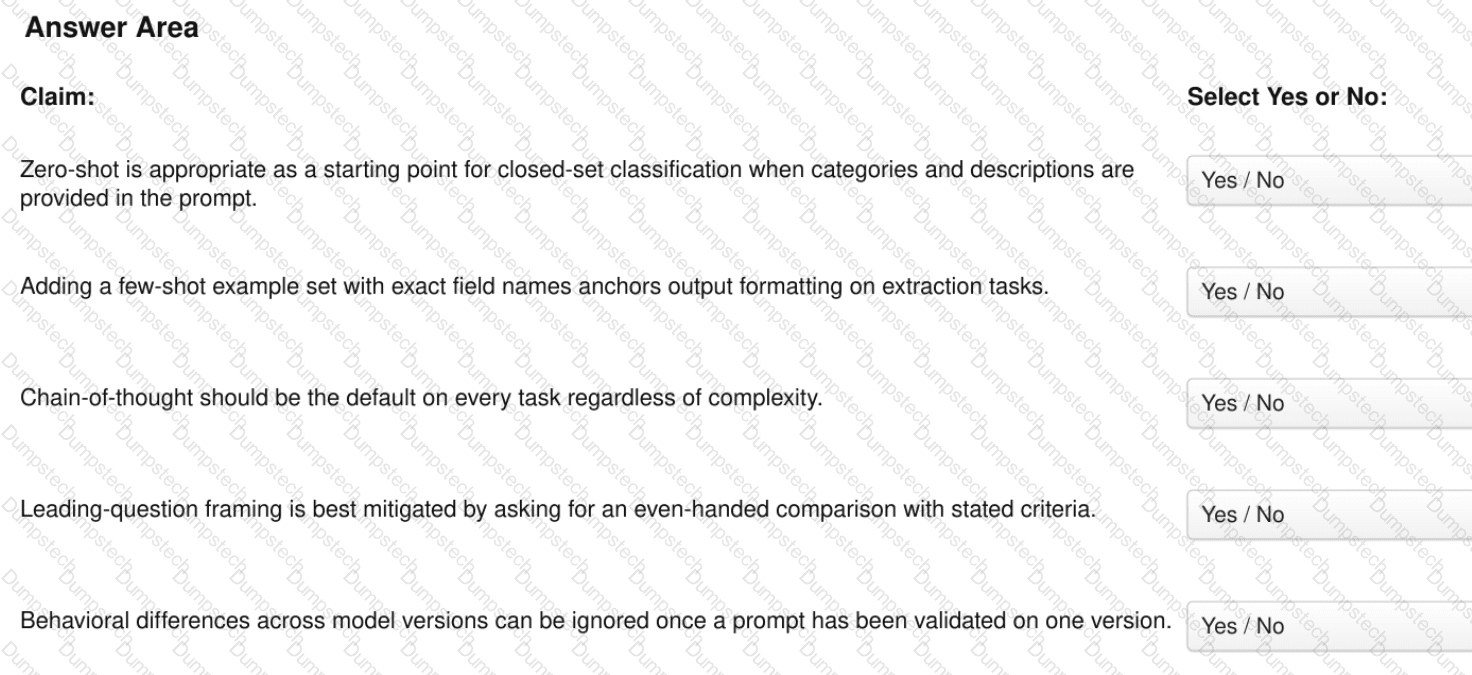
Questions # 32:

You are evaluating prompting claims in a peer’s design document.

For each claim, select yes if the claim reflects sound practice. Otherwise, select no.
Question # 32

Options:

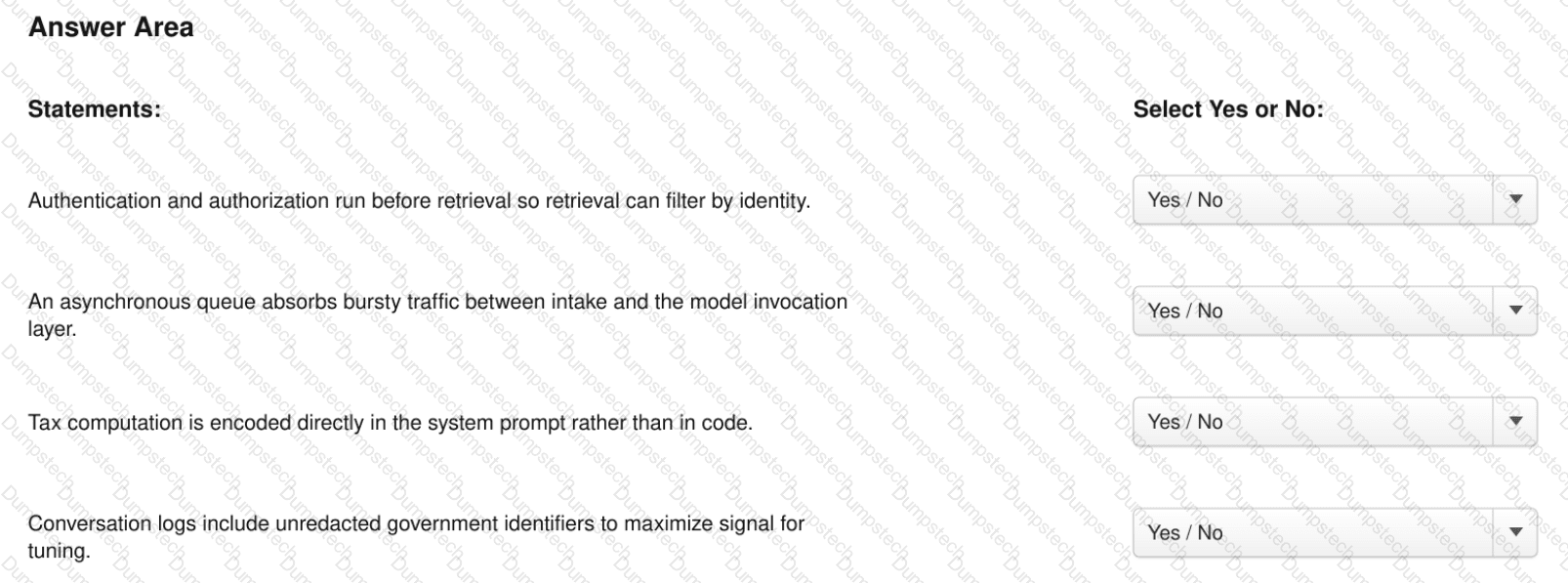
Questions # 33:

You are reviewing a peer’s end-to-end design for a Claude-based platform expected to scale to thousands of concurrent users.

For each statement, indicate Yes if it reflects sound architectural practice. Otherwise, select No.
Question # 33

Options:

Questions # 34:

A research summarization assistant has been deployed for six months. A user has flagged that a generated summary contained a fabricated citation. The product team has asked whether the incident requires architectural action or whether it is an isolated case.

Which two Diligence-competency actions should you take? (Select two.)

Each correct answer presents part of the solution.

Options:

A.

Sample recent summaries to estimate the fabrication frequency across the population.

B.

Disable the assistant immediately for all current users without any prior diagnostic analysis.

C.

Review whether citation-grounding controls exist anywhere in the current generation pipeline.

D.

Communicate to users that the assistant does not fabricate output as a matter of design.

E.

Treat the incident as an anecdotal isolated case and take no further investigative action.

Questions # 35:

You are a solution architect evaluating candidate use cases for a Claude-based program.

For each scenario, select Yes if Claude is appropriate as the primary solution at the architectural level. Otherwise, select No.

Question # 35

Options:

Questions # 36:

The platform team at Trenova Systems, Inc. needs to reduce per-query cost and p95 latency for a high-volume Claude pipeline without degrading output quality on the core use case.

Which two optimizations directly target both cost and latency simultaneously? (Select two.)

Options:

A.

Enable prompt caching on the static system-prompt prefix to reduce billable input tokens on repeated calls.

B.

Route straightforward query types to a smaller, faster Claude model and reserve the full model for complex cases.

C.

Increase max_tokens to reduce the frequency of truncated responses requiring follow-up calls.

D.

Add a retrieval step that fetches the full source corpus into the context window before generation.

E.

Expand the system prompt to include additional few-shot examples on every request.

Questions # 37:

You are defining transparency practices for a customer-facing assistant whose responses are materially shaped by AI.

Which transparency practice most directly supports responsible deployment?

Options:

A.

Misrepresent the AI’s role in producing responses in order to make the assistant feel more trustworthy or more human, undermining informed user consent and organizational transparency.

B.

Refuse to answer any user question about how the responses were produced or whether AI was involved, treating the AI’s role as confidential operational information.

C.

Disclose AI involvement to end users in line with the organization’s transparency policy and provide a documented path to reach a human when needed.

D.

Disclose AI involvement only to internal staff and operators while withholding that information from the end users whose interactions are materially shaped by the AI system.

Questions # 38:

A healthcare organization is evaluating two Claude-powered AI architectures for a clinical documentation assistant. Architecture X produces higher output quality scores but costs $0.18 per documentation session and averages 4.2 seconds per response. Architecture Y scores slightly lower on quality metrics but costs $0.09 per session and averages 2.1 seconds per response. The stated SLA requires responses under 3 seconds, and the annual volume is projected at 2 million documentation sessions.

Which evaluation approach correctly applies business value pillar analysis to this decision?

Options:

A.

Select Architecture Y based solely on the 50% cost reduction, since solution cost is the most important value pillar in healthcare budget-constrained environments.

B.

Select Architecture X because the higher quality scores justify the cost premium, and any SLA gap can be addressed through infrastructure optimization after deployment.

C.

Eliminate Architecture X on SLA grounds, then evaluate Architecture Y against the efficiency and solution cost pillars by calculating annual cost difference and assessing whether the quality delta materially impacts clinical workflow productivity.

D.

Recommend a hybrid approach using Architecture X for complex cases and Architecture Y for routine cases, without additional analysis, since this preserves quality where it matters most.

Questions # 39:

You are integrating Claude Code into a workflow that runs against a production database.

Which guardrail design most directly preserves safety on data-modifying operations?

Options:

A.

Allow Claude Code to write directly to the production database without subagent scoping, read-only credential defaults, or human confirmation gates on data-modifying operations.

B.

Configure the database MCP server with a fully privileged credential that can perform any read or write operation, and allow all operations to proceed without explicit human confirmation.

C.

Disable all logging and auditing on database operations through the MCP server to reduce alert noise, removing the observability needed to detect unintended data modifications.

D.

Configure the database MCP server with a read-only credential by default, restrict the subagent’s tool list to read-only operations, and require explicit human confirmation on any operation that would modify data.

Questions # 40:

You are designing a feedback session for a deployment in flight.

Which structure best supports productive stakeholder feedback?

Options:

A.

Hold an open-ended meeting with no pre-distributed agenda or artifacts, and rely on participants’ memory to carry decisions and follow-up owners forward.

B.

Define a focused agenda, share the artifacts in advance, capture decisions and follow-ups in writing, and confirm action owners and dates.

C.

Distribute artifacts at the session start rather than in advance, so stakeholders review materials in real time without preparation before the discussion begins.

D.

End the session without recording decisions, follow-up items, action owners, or dates, relying on participant memory to carry the session’s outcomes forward.

Viewing page 4 out of 4 pages
Viewing questions 31-40 out of questions