
Summer Sale Limited Time 75% Discount Offer - Ends in 0d 00h 00m 00s - Coupon code = simple75

Pass the Anthropic Claude Certified Architect CCAR-P Questions and answers with Dumpstech

Exam CCAR-P Premium Access

View all detail and faqs for the CCAR-P exam

Practice at least 50% of the questions to maximize your chances of passing.
Viewing page 3 out of 4 pages
Viewing questions 21-30 out of questions
Questions # 21:

A pilot AI assistant for procurement specialists shows 89 percent first-response acceptance, but follow-up surveys reveal that specialists frequently override the assistant’s vendor recommendations after considering criteria the assistant did not evaluate. The pilot owner wants to ship the assistant unchanged because of the strong acceptance rate.

Which two Discernment-competency observations should you raise BEFORE approving the launch? (Select two.)

Options:

A.

The acceptance rate alone proves readiness for general production use.

B.

The survey response rate may not be statistically representative of all specialists.

C.

The unconsidered criteria represent a scope gap in the assistant’s input space.

D.

Acceptance does not establish whether recommendations remain correct after specialist review.

E.

The pilot duration was probably too short to demonstrate reliability across the full year.

Questions # 22:

You are classifying chunking strategies by the corpus type each is best suited to.

For each chunking strategy, select the appropriate corpus type: “Long Structured Documents,” “Heterogeneous Short Records,” or “Code or Hierarchical Specifications.”
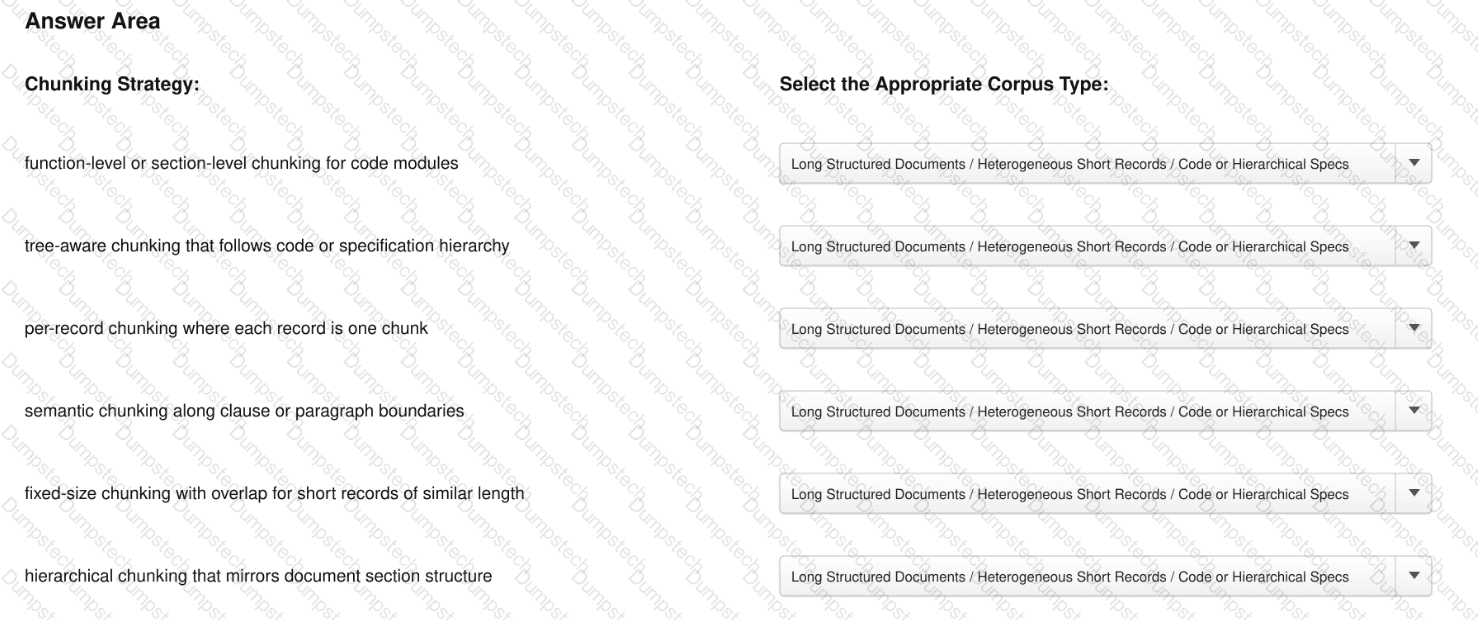
Question # 22

Options:

Questions # 23:

You are selecting a pattern for a compliance Q & A assistant that must answer policy questions with citations to the authoritative internal source set. Latency, cost, and audit predictability are prioritized.

Which pattern is the best fit?

Options:

A.

Augmented LLM with retrieval-augmented generation over the indexed authoritative corpus and citation rendering on each answer.

B.

Multi-agent orchestration with a planner, researcher, and writer agent for every query.

C.

A pure agent loop with open web-browsing tools to surface the most current policy information, without constraining retrieval to the authoritative internal corpus.

D.

A static prompt with the entire policy corpus concatenated into every request.

Questions # 24:

Engineering leadership wants to roll out Claude Skills to 280 developers across 14 teams. Skills will encode internal coding standards, code-review checklists, and incident-postmortem templates. Leadership has asked how to govern Skill authorship so that Skills remain trustworthy without bottlenecking on a single central team.

Which governance model should you recommend?

Options:

A.

Per-developer authorship across the 280 engineers with no team-level coordination required.

B.

Centralized authorship by a single platform team responsible for every Skill produced.

C.

Fully decentralized authorship across the 14 teams with no review before publication.

D.

Federated authorship across the 14 teams with a central review and publication gate.

Questions # 25:

You are presenting an architectural decision to a mixed audience that includes an executive sponsor and the engineering leads who will implement the decision.

Which presentation strategy best serves both audiences?

Options:

A.

Open with a deep dive into low-level implementation details targeted at engineering leads, and stop there without addressing the business outcomes or trade-offs the executive sponsor needs.

B.

Lead with the decision, the business outcomes it serves, and the trade-offs accepted; follow with the technical rationale, alternatives, and implementation implications for the engineering audience.

C.

Skip the rationale, alternatives, and trade-off discussion entirely and simply announce the chosen decision, leaving both audiences without the context needed to implement or validate it.

D.

Present a single undifferentiated narrative that addresses technical and business concerns with equal weight throughout, treating both audiences as requiring the same depth on every section.

Questions # 26:

A healthcare organization is evaluating two Claude-powered AI architectures for a clinical documentation assistant. Architecture X produces higher output quality scores but costs $0.18 per documentation session and averages 4.2 seconds per response. Architecture Y scores slightly lower on quality metrics but costs $0.09 per session and averages 2.1 seconds per response. The stated SLA requires responses under 3 seconds, and the annual volume is projected at 2 million documentation sessions.

Which evaluation approach correctly applies business value pillar analysis to this decision?

Options:

A.

Select Architecture Y based solely on the 50% cost reduction, since solution cost is the most important value pillar in healthcare budget-constrained environments.

B.

Select Architecture X because the higher quality scores justify the cost premium, and any SLA gap can be addressed through infrastructure optimization after deployment.

C.

Eliminate Architecture X on SLA grounds, then evaluate Architecture Y against the efficiency and solution cost pillars by calculating annual cost difference and assessing whether the quality delta materially impacts clinical workflow productivity.

D.

Recommend a hybrid approach using Architecture X for complex cases and Architecture Y for routine cases, without additional analysis, since this preserves quality where it matters most.

Questions # 27:

A technical team is cataloguing risks specific to Claude’s use in a document-grounded Q & A system.

Which two items represent failure modes intrinsic to LLM-based systems rather than generic software defects? (Select two.)

Options:

A.

An expired TLS certificate blocks outbound API calls to Claude.

B.

A database connection timeout causes retrieval to return an empty result set.

C.

The model refuses a legitimate query because surface features trigger an overly broad safety pattern.

D.

A misconfigured load balancer routes requests to a deprecated API version.

E.

The model generates a plausible-sounding answer unsupported by any retrieved document.

Questions # 28:

You are identifying inefficiency in a Claude Code workflow where each engineer manually re-explains the project's conventions and architecture in every session.

Which adjustment most directly removes this inefficiency?

Options:

A.

Forbid the use of Claude Code on the project entirely to avoid the session-initialization overhead, accepting that the team loses all AI-assisted development productivity for this codebase.

B.

Capture the project's conventions and architecture in a project-scoped CLAUDE.md (or equivalent persistent project-context file) committed to the repository, so each session loads it automatically.

C.

Tell each engineer to retype the project conventions and architecture context more quickly at the start of each session, reducing time lost without eliminating the repeated manual effort.

D.

Remove all documented project conventions and architectural standards so engineers have nothing to re-explain at session start, accepting the loss of consistency and shared coding standards.

Questions # 29:

You are running a risk assessment on a planned Claude-based deployment and must complete the inventory steps before assessing threats against assets.

Which two steps must be completed BEFORE assessing threats against assets to estimate likelihood and impact? (Select two.)

Each correct answer presents part of the solution.

Options:

A.

Document the assessment outcome with risks, mitigations, residual risk, and acceptance owners.

B.

Recommend mitigations and residual-risk acceptance for the risks that remain after analysis.

C.

Identify the assets that the deployment touches, along with the sensitivity of each asset.

D.

Recommend mitigations and residual-risk acceptance for risks that remain.

E.

Enumerate the threat actors and attack vectors relevant to the deployment.

Questions # 30:

You are running a controlled experiment to compare two prompts and must complete the design steps before executing the experiment.

Which two steps must be completed BEFORE running the experiment with random assignment? (Select two.)

Each correct answer presents part of the solution.

Options:

A.

Determine the minimum detectable effect size and the sample size needed for power.

B.

Decide whether to promote, reject, or iterate the candidate based on the analysis.

C.

Define the hypothesis and the primary success metric for the comparison.

D.

Analyze the results against the predefined success metric and significance threshold.

E.

Document the recommendation, the trade-offs accepted, and the alternatives considered.

Viewing page 3 out of 4 pages
Viewing questions 21-30 out of questions