Black Friday VIP Hour Limited Time 75% Discount Offer - Ends in 0d 00h 00m 00s - Coupon code = simple75
Pass the Cisco CCNP Wireless 300-120 Questions and answers with Dumpstech
An engineer completed the basic installation for two Cisco CMX servers and is in the process of configuring high availability, but it fails. Which two statements about the root of the issue are true? (Choose two.)
A customer must use deep-packet inspection on the Cisco Catalyst 9800 Series Wireless Controller. The details must include all wireless client use details. Where must AVC be configured to meet this requirement?
A customer has Cisco FlexConnect APs at all remote branches and requires zero downtime through the FlexConnect Fault Tolerance feature. Which two configurations must be identical on both controllers to maintain connectivity when the APs switch from the primary WLC to the backup WLC because of a WAN failure? (Choose two.)
When the Cisco FlexConnect AP Image Upgrade feature is used, APs must communicate with each other to distribute the image. Which two elements are required for this feature to work when the APs are on different subnets? (Choose two.)
What is configured to use more than one port on the OEAP to extend the wired network?
Which three properties are used for client profiling of wireless clients? (Choose three.)
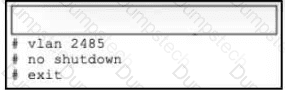
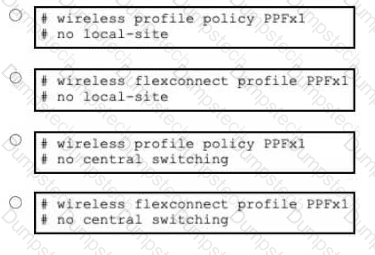
Refer to the exhibit A network engineer is using a Cisco Catalyst 9800 Series WLC to deploy a new wireless solution in a branch location Client traffic must be configured to break out locally Which code snippet must be added to the box in the code to complete the policy profile?
A corporation has a wireless network in which all APs are configured in FlexConnect mode. The WLC has a data WLAN and a VoWiFi WLAN, and both SSIDs are centrally switched. Which QoS configuration must be implemented so that wireless packets maintain their markings across the wired and wireless networks?
All APs are receiving multicast traffic, instead of only the APs that need it. What is the cause of this problem?
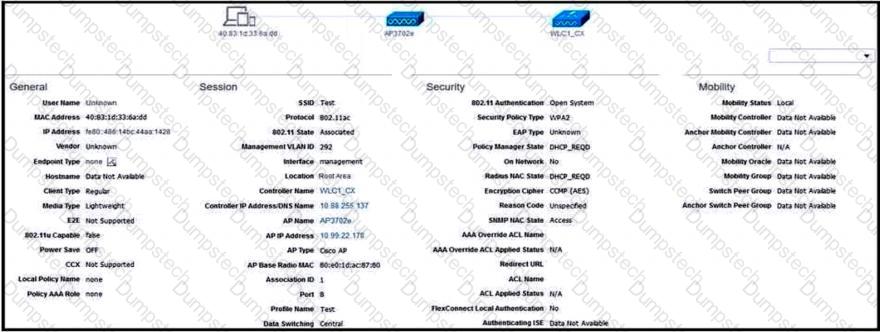
Refer to the exhibit.
What is the reason that the wireless client cannot get the RUN state?