
Black Friday VIP Hour Limited Time 75% Discount Offer - Ends in 0d 00h 00m 00s - Coupon code = simple75
Pass the HP Aruba Certified Switching Expert HPE7-A10 Questions and answers with Dumpstech
Exam HPE7-A10 Premium Access
View all detail and faqs for the HPE7-A10 exam
A customer needs the following rights for clients in the medical-mobile AOS firewall role on HPE Aruba Networking Mobility Controllers (MCs):
* They may receive IP addresses through DHCP.
* They may access DNS services at 10.8.9.7, and no other server.
* They may access all subnets in the 10.1.0.0/16 range, except 10.1.12.0/22, which must be denied.
* They must be denied access to other 10.0.0.0/8 subnets.
* They may access the Internet.
* They must be denied WLAN access for a period of time if they send any SSH traffic.
* They must be denied WLAN access for a period of time if they send any Telnet traffic.
* They must be denied access to all high-risk websites.
* External devices must not be allowed to initiate sessions with medical-mobile clients; they may send only return traffic.
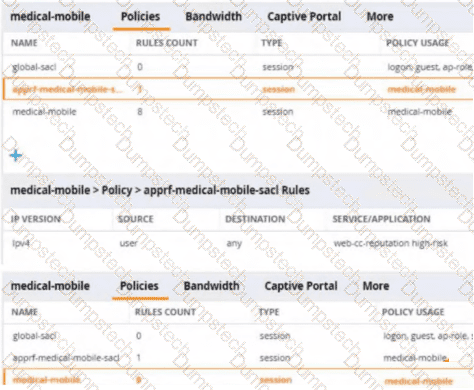
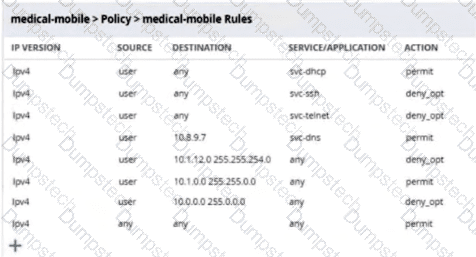
Refer to the scenario. The exhibits below show the role configuration.
* Role policies: `apprf-medical-mobile-sacl` (Rule: `user any web-cc-reputation high-risk deny`) and `medical-mobile` (8 rules configured).
Which setting not shown in the exhibits must you check to ensure the scenario requirements are met?
A customer has an AOS-10 architecture that includes HPE Aruba Networking APs. The customer recently enabled WIDS at the high level on the APs. Administrators see several "ad hoc using valid SSID" events.
What should you explain?
A hospital has an AOS-10 architecture managed by HPE Aruba Networking Central. The customer has deployed a pair of HPE Aruba Networking 9000 Series gateways with Security licenses at each clinic. The gateways implement IDS/IPS in IDS mode.
The Security Dashboard shows several recent events with the same signature, as shown below:
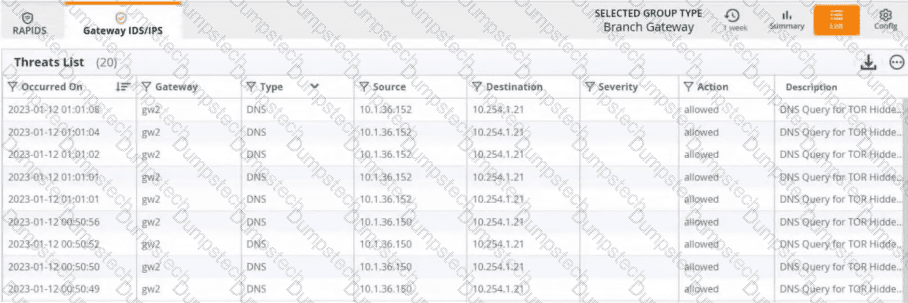
Occurred On: 2023-01-12 | Gateway: gw2 | Type: DNS | Source: 10.1.36.152 | Destination: 10.254.1.21 | Action: allowed | Description: DNS Query for TOR Hidden...
Refer to the scenario.
You have learned that nurse call stations are the source of the events. What can you conclude?
Introduction to the customer
You are assisting a company with adding HPE Aruba Networking ClearPass to its network, which uses HPE Aruba Networking network-infrastructure devices.
The company already has a Windows domain and Windows CA. The Windows CA issues certificates to domain computers, domain users, and servers such as domain controllers.
ClearPass cluster IP addressing and hostnames
Publisher = 10.47.47.5
Subscriber 1 = 10.47.47.6
Subscriber 2 = 10.47.47.7
Virtual IP with Subscriber 1 and Subscriber 2 = 10.47.47.8
Refer to the scenario.
Assume that you configured CPPM to assign HPE Aruba Networking ClearPass roles and AOS user roles as indicated in the scenario. However, a penetration tester was able to access the network with medical-staff privileges on a client with a valid computer certificate but a revoked medical user certificate. In this situation, the customer wants the client to receive computer-only access.
What can you do to resolve this issue while continuing to meet the other customer requirements?
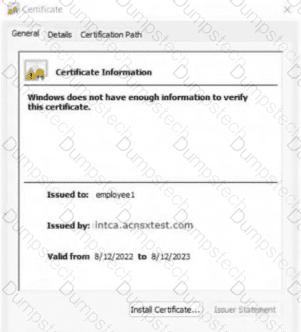
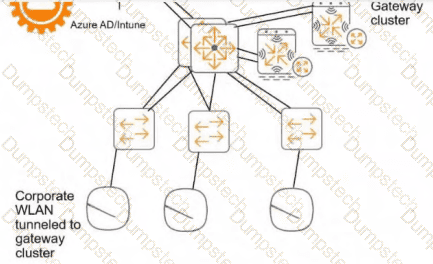
You must install a certificate on a standalone HPE Aruba Networking Mobility Controller (MC). The MC must use the certificate for the Web UI and to implement RadSec with HPE Aruba Networking ClearPass Policy Manager. You have received a certificate with these settings:
Subject: CN=mc49.site30.example.com
No SANs
Issuer: CN=ca89.example.com
EKUs: Server Authentication, Client Authentication
What problem does this certificate have for its intended uses?
Your company has an HPE Aruba Networking infrastructure that includes a variety of HPE Aruba Networking APs and gateways. The company has recently added HPE Aruba Networking SSE. The company needs to enhance security for branch users behind an HPE Aruba Networking SD-WAN gateway.
You need to control users’ actions across various SaaS applications. What is included in the setup?
A customer has HPE Aruba Networking mobility devices and AOS-CX switches that use RADIUS authentication and accounting with HPE Aruba Networking ClearPass Policy Manager (CPPM). The customer relies on accounting data for auditing and has found that accounting records for clients connected to access switches lack IP address information.
Which action could you take to populate this information?
You are configuring gateway IDS/IPS settings in HPE Aruba Networking Central.
Why would you set the Fail Strategy to Bypass?
The customer needs a secure wireless solution that lets users onboard new wireless clients. You are recommending a new WLAN that will give users limited access for this process.
Which WLAN security should you recommend, assuming users have a mixture of WPA2- and WPA3-capable devices?
Refer to the exhibit.
An administrator has configured a remote mirror between an AOS-CX switch and a station running a protocol analyzer. The exhibit displays a sample of the packet capture.
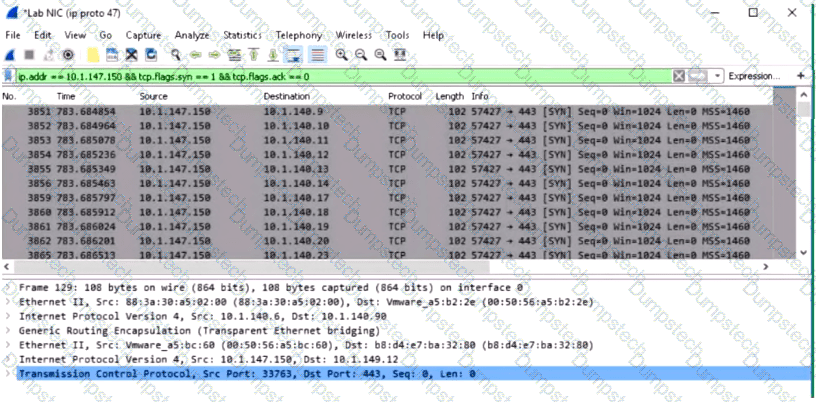
Packet trace details:
Source: 10.1.147.150 - > Destination: 10.1.140.9 TCP 57427 - > 443 [SYN] Seq=0 Len=0
Source: 10.1.147.150 - > Destination: 10.1.140.10 TCP 57427 - > 443 [SYN] Seq=0 Len=0
Source: 10.1.147.150 - > Destination: 10.1.140.11 TCP 57427 - > 443 [SYN] Seq=0 Len=0
Source: 10.1.147.150 - > Destination: 10.1.140.12 TCP 57427 - > 443 [SYN] Seq=0 Len=0
Source: 10.1.147.150 - > Destination: 10.1.140.13 TCP 57427 - > 443 [SYN] Seq=0 Len=0
Packet encapsulation tree shows Generic Routing Encapsulation (Transparent Ethernet bridging).
Which characteristic is suspicious?
