
Black Friday VIP Hour Limited Time 75% Discount Offer - Ends in 0d 00h 00m 00s - Coupon code = simple75
Pass the HP Aruba Certified Switching Expert HPE7-A10 Questions and answers with Dumpstech
What benefit does an organization obtain by upgrading wireless security from WPA2-Personal to WPA3-Personal?
A company has HPE Aruba Networking gateways and plans to begin implementing gateway IDS/IPS. The customer has chosen Block as the Fail Strategy.
What could you recommend to help reduce unexpected outages caused by this particular fail strategy?
Refer to the exhibit.
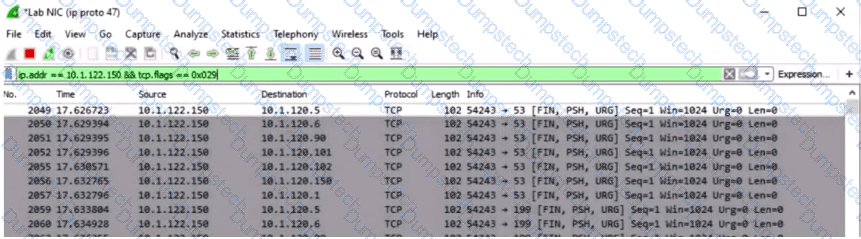
Packet trace display:
Source: 10.1.122.150 - > Destination: 10.1.120.5 TCP 54243 - > 53 [FIN, PSH, URG] Seq=1 Win=1024 Urg=0 Len=0
Source: 10.1.122.150 - > Destination: 10.1.120.6 TCP 54243 - > 53 [FIN, PSH, URG] Seq=1 Win=1024 Urg=0 Len=0
Source: 10.1.122.150 - > Destination: 10.1.120.90 TCP 54243 - > 53 [FIN, PSH, URG] Seq=1 Win=1024 Urg=0 Len=0
Source: 10.1.122.150 - > Destination: 10.1.120.101 TCP 54243 - > 53 [FIN, PSH, URG] Seq=1 Win= 1024 Urg=0 Len=0
Source: 10.1.122.150 - > Destination: 10.1.120.5 TCP 54243 - > 199 [FIN, PSH, URG] Seq=1 Win=1024 Urg=0 Len=0
What does this indicate?
A customer has an AOS-10 architecture managed by HPE Aruba Networking Central. HPE Aruba Networking infrastructure devices authenticate clients to an HPE Aruba Networking ClearPass cluster.
In HPE Aruba Networking Central, you are reviewing network traffic flows for a wireless IoT device categorized as a “Raspberry Pi” client. You observe SSH traffic. You then review several additional wireless IoT clients and find that they are also sending SSH.
Which element helps establish a foundation for robust network-security forensics?
A customer has an HPE Aruba Networking ClearPass cluster. The customer has AOS-CX switches that use 802.1X authentication with HPE Aruba Networking ClearPass Policy Manager (CPPM).
The switches use local port-access policies. The customer wants to begin tunneling wired clients that pass user authentication only to an HPE Aruba Networking gateway cluster. The gateway cluster must assign these clients the eth-internet role. The gateway must also assign the clients to VLAN 20.
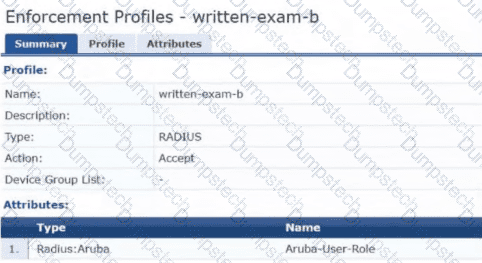
The planned enforcement policy and profiles are shown below:
* Policy: `written-exam-3`
* Profile: `written-exam-b`
The gateway cluster contains two gateways with these IP addresses:
Gateway 1: VLAN 4085 (system IP) = 10.20.4.21 | VLAN 20 (users) = 10.20.20.1 | VLAN 4094 (WAN) = 198.51.100.14
Gateway 2: VLAN 4085 (system IP) = 10.20.4.22 | VLAN 20 (users) = 10.20.20.2 | VLAN 4094 (WAN) = 198.51.100.12 | VRRP on VLAN 20 = 10.20.20.254
The customer requires high availability for tunnels between the switches and the gateway cluster. If one gateway fails, the other gateway must take over its tunnels. The switch must also be able to discover the gateway cluster whether either gateway is in the cluster.
Refer to the scenario.
What is one change that should be made to the solution?
What could be a strong indication that a client has been compromised?
Introduction to the customer
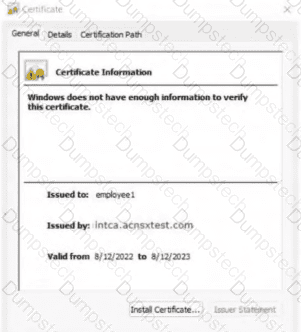
You are assisting a company with adding HPE Aruba Networking ClearPass to its network, which uses HPE Aruba Networking network-infrastructure devices.
The company already has a Windows domain and Windows CA. The Windows CA issues certificates to domain computers, domain users, and servers such as domain controllers.
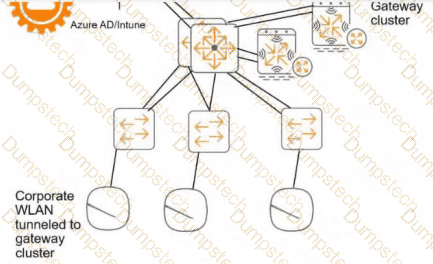
ClearPass cluster IP addressing and hostnames
Publisher = 10.47.47.5
Subscriber 1 = 10.47.47.6
Subscriber 2 = 10.47.47.7
Virtual IP with Subscriber 1 and Subscriber 2 = 10.47.47.8
Refer to the scenario.
You imported the root certificate for the Windows CA into the ClearPass CA Trust list. Based on the scenario requirements, which usages should be added to it?
An organization wants an AOS-CX switch to generate an alert when its RADIUS server (cp.acnsxtest.local) rejects an abnormal number of client authentication requests each hour. After discussing this with other HPE Aruba Networking administrators, you still do not know how many rejections should be considered normal or abnormal. You expect this value may vary for every switch.
You are assisting the developer with developing an NAE script for this use case.
Refer to the scenario.
You are helping a customer define an NAE script for AOS-CX switches. The script will monitor statistics from a RADIUS server configured on the switch. To future-proof the script, you want administrators to be able to choose a different hostname or IP address for the monitored RADIUS server when they create an agent from the script.
What should you recommend?
A customer operates an HPE Aruba Networking ClearPass cluster. The customer has AOS-CX switches that use 802.1X authentication with HPE Aruba Networking ClearPass Policy Manager (CPPM).
The switches use local port-access policies. The customer wants to begin tunneling wired clients that pass only user authentication to an HPE Aruba Networking gateway cluster. The gateway cluster must assign these clients the eth-internet role. The gateway must also assign the clients to VLAN 20.
The intended enforcement policy and profiles are shown below:
* Policy: `written-exam-3`
* Profile: `written-exam-b`
The gateway cluster contains two gateways with the following IP addresses:
Gateway 1: VLAN 4085 (system IP) = 10.20.4.21 | VLAN 20 (users) = 10.20.20.1 | VLAN 4094 (WAN) = 198.51.100.14
Gateway 2: VLAN 4085 (system IP) = 10.20.4.22 | VLAN 20 (users) = 10.20.20.2 | VLAN 4094 (WAN) = 198.51.100.12 | VRRP on VLAN 20 = 10.20.20.254
The customer needs high availability for tunnels between the switches and the gateway cluster. If one gateway fails, the other gateway must take over its tunnels. The switch must also be able to discover the gateway cluster even if one gateway in the cluster is unavailable.
Refer to the scenario. Assume that `myzone` is the name used for the UBT zone.
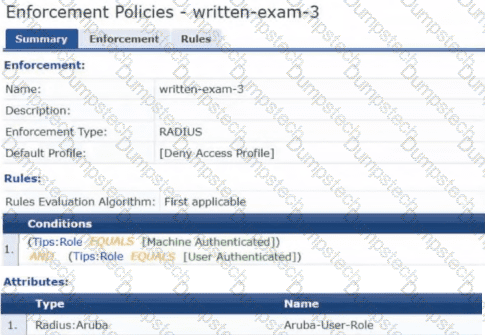
Which option is a valid minimal configuration for the AOS-CX port-access roles?
You are assisting a company with designing role-based access control policies on HPE Aruba Networking AOS-10 gateways. The security policy dictates that traffic originating from authenticated corporate user roles must be inspected statefully, allowing client-initiated outbound flows to the data center while strictly dropping any unsolicited inbound connection attempts initiated from data center servers back toward the clients.
What design principle ensures this traffic flow behavior?
