
Black Friday VIP Hour Limited Time 75% Discount Offer - Ends in 0d 00h 00m 00s - Coupon code = simple75
Pass the HPE Networking HPE7-A11 Questions and answers with Dumpstech
Exam HPE7-A11 Premium Access
View all detail and faqs for the HPE7-A11 exam
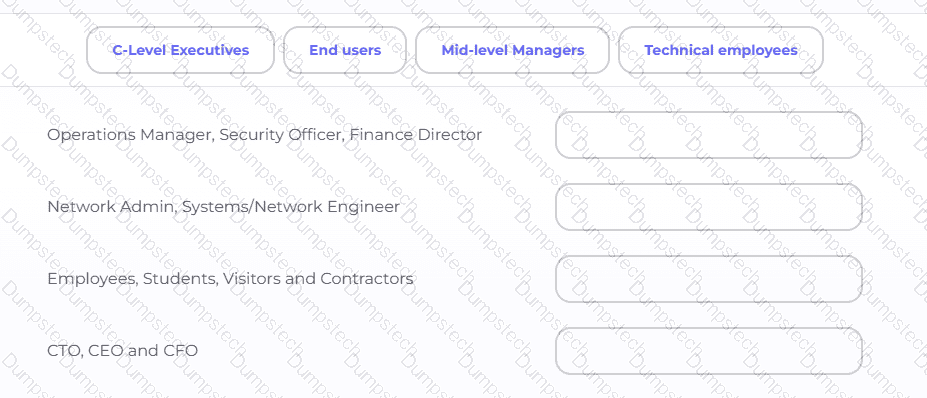
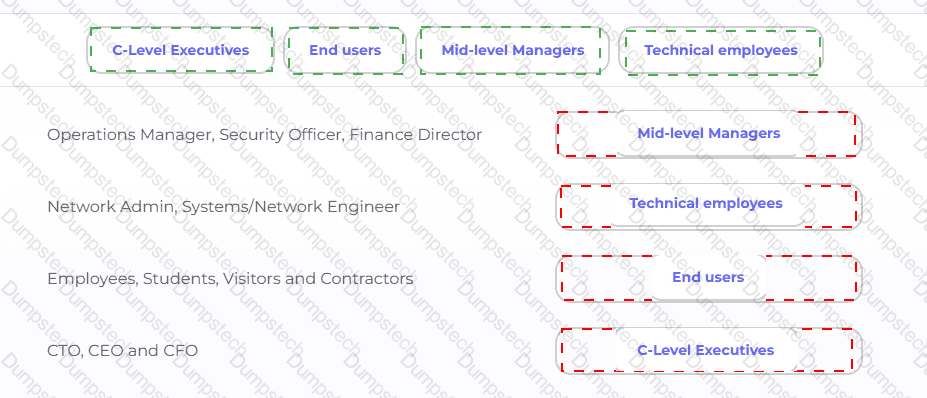
Match the stakeholders to the appropriate roles.
A global cruise-line company needs to refresh its current fleet. It will refresh the ship’s internal infrastructure to be cost-effective and improve sustainability. It will replace all WLAN/LAN hardware on the ship. As part of this refresh, the company will not change its existing security requirements. The CIO also wants to minimize the number of unused switch ports. Any future expansion will always require a hardware refresh. The company will begin with the smallest ship, with a maximum of 800 guests.
Each ship has a LAN infrastructure comprising two core switches, up to 10 redundant distribution switches, and up to 500 access switches (400 cabins and 100 technical rooms). The core switches are in the ship’s MDF, and the distribution switches are in the IDFs. Each cabin and technical room receives a single access switch.
The ship’s cabling infrastructure will not be replaced. Each IDF connects to the MDF over SMF, with two pairs available for the interconnect between core and distribution. The SMF length between the MDF and IDF is less than 300 meters (980 ft), and it is OS1 fiber. Each cabin connects to its IDF with one OM2 pair, with a maximum length of 60 meters (200 ft). Each technical room connects to its IDF with one OM2 pair, with lengths from 100 to 150 meters (320 to 500 ft).
For every cabin and technical room, the customer wants to replace its current fanless 2530/2540 switches without changing the requirements, except that the uplink to the distribution switch must be upgraded to 10GbE to accommodate increased network traffic, and the technical rooms require redundant power.
The WLAN infrastructure will be refreshed 1:1, with no new cabling or AP locations. Its WLAN infrastructure uses 200/300-series indoor and outdoor APs running InstantOS (fewer than 300 APs), and the customer has no changes to WLAN requirements.
The cruise-line company will replace its existing Internet connection before the LAN/WLAN refresh. The new Internet connection will offer 99.8% uptime, needed to keep paid guest Wi-Fi continuously operational. With this new Internet connection, the CIO wants to base the design on Aruba’s ESP architecture because the Internet connection is guaranteed.
Based on best practices, what optic type should be recommended for the connection between the MDF and the IDFs?
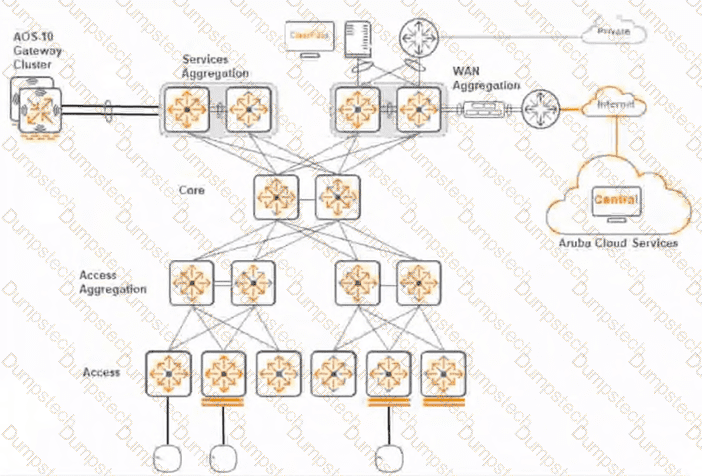
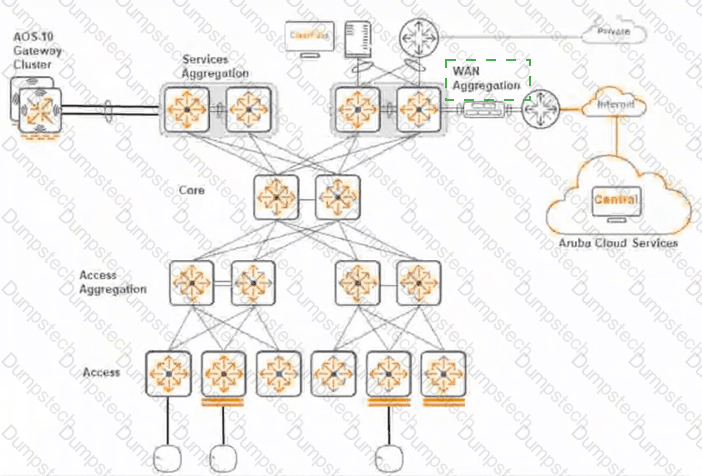
Based on this campus design, select the layer most suitable to be designed as a Border Persona when considering an EVPN VXLAN Fabric.
Original network architecture exhibit
A large multinational financial institution has hired you to design a new full-stack wired and wireless network for its new 6-story regional office building. The bottom two floors of the facility will provide retail space for a large banking branch. The upper floors will be carpeted corporate office space, with each floor measuring approximately 100,000 sq ft (9290 sq m). All data centers are offsite and are out of scope for this project. The customer is underserved by its existing L2-based network infrastructure and wants to use modern best practices in the new design. The network must be fully resilient and fault-tolerant, with dynamic segmentation at the edge.
The retail space will provide public guest Wi-Fi access. Retail associates will use corporate tablets for customer service, and the retail floors will contain a mix of wired and wireless devices. Corporate users will primarily connect wirelessly, but several wired clients, printers, and hard VoIP phones will also be used.
The customer also plans to renovate the corporate office space to take advantage of 'smart office' technology. These improvements will enable blue-dot wayfinding, presence analytics, and other location-based services.
The client has decided that the more critical switch stacks supporting Contact Center resources must support greater than 600W of CL4 PoE and redundant power supplies. These stacks will have approximately six members.
What is the most economical switch series choice that meets these requirements?
As part of several technical proposals for a customer deploying both Wi-Fi 7 high-throughput HD and very high-throughput VHD networks based on HPE Aruba Networking AOS-10, you are identifying key considerations for radio frequency (RF) design and channel optimization.
Which statements are recommended AOS-10 best practices for RF planning and should be included in your proposals to deliver optimal wireless performance?
Choose two.
Which type of member must be rebooted when performing an In-Service Software Upgrade within a VSF stack?
During the stakeholder interview, an agenda is created to clarify customer expectations. The customer is concerned about future business requirements, with network scalability and flexibility being key.
Which expectations should be considered to solve upcoming business problems?
Choose two.
Which licenses are required to use the UXI Client on Zebra devices?
Choose two.
A customer wants the ability to view network usage.
Which product would provide this visibility?
You are taking part in a joint technical and business review with a customer that plans to deploy HPE Aruba Networking User Experience Insight (UXI) across multiple sites. The customer has a large campus with several buildings and smaller remote offices, and is assessing UXI as part of its digital-experience monitoring strategy.
During the review, the technical team is concentrating on deployment best practices and technical capabilities, while business stakeholders are concerned about deployment efficiency, cost justification, and ensuring the sensors deliver actionable visibility throughout the environment.
You are asked to provide validated deployment guidance and correct any misconceptions about UXI capabilities and deployment options.
What is a valid recommendation for UXI deployment options?
