
Black Friday VIP Hour Limited Time 75% Discount Offer - Ends in 0d 00h 00m 00s - Coupon code = simple75
Pass the HPE Networking HPE7-A11 Questions and answers with Dumpstech
A large multinational financial institution has hired you to design a new full-stack wired and wireless network for its new 6-story regional office building. The bottom two floors of the facility will provide retail space for a large banking branch. The upper floors will be carpeted corporate office space, with each floor measuring approximately 100,000 sq ft (9290 sq m). All data centers are offsite and outside this project’s scope. The customer is underserved by its existing L2-based network infrastructure and wants to use modern best practices in the new design. The network must be fully resilient and fault-tolerant, with dynamic segmentation at the edge.
The retail space will provide public guest Wi-Fi access. Retail associates will use corporate tablets for customer service, and the retail floors will contain a mixture of wired and wireless devices. Corporate users will primarily connect wirelessly, although several wired clients, printers, and hard VoIP phones will be used.
The customer also plans to renovate the corporate office space to take advantage of 'smart office' technology. These enhancements will enable blue-dot wayfinding, presence analytics, and other location-based services.
The client has supplied floorplans, wall density, and ceiling heights for the wireless deployment in the carpeted office space.
What additional information is needed to produce an accurate bill of material?
Choose two.
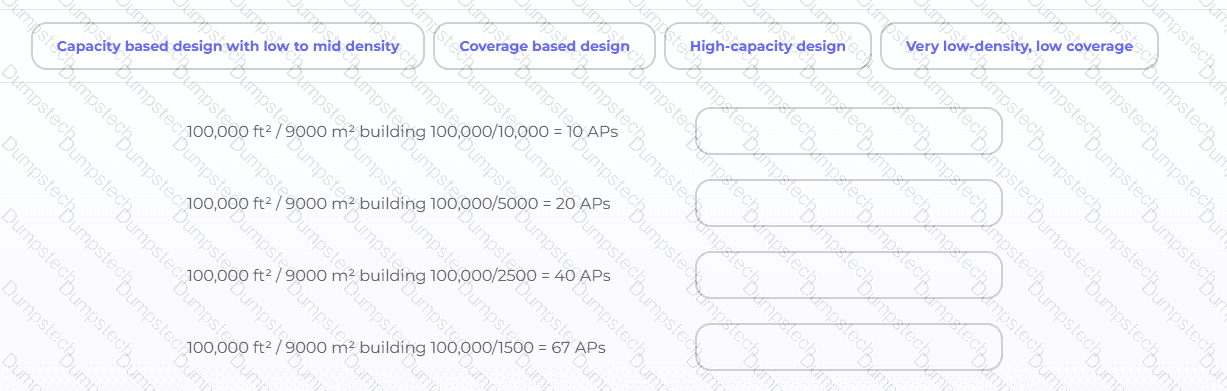
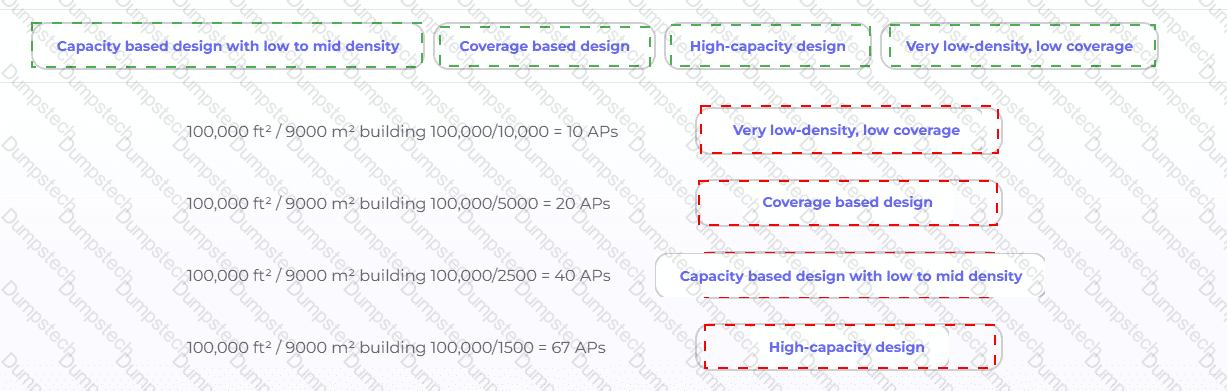
Match each deployment type with its estimated number of APs.
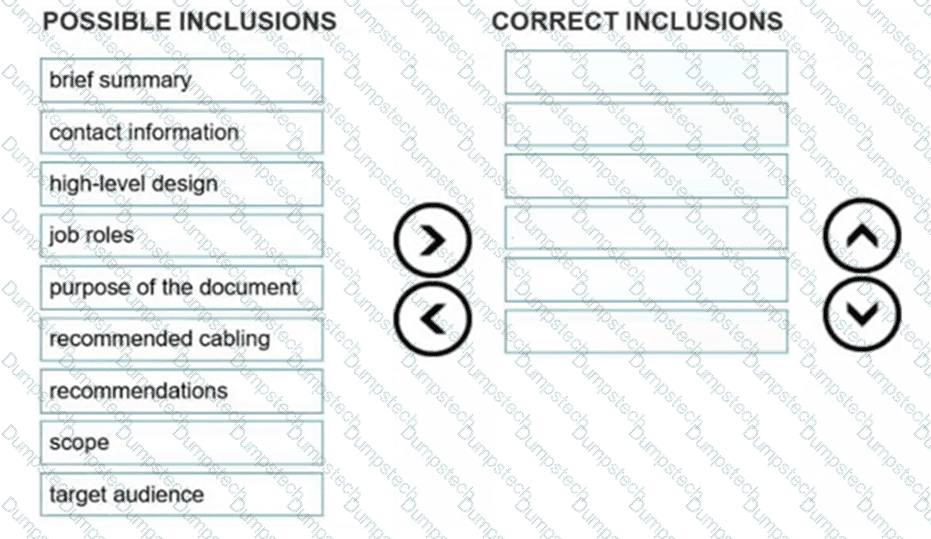
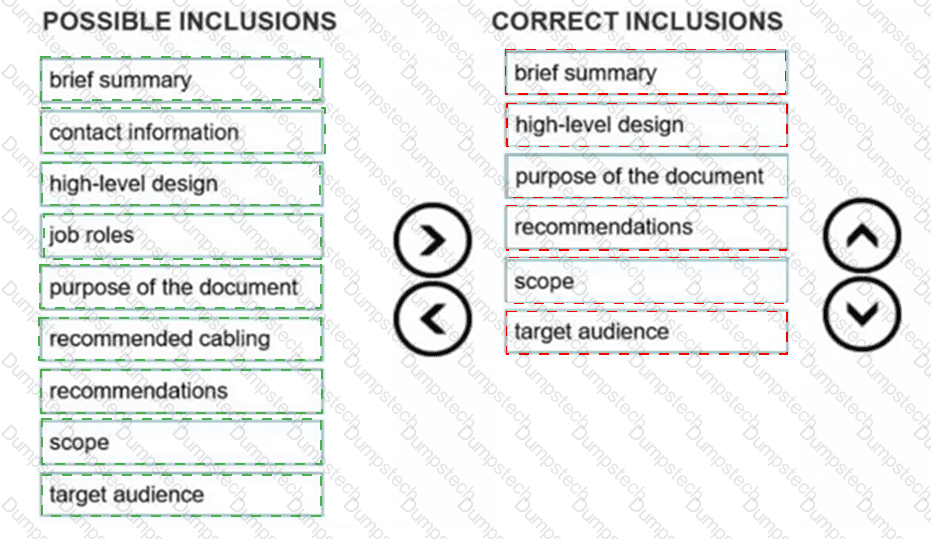
What items should an Executive Summary include? Place the correct items in the list on the right. The order does not matter, and some options will not be used.
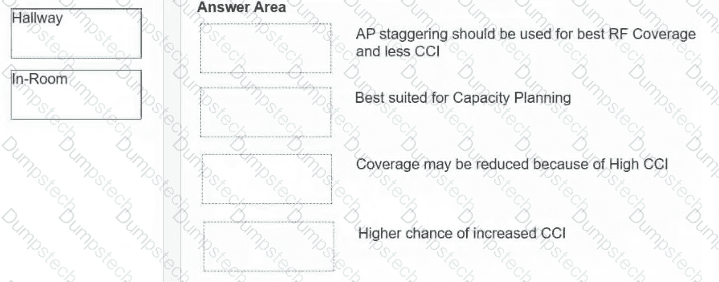
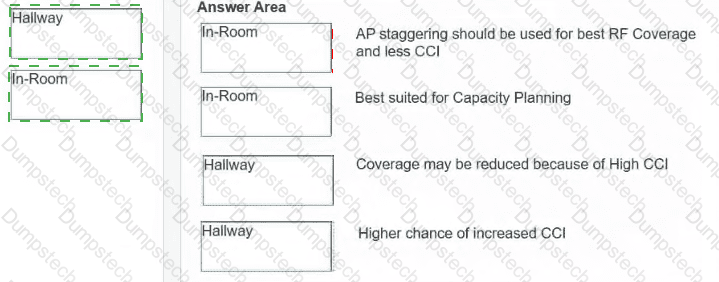
Match each deployment mode to its description.
A colleague has produced a proposed design for a large enterprise customer that uses HPE Aruba Networking AOS-CX 6300 switches at the wired access layer. The customer requires a secure, scalable solution founded on Zero Trust Security (ZTS) principles.
In the current environment, endpoint devices connected to access switches are configured to transmit 802.1Q-tagged frames, and the new design plans to tunnel traffic from the switches to an AOS-10 Gateway cluster by using User-Based Tunneling (UBT) in its default mode.
During a design review, you are asked to determine whether this solution supports the customer requirement to retain endpoint VLAN tags across the tunnel.
You recommend a modification, explaining that the proposed default configuration will not satisfy the customer’s technical requirement.
Which UBT configuration would support the customer requirement to preserve VLAN tagging from the endpoints across the UBT tunnel to the gateway?
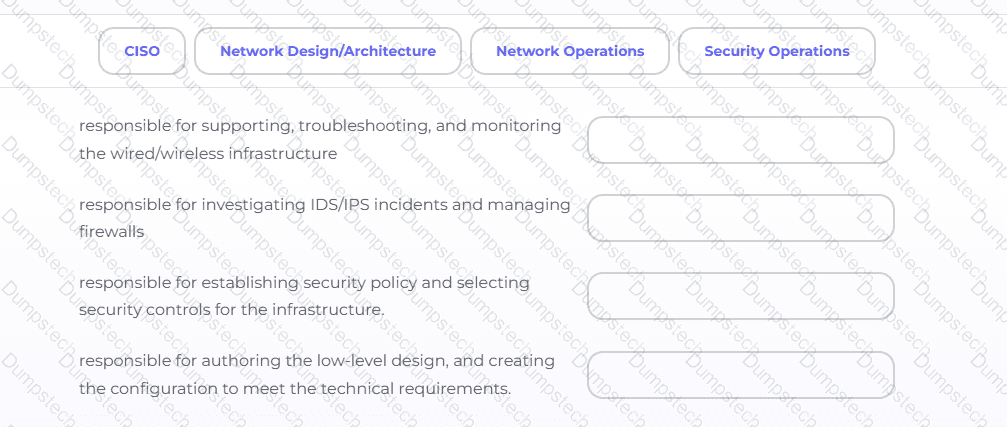
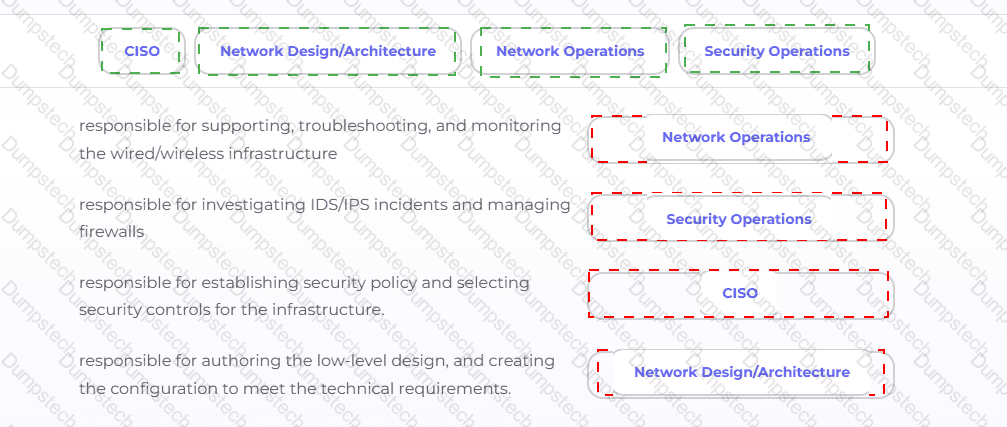
A junior engineer has been hired to help with a large-scale network infrastructure project. Because the engineer has not previously worked on a project this complex, they want to better understand the role each stakeholder will have.
Match each stakeholder title with the responsibility most likely associated with that role.
A global cruise-line company needs to modernize its existing fleet. To make the ships more cost-effective and sustainable, it will refresh the ship “insides” and replace all WLAN/LAN hardware. This refresh will not change the company’s current security requirements. The CIO also wants to minimize unused switch ports. Any future expansion will always require a hardware refresh. The effort begins with the smallest ship, which supports a maximum of 800 guests.
Each ship has a LAN infrastructure comprising two core switches, up to 10 redundant distribution switches, and up to 500 access switches (400 cabins and 100 technical rooms). The core switches are in the ship’s MDF, and the distribution switches are in the IDFs. Every cabin and technical room receives one access switch.
The ship’s cabling structure will remain unchanged. Each IDF connects to the MDF through SMF, with two pairs available for the core-to-distribution interconnect. The SM fiber between the MDF and IDF is under 300 meters (980 ft) and is OS1. Each cabin connects to the IDF through one OM2 pair, at a maximum length of 60 meters (200 ft). Each technical room connects to the IDF through one OM2 pair, with lengths from 100 to 150 meters (320 to 500 ft).
For every cabin and technical room, the customer wants to replace the existing fan-less 2530/2540 switches without altering requirements, except that the uplink to the distribution switch must be upgraded to 10GbE to accommodate increased network traffic, and technical rooms require redundant power.
The WLAN infrastructure will be refreshed 1:1, with no new cabling or AP locations. It is based on 200/300-series indoor and outdoor APs running InstantOS (fewer than 300 APs), and the customer has no WLAN requirement changes.
The cruise-line company will replace its current Internet connection before the LAN/WLAN refresh. The new connection will deliver 99.8% uptime, needed to keep paid guest Wi-Fi continuously operational. Because this Internet connection is guaranteed, the CIO wants the design based on Aruba’s ESP architecture.
Based on best practices, which switch model is the most cost-effective choice for the distribution layer?
You are presenting your network-design solution to a customer. What is important to include in the presentation?
A large multinational financial institution has engaged you to design a new full-stack wired and wireless network for its new 6-story regional office building. The bottom two floors of the facility will be retail space for a large banking branch. The upper floors will be carpeted corporate office space, with each floor measuring approximately 100,000 sq ft (9290 sq m). All data centers are offsite and are out of scope for this project. The customer is underserved by its existing L2-based network infrastructure and wants to apply modern best practices in the new design. The network must be fully resilient and fault-tolerant, with dynamic segmentation at the edge.
The retail space will provide public guest Wi-Fi access. Retail associates will use corporate tablets for customer service, and the retail floors will contain a mix of wired and wireless devices. Corporate users will primarily connect wirelessly, but several wired clients, printers, and hard VoIP phones will also be used.
The customer also plans to renovate the corporate office space to take advantage of 'smart office' technology. These enhancements will enable blue-dot wayfinding, presence analytics, and other location-based services.
The client has decided to manage two wiring closets as one stack totaling 10 switches, with a minimum transport speed of 25Gbps over OM4 MM fiber. They also want to minimize stacking-cabling cost.
Which switch series would most economically meet these requirements?
The customer has recently learned that OS-CX switches support Application Recognition.
Which two switch models should be used for this capability?
Choose two.
