
Black Friday VIP Hour Limited Time 75% Discount Offer - Ends in 0d 00h 00m 00s - Coupon code = simple75
Pass the HPE Networking HPE7-A11 Questions and answers with Dumpstech
Exam HPE7-A11 Premium Access
View all detail and faqs for the HPE7-A11 exam
Manufacturing A.B.C. is an international, mid-sized company that specializes in manufacturing industrial equipment. It has operated in the market for more than two decades and has become a reputable player in its industry. However, rapid technological advances have left its present network infrastructure outdated and unable to keep pace with modern manufacturing-process demands.
Manufacturing A.B.C.'s network combines multi-vendor legacy wired and wireless components, resulting in frequent downtime and reduced production efficiency. Its aging equipment causes slow data-transfer rates, unreliable connectivity, and greater exposure to cyber threats. Fiber cabling should also be upgraded because OM2 is used for the most part.
Further compounding the network problems, the recent departure of the CTO has left the company without a clear course for the network-refresh project. The management team lacks consensus on the upgrade's scope, budget, and timeline.
The manufacturing customer's primary objectives are:
Improve network performance and reliability to improve production processes and minimize downtime.
Strengthen network security to safeguard sensitive data and intellectual property.
Streamline communication and collaboration among the organization's different departments.
Provide scalability for future growth and technological advances.
Manufacturing A.B.C. wants a comprehensive network refresh that includes:
Upgrading the wired infrastructure with high-speed Ethernet switches to support higher data-transfer rates and lower latency.
Deploying a robust wireless solution using enterprise-grade access points to provide seamless connectivity throughout the manufacturing facility.
Centralized network-management tools to simplify network administration and monitoring.
Expectations:
The customer expects the network-refresh project to be completed efficiently, with minimal disruption to ongoing operations. They want a reliable, experienced network-solutions provider that understands their distinctive manufacturing requirements and can deliver a tailored solution that meets their budget constraints. Given the recent CTO change, the manufacturing customer is eager to receive clear project proposals and decision-making support.
As the network-solutions provider, your role is to address these concerns, provide expert guidance, and present a clearly defined plan that effectively meets their objectives.
Assume that the current network infrastructure has no wireless shadow-IT equipment operating across the different floors/production sites, but you want to confirm this. How can you determine whether wireless shadow-IT equipment is currently in operation?
You are designing a solution with OS10-based access points and redundant gateways, with these requirements:
Wi-Fi6E-based access points
Support for tunneled traffic
Application visibility
Rogue APs
Live upgrades
Air Slice
Cloud Guest Authentication
AI Insights
Which licenses are required?
Choose two.
Manufacturing A.B.C. is an international, mid-sized company that specializes in producing industrial equipment. It has operated in the market for more than two decades and has established itself as a reputable industry player. However, rapid technological advances have left its current network infrastructure outdated and unable to keep pace with the requirements of modern manufacturing processes.
Manufacturing A.B.C.'s network combines multi-vendor legacy wired and wireless components, resulting in frequent downtime and reduced production efficiency. The aging equipment causes slow data-transfer rates, unreliable connectivity, and greater exposure to cyber threats. Fiber cabling also needs upgrading, as OM2 is used predominantly.
Further complicating these network issues, the recent CTO departure has left the company without clear direction for the network-refresh project. The management team has not reached consensus on the scope, budget, or timeline for the upgrade.
The manufacturing customer's primary objectives are as follows:
Improve network performance and reliability to enhance production processes and minimize downtime.
Enhance network security to protect sensitive data and intellectual property.
Streamline communication and collaboration among the organization's different departments.
Ensure scalability for future growth and technological advancements.
Manufacturing A.B.C. is seeking a comprehensive network refresh that includes the following components:
Upgrade the wired infrastructure to high-speed Ethernet switches to support higher data-transfer rates and reduce latency.
Implement a robust wireless solution with enterprise-grade access points to provide seamless connectivity throughout the manufacturing facility.
Use centralized network-management tools to simplify network administration and monitoring.
Expectations:
The customer expects the network-refresh project to be completed efficiently, with minimal disruption to ongoing operations. They seek a reliable, experienced network-solutions provider that understands their unique manufacturing requirements and can deliver a customized solution aligned with their budget constraints. Given the recent CTO change, the manufacturing customer is eager to receive clear project proposals and decision-making support.
As a network-solutions provider, your role is to address these concerns, provide expert guidance, and present a clearly defined plan that meets their objectives effectively.
A manufacturing customer runs a 24/7 production facility and is concerned that the migration could disrupt the production chain.
What are two ways to minimize or eliminate this disruption?
Choose two.
A global cruise line company must refresh its current fleet. It will refresh the ship’s “insides” to be cost-effective and improve sustainability, replacing all WLAN/LAN hardware. During this refresh, the company will not change its existing security requirements. The CIO also wants to minimize unused switch ports. Any future expansion will require a hardware refresh. They will begin with the smallest ship, with a maximum of 800 guests.
Each ship has a LAN infrastructure comprising two core switches, up to 10 redundant distribution switches, and up to 500 access switches (400 cabins and 100 technical rooms). The core switches are in the ship’s MDF, and the distribution switches are in the IDFs. Each cabin and technical room receives one individual access switch.
The ship’s cabling infrastructure will not be refreshed. Every IDF is connected to the MDF by SMF, with two pairs available for the interconnect between core and distribution. The SM fiber between the MDF and IDF is less than 300 meters (980 ft) long and is OS1. Each cabin is connected to the IDF by one OM2 pair, with a maximum length of 60 meters (200 ft). Each technical room is connected to the IDF by one OM2 pair, with lengths from 100 to 150 meters (320 to 500 ft).
For every cabin/technical room, the customer wants to replace the existing fan-less 2530/2540 switches without changing the requirements, except that the uplink to the distribution switch must be upgraded to 10GbE to accommodate increased network traffic, and the technical rooms require redundant power.
The WLAN infrastructure will be refreshed 1:1, with no new cabling or AP locations. The WLAN infrastructure uses 200/300 series indoor and outdoor APs running InstantOS (fewer than 300 APs), and the customer has no WLAN requirement changes.
The cruise line company will replace its existing Internet connection before the LAN/WLAN refresh. The new Internet connection will provide 99.8% uptime, required to keep paid guest Wi-Fi operational. With this new Internet connection, the CIO wants to base the design on Aruba’s ESP architecture because the Internet connection is guaranteed.
Based on best practices, what optic type should be recommended for the connection between the IDF and the technical rooms?
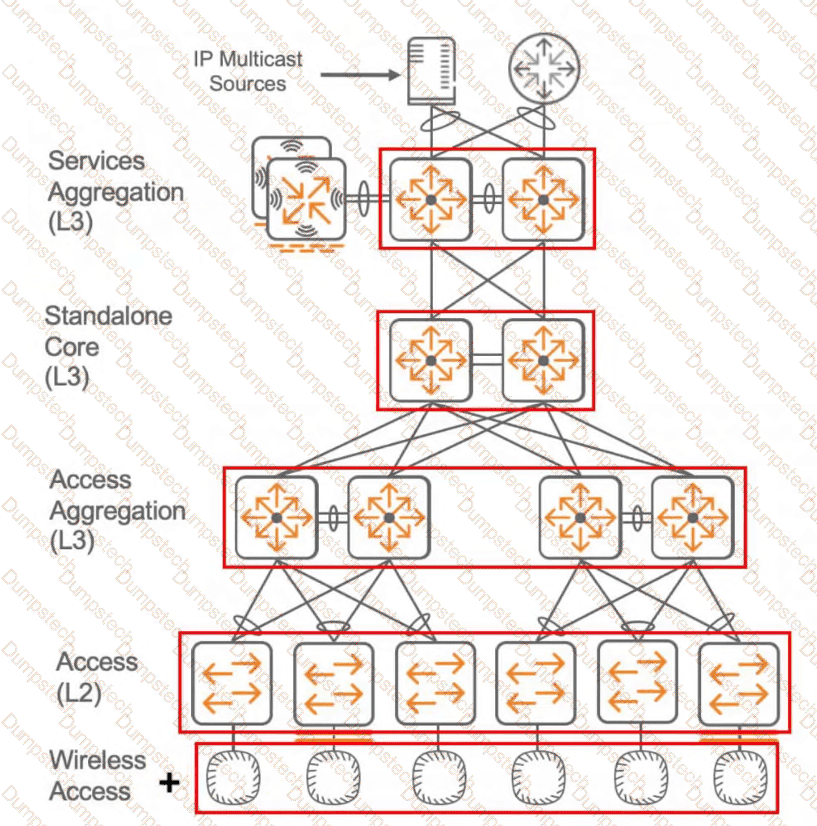
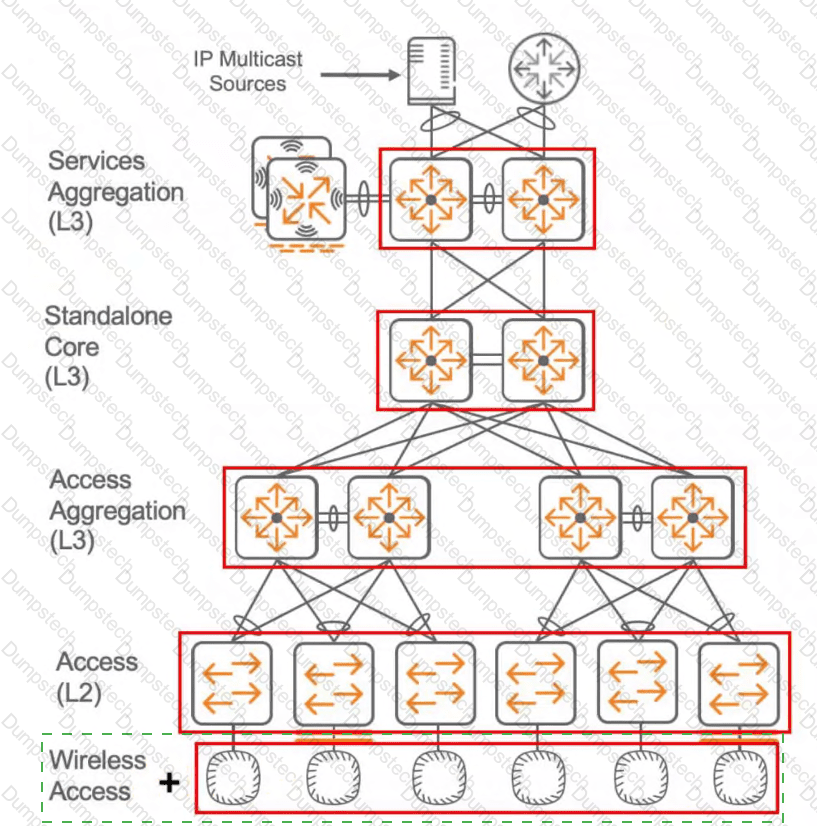
Mark the layer at which Dynamic Multicast Optimization should be activated.
HPE campus multicast network diagram showing services aggregation, standalone core, access aggregation, access layer and wireless access
A large multinational financial institution has engaged you to design a new full-stack wired and wireless network for its new 6-story regional office building. The bottom two floors of the facility will provide retail space for a large banking branch. The upper floors will be carpeted corporate office space, with each floor approximately 100,000 sq ft (9290 sq m). All data centers are offsite and outside this project’s scope. The customer is inadequately served by its existing L2-based network infrastructure and wants to use modern best practices in the new design. The network must be fully resilient and fault-tolerant, with dynamic segmentation at the edge.
The retail space will offer public guest Wi-Fi access. Retail associates will use corporate tablets for customer service, and the retail floors will contain a mix of wired and wireless devices. Corporate users will mainly connect wirelessly, although several wired clients, printers, and hard VoIP phones will also be used.
The customer also plans to renovate the corporate office space to take advantage of “smart office” technology. These enhancements will enable blue-dot wayfinding, presence analytics, and other location-based services.
The client wants redundant RADIUS resources in each of its three geographic regions: AMER, EMEA, and APAC. A large office location in each region has sufficient VMware resources available.
Each region has between 4,481 and 5,692 clients, all of which must perform either 802.1X wired or wireless authentication, as well as 802.1X authentication for one personal Wi-Fi device.
All non-personal devices must also validate health using a local agent.
A total of 500 guests are expected to be connected on average, with a maximum of 700 simultaneous connections using Guest Portal for Internet access.
TACACS authentication will also be configured for 1200 evenly distributed NADs.
How many OnGuard Licenses are required in this scenario?
Refer to the exhibit.
Original exhibit — Question 39
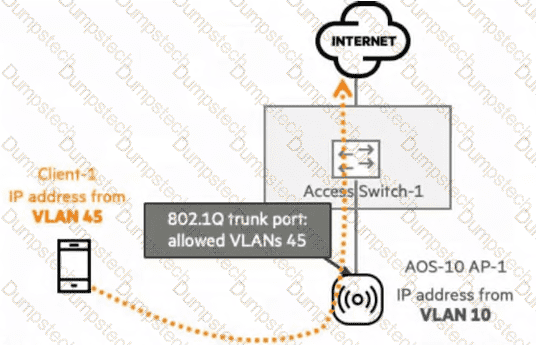
The exhibit shows an AOS-10 access point using VLAN 10 for management and a bridged wireless client receiving an IP address from VLAN 45, with the access switch carrying the client VLAN.
Your client is deploying an HPE Aruba Networking solution in which AOS-10 APs operate in bridged mode and connect directly to AOS-CX access switches in a campus environment.
A leading security priority is to block user traffic to any destination classified by BrightCloud Web Classification as “Bot Nets.” You have been asked to review and confirm the appropriate technical steps for accurate identification, classification, and blocking of this traffic through Central-managed policies and AOS-CX integration.
To block user access to the specified web destination(s) in this deployment model, which action should be taken?
A large multinational financial institution has hired you to design a new full-stack wired and wireless network for its new six-story regional office building. The bottom two floors will provide retail space for a large banking branch. The upper floors will be carpeted corporate office space, with each floor approximately 100,000 sq ft (9290 sq m). All data centers are offsite and outside this project’s scope. The customer is underserved by its existing L2-based network infrastructure and wants to use modern best practices in the new design. The network must be fully resilient and fault-tolerant, with dynamic segmentation at the edge.
The retail space will offer public guest Wi-Fi. Retail associates will use corporate tablets for customer service, and the retail floors will contain a mix of wired and wireless devices. Corporate users will primarily connect wirelessly, although several wired clients, printers, and hard VoIP phones will also be used.
The customer also plans to renovate the corporate office space to take advantage of 'smart office' technology. These enhancements will enable blue-dot wayfinding, presence analytics, and other location-based services.
The client wants redundant RADIUS resources in each of its three geographical regions (AMER, EMEA, and APAC). A large office location in each region has sufficient VMware resources available.
Each region has 5,000 clients, all of whom must perform either 802.1x wired or wireless authentication, as well as 802.1x authentication for one personal Wi-Fi device.
All non-personal devices must also validate health with a local agent.
An average of 500 guests are expected to be connected, with a maximum of 700 simultaneous connections using Guest Portal for Internet access.
TACACS authentication will also be configured for a total of 1,200 evenly distributed NADs.
To support virtual IPs and server redundancy in every region, how many Virtual Policy Manager Licenses are required?
