Summer Sale Limited Time 75% Discount Offer - Ends in 0d 00h 00m 00s - Coupon code = simple75
Pass the Microsoft Certified: Azure Databricks Data Engineer DP-750 Questions and answers with Dumpstech
Exam DP-750 Premium Access
View all detail and faqs for the DP-750 exam
You have an Azure Databricks workspace that is enabled for Unity Catalog.
You need to implement a daily batch data process that requires complex and highly customized Python transformations. The solution must minimize additional complexity.
What should you include in the solution?
You have an Azure Databricks workspace that is enabled for Unity Catalog and contains:
A catalog named Finance
A schema named Purchases in the Finance catalog
A table named Transactions in the Purchases schema
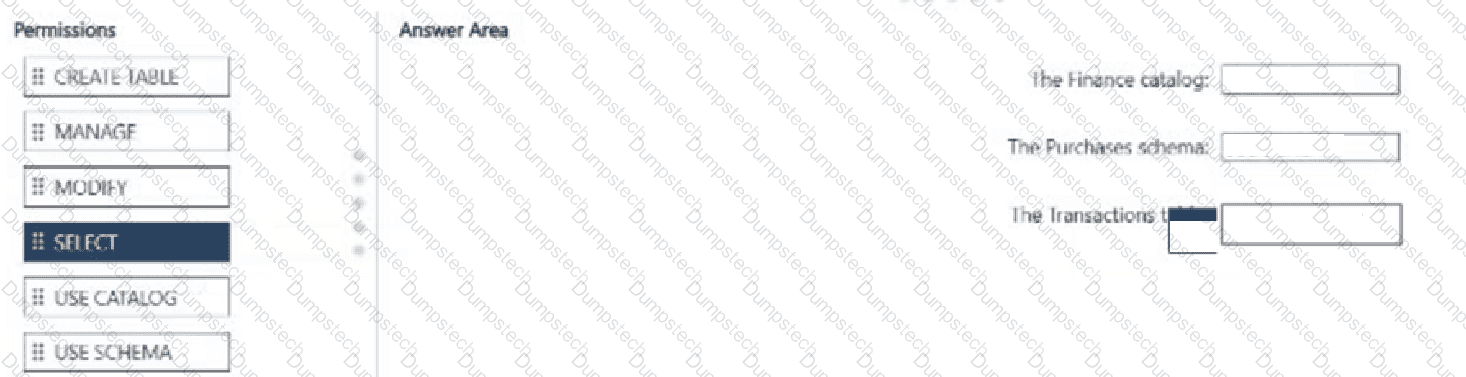
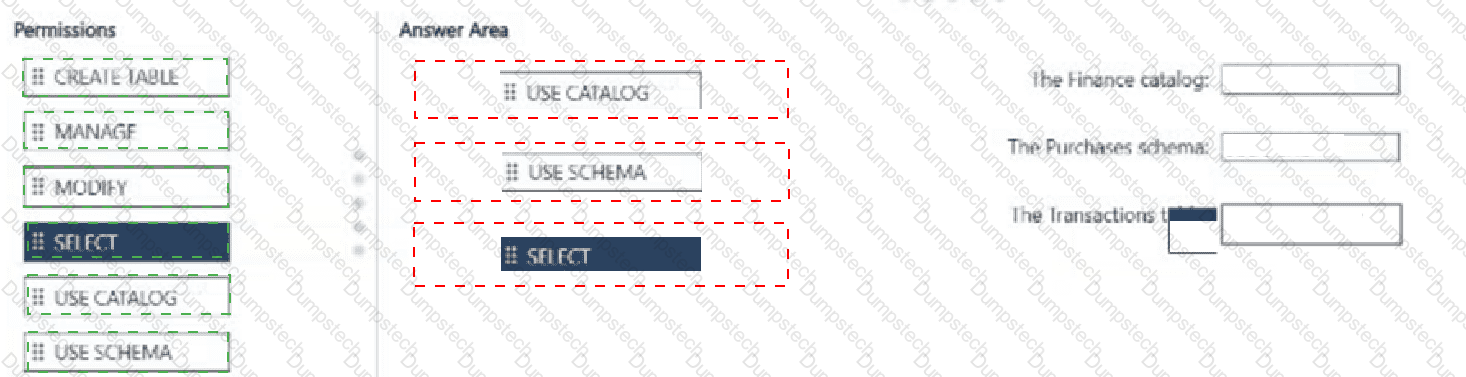
You need to ensure that a user named finance_user can query the Transactions table. The solution must follow the principle of least privilege.
Which permission should you grant to finance_user for each object? To answer, drag the appropriate permissions to the correct objects. Each permission may be used once, more than once, or not at all. You may need to drag the split bar between panes or scroll to view content.
NOTE: Each correct selection is worth one point.
You have an Azure Databricks workspace named Workspace1 that contains a takehouse and is enabled for Unity Catalog.
You have a connection to a Microsoft SQL Server database named DB1.
You need to expose the schemas and tables of DB1 to meet the following requirements:
• The schemas and tables can be queried in Databricks.
• The schemas and tables appear alongside other Unity Catalog objects.
• The data is NOT copied into Databricks-managed storage.
Solution: You create a new native catalog in Unity Catalog. Does this meet the goal?
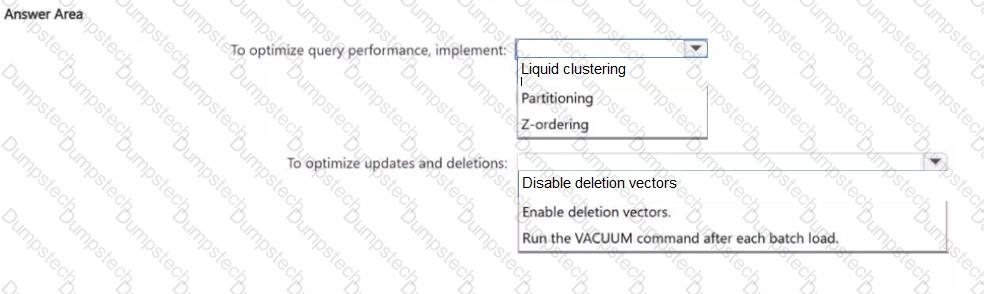
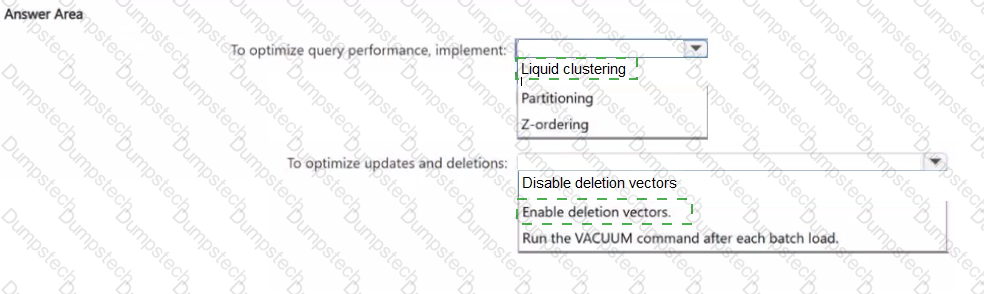
You have an Azure Databricks workspace that is enabled for Unity Catalog and contains a managed Delta table named Tabid.
Table! is written by batch jobs every hour and is queried frequently by filtering two columns named Customerld and EventDate.
You expect Table1 to grow significantly over time.
The rows in Table1 are frequently updated and deleted to support compliance requests.
You need to keep query performance consistent as Table1 grows. The solution must minimize update and deletion effort.
What should you include in the solution? To answer, select the appropriate options in the answer area
NOTE: Each correct selection is worth one point.
You have an Azure Databricks workspace
You are creating a Lakeflow Spark Declarative Pipelines (SDP) pipeline that scales automatically. You need to configure compute for the pipeline. The solution must minimize operational costs and effort. What should you use?
You have an Azure Databricks workspace that is enabled for Unity Catalog.
You have 500 GB of sales data stored as multiple CSV files in cloud storage.
You plan to load the data into a Delta table.
You need to ingest the bulk data by using a solution that meets the following requirements:
• Minimize how long it takes to implement the solution.
• Minimize the amount of custom code required.
What should you use?
You have an Azure Databricks workspace named Workspace1.
You create a compute cluster named Cluser1 that will be used to ingest data.
You need to install the required libraries on Cluster1. The solution must use Unity Catalog for access control.
What should you do?
You have an Azure Databricks workspace named Workspace1 that contains a Git folder linked to a remote Git repository. The Git folder contains a Databricks notebook named Notebook1.
From the main branch, you create a feature branch named Branch1 and commit changes to Notebook1.
Another user commits changes to Notebook1 in main.
When you attempt to merge Branch1 into main, a merge conflict occurs.
You need to ensure that Notebook1 in main includes the changes from both branches.
What should you do?
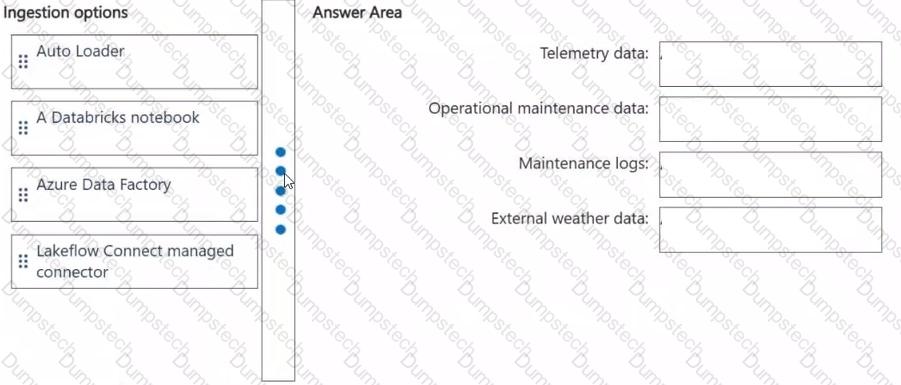
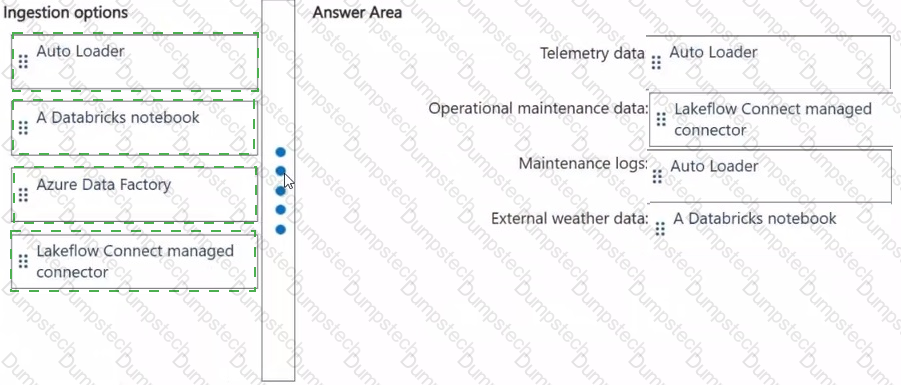
Which ingestion option should you recommend for each data source? To answer, drag the appropriate options to the correct data sources. Each option may be used once, more than once, or not at all. You may need to drag the split bar between panes or scroll to view content.
NOTE: Each correct selection is worth one point.
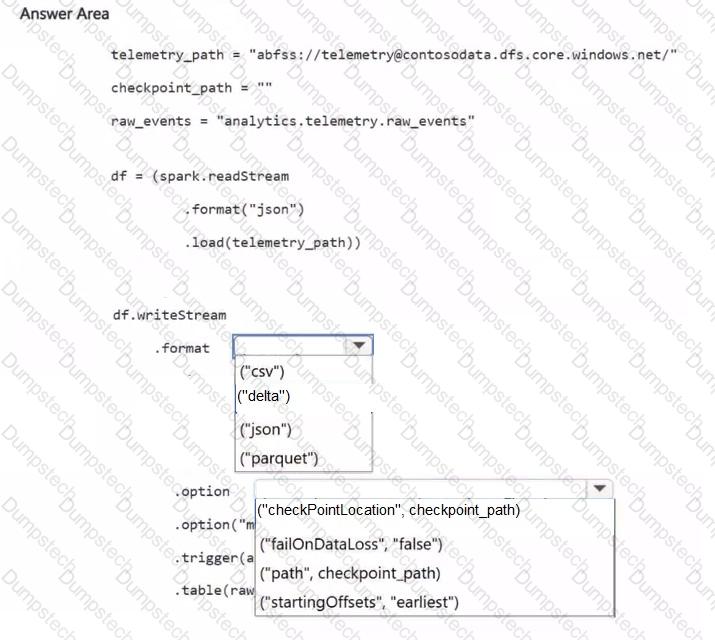
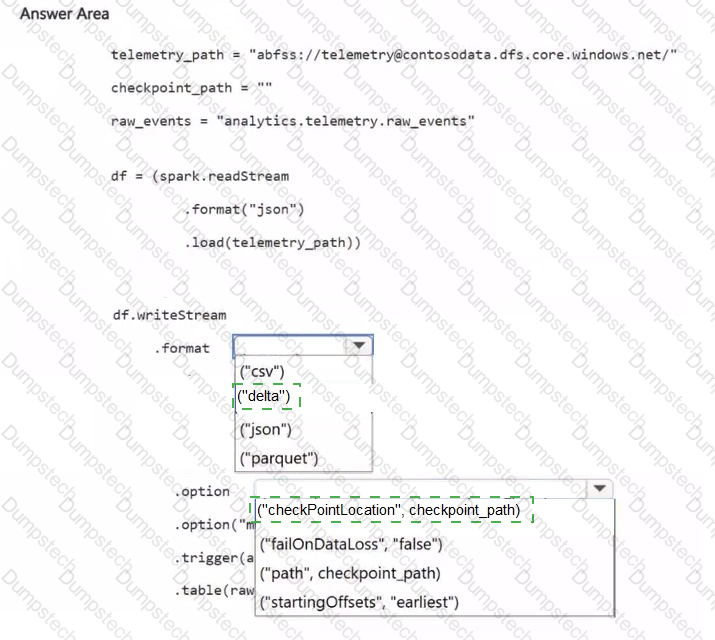
You need to complete the PySpark code for the Spark Structured Streaming pipelines. The solution must meet the data ingestion and processing requirements.
How should you complete the code segment? To answer, select the appropriate options in the answer area.
NOTE: Each correct selection is worth one point.