Pre-Winter Sale Limited Time 75% Discount Offer - Ends in 0d 00h 00m 00s - Coupon code = simple75
Pass the VMware VCAP-Storage 3V0-23.25 Questions and answers with Dumpstech
Exam 3V0-23.25 Premium Access
View all detail and faqs for the 3V0-23.25 exam
As part of standard operating procedures, when an administrator leaves the organization, a shallow rekey operation must be performed on a vSAN ESA cluster with vSAN Data-at-Rest Encryption enabled.
Which key is rotated during a shallow rekey operation?
An administrator just built a new workload domain including a vSAN ESA cluster. The architecture design included the use of memory tiering and a specific smaller NVMe device has been installed in each ESX host for this purpose.
When looking in the vSphere UI, the administrator notices that the device intended to be used for memory tiering has been claimed by vSAN.
What action should be taken on each host to achieve the desired configuration?
An administrator needs to quickly test a possibly destructive change to a Virtual Machine (VM) in production. The VM is currently protected by vSAN Data Protection.
Which feature of vSAN Data Protection can be leveraged to achieve this objective?
An administrator is tasked with deploying a VMware Cloud Foundation (VCF) Workload Domain that meets the following requirements:
• vSAN ESA as principal storage
• RAID-6 with FTT=2
• Support for Storage Traffic Separation
The administrator is provided the following hardware to perform the task:
• Four ESX hosts, each host contains:
24 CPU cores
96 GB memory
Two 25GbE network NICs
12 NVMe devices 4 TB each, connected to a single SATA/SAS/NVMe Tri-mode controller What four changes must the administrator make to the hardware before deploying the new Workload Domain? (Choose four.)
The security team has notified the VMware Cloud Foundation (VCF) Storage Administrator of a new security vulnerability that must be patched immediately. The vSAN Cluster uses vSphere Lifecycle Manager images.
After updating the image with the patch, what method should the administrator use to apply this patch with the least amount of disruption to the cluster?
An administrator is responsible for managing a VMware Cloud Foundation (VCF) Private Cloud.
The following information has been provided about the environment:
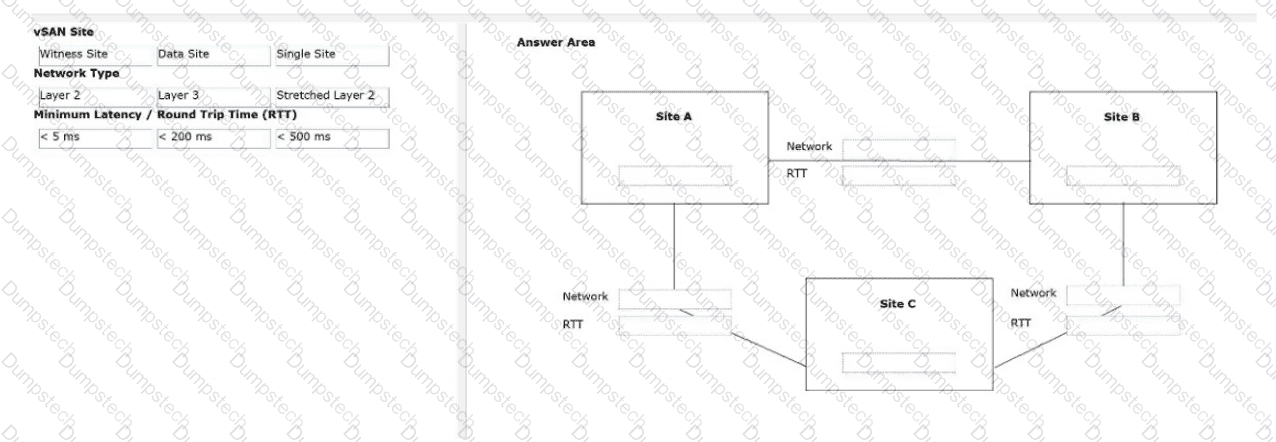
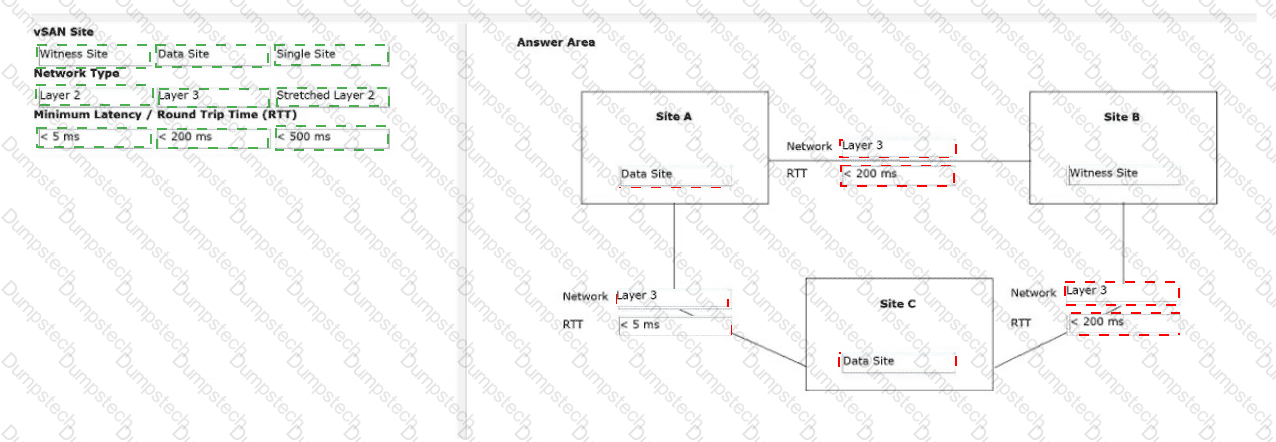
• There are 3 customer datacenters, Site A, Site B and Site C.
• The datacenter at Site A runs all Production Services.
• The datacenter at Site B has reached capacity and there is no space for additional physical hardware.
• The datacenter at Site C has been commissioned to replace Site B, because there is more rack space and power capacity to cater for future demand.
The administrator has been tasked with identifying the networking requirements for a new VMware vSAN Stretched Cluster with the following requirements:
• The solution will deploy a total of 10 new ESX host servers to create a VMware vSAN Stretched Cluster.
• The solution must deploy appropriate networking to ensure minimal disruption from issues with Spanning Tree Protocol (STP).
Drag and drop the correct vSAN Site Type, Networking Type and Round Trip Latency (RTT) within the boxes provided to complete the high-level diagram.
An administrator is managing a local vSAN 3-node cluster running the Express Storage Architecture (ESA) as part of a VMware
Cloud Foundation (VCF) Workload Domain.
The following parameters apply at the cluster level:
• HA is enabled
• Reserved Failover Capacity = 25% for both CPU and Memory
The administrator is tasked with configuring the VSAN storage policy so it will tolerate the maximum number of failures.
What two protection levels can the administrator configure? (Choose two.)
An administrator is tasked with configuring the vSAN File Service to deliver NFS file shares for an Edge environment.
Which three are required to deliver the service? (Choose three.)
During maintenance on hosts in a four-node vSAN cluster, a host is placed in maintenance mode with the “Ensure Accessibility” option.
All VMs are running with the Default Storage Policy (RAID-1, FTT=1) which has not been modified from the default settings.
While one of the hosts in the cluster is down for firmware upgrade, a second host in the cluster loses network connectivity.
How will the cluster be affected?
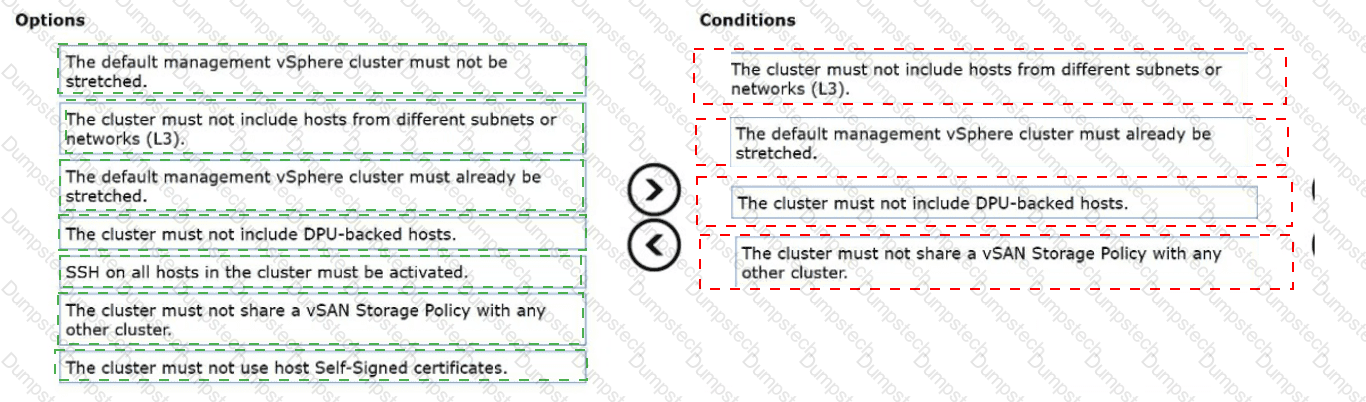
An administrator is tasked with stretching a vSAN cluster in a VMware Cloud Foundation (VCF) Workload Domain across two availability zones within a region. Both availability zones contain an equal number of hosts.
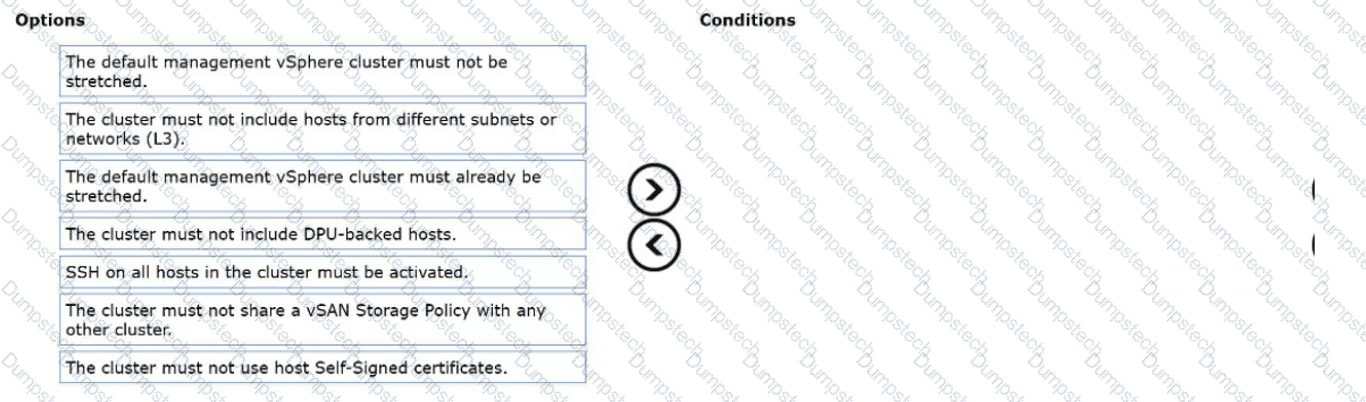
What four Conditions must also be met in order to stretch the cluster?
Drag and drop the four correct options from the Options list on the left and place them into the Conditions on the right in any order. (Choose four.)