
Pre-Winter Sale Limited Time 75% Discount Offer - Ends in 0d 00h 00m 00s - Coupon code = simple75
Pass the VMware VCAP-Storage 3V0-23.25 Questions and answers with Dumpstech
A six-node vSAN ESA cluster contains multiple Virtual Machines (VMs), and a vSAN storage policy with the rule “Failures to tolerate” set to “1 failure - RAID-5 (Erasure Coding)” is assigned. A vSAN administrator has changed the rule in the assigned policy to “2 failures - RAID-6 (Erasure Coding).”
What is the result of this change?
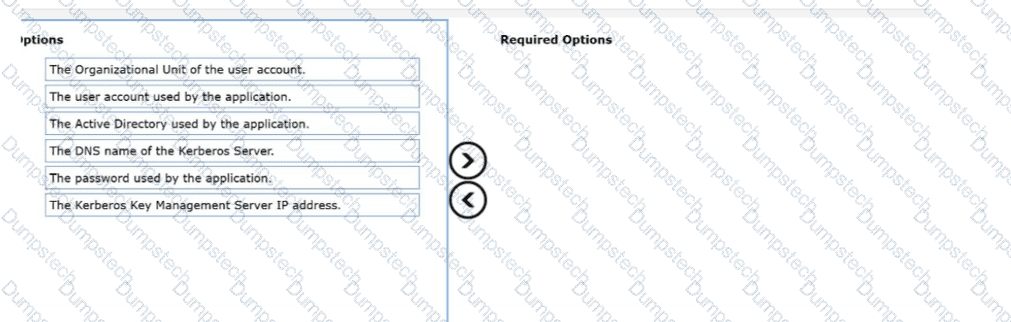
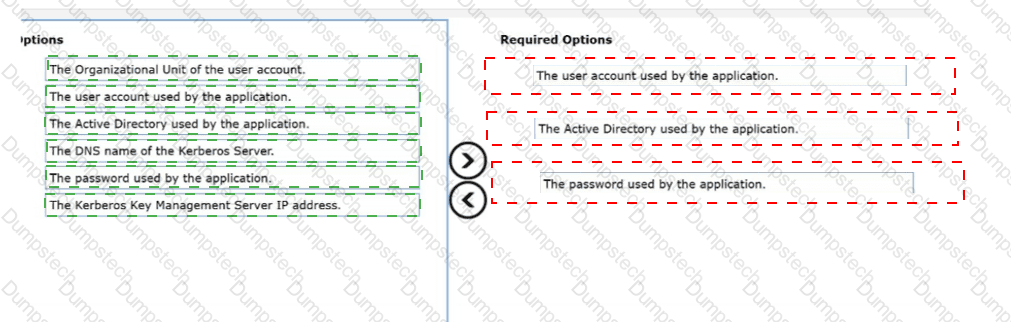
An administrator has been presented with the following requirements from an application owner:
• The application is distributed across multiple data centers.
• The application currently uses NFSv4.1 for mounting data volumes.
• The application requires Kerberos encryption.
Drag and drop the three correct options from the Options list on the left and place them into the Required Options on the right to properly configure the storage solution to meet the requirements in any order. (Choose three.)
A customer attaches an external Fibre Channel (FC) VMFS datastore to a VMware Cloud Foundation (VCF) workload domain for backup staging. The administrator must confirm that the datastore is visible to all hosts, and that path and device health alarms will trigger should a fabric link or path fail.
Which action should the administrator take to verify this?
A multinational corporation is deploying a VMware Cloud Foundation (VCF) Workload Domain cluster to host tier-1 business applications with the following requirements:
• Deliver high performance to all workloads.
• Integration with automated VM placement.
• Reuse of existing infrastructure including multiple Fibre Channel (FC) arrays partitioned by business unit.
• The storage architecture must avoid vSAN.
• Meet organizational separation requirements.
Which two deployment approaches meet these requirements? (Choose two.)
A storage administrator is being presented with the following VMware Cloud Foundation (VCF) architectural details:
• The applications data will require 2.5 PB of capacity.
• The production applications will be hosting archival solutions and gateways.
• There will be some applications deployed for the purpose of testing and development.
What is the optimal principal storage that the administrator can recommend?
An administrator is presented with the following scenario:
• 20 TB of additional storage is being requested by a VM application owner.
• The application has high CPU/Memory requirements that can only be satisfied by the current cluster the application runs in.
• The application has high IOPS and bandwidth requirements to run properly.
• The existing vSAN cluster only has 10 TB of unused capacity.
• The hosts in the cluster have no additional NVMe slots left.
• The administrator does not have permission to purchase additional hosts or re-assign hosts from other vSAN clusters.
• Other vSAN clusters exist in the environment that can satisfy the requirement.
Which vSAN feature should be used to fulfill this scenario?
An administrator is monitoring a vSAN ESA backed workload domain that is dedicated for running AI inferencing. When the administrator navigates to the Storage Performance dashboard in VMware Cloud Foundation Operations, the performance dashboard shows:
• High backend write latency ( > 8 ms)
• Low read latency ( < 1 ms)
• Normal network throughput
• Disk Group Health = Green
Based on the readings above, what would be the explanation?
An administrator attempts to enable vSAN Data-at-Rest Encryption on a cluster but receives the following error message:
“Key provider < vSphere Native Key Provider > is not available on host.”
The administrator configured the vSphere Native Key Provider (NKP) using the default settings.
What should the administrator validate before enabling vSAN Data-at-Rest Encryption?
An administrator is tasked with setting up immutable snapshots for recovery in case of a cyber-attack.
Which two limitations apply when configuring immutable snapshots? (Choose two.)
An administrator reports that after rebooting one host in a vSAN cluster configured with Data-at-Rest Encryption using an external Key Management Server (KMS), the host shows all vSAN disk groups as unmounted.
The KMS is online and reachable from all hosts.
In vCenter, the host displays the following event:
“Failed to retrieve encryption key from KMS.”
Key ID:
All other hosts in the cluster remain healthy and show “Encryption: Enabled.”
Why did the encryption key retrieval fail for this host?
