Pre-Winter Sale Limited Time 75% Discount Offer - Ends in 0d 00h 00m 00s - Coupon code = simple75
Pass the VMware VCAP-Storage 3V0-23.25 Questions and answers with Dumpstech
Exam 3V0-23.25 Premium Access
View all detail and faqs for the 3V0-23.25 exam
An administrator is tasked designing a vSAN storage solution while respecting the following requirements:
• Must use vSAN ESA
• Must be stretched between two data centers
• Must configure Failures to tolerate = 1
• Must configure Erasure Coding
How many components per Virtual Machine (VM) will be created?
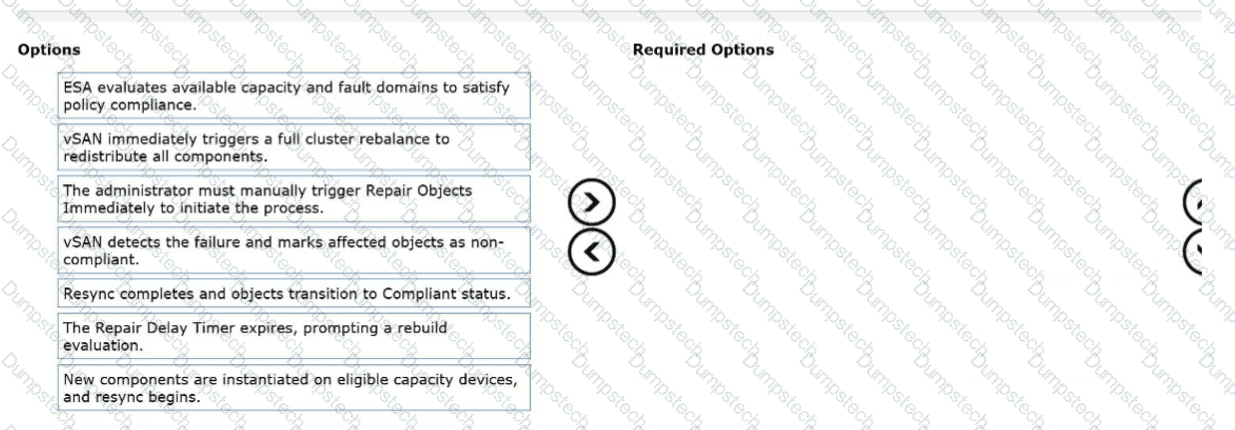
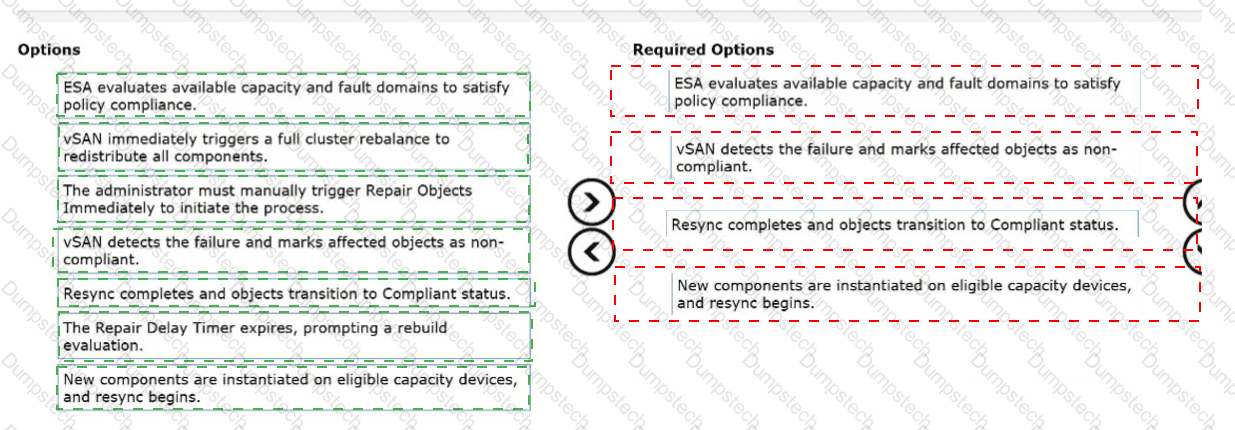
A vSAN ESA cluster experienced a host NVMe failure, causing several objects to become non-compliant.
Select the steps vSAN ESA follows to detect, evaluate and repair the non-compliant objects.
Drag and drop the four correct options from the Options list on the left and place them into the Required Options on the right in any order. (Choose four.)
An administrator is tasked with configuring the vSAN File Service to deliver NFS file shares for an Edge environment.
Which three are required to deliver the service? (Choose three.)
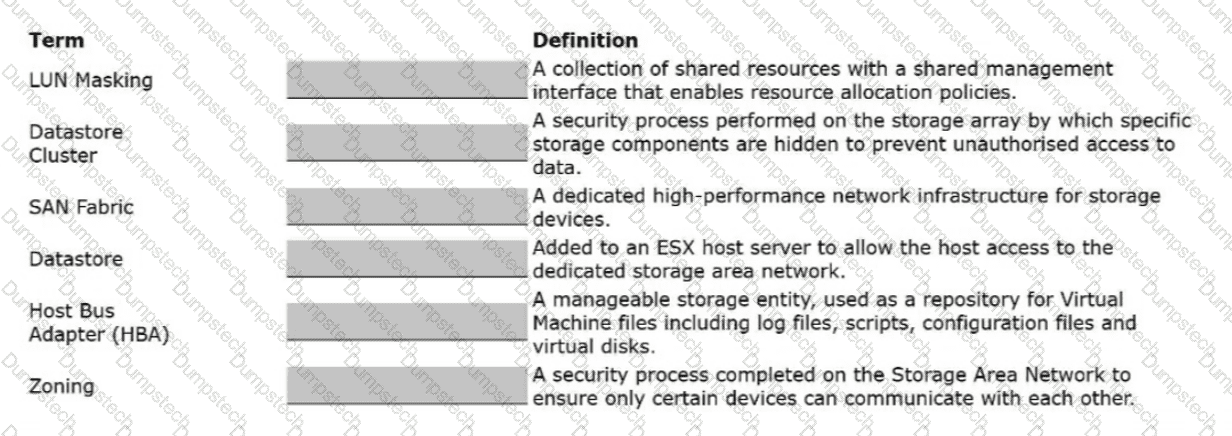
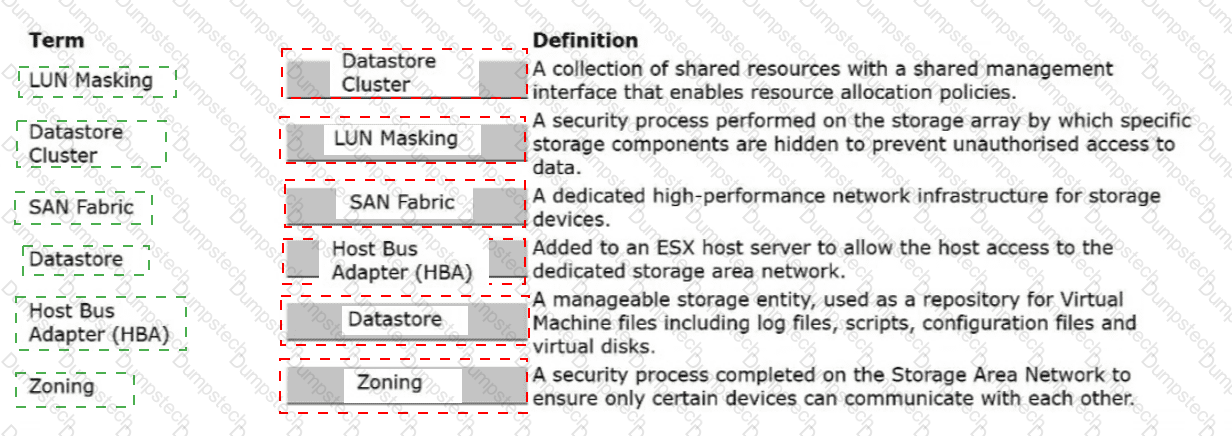
An administrator is responsible for a VMware Cloud Foundation (VCF) Private Cloud and has been tasked with identifying and explaining the different Fibre Channel (FC) Storage Area Network (SAN) components within a VCF Workload Domain cluster.
Drag and drop the correct Term onto its matching Definition.
An administrator is monitoring a vSAN ESA backed workload domain that is dedicated for running AI inferencing. When the administrator navigates to the Storage Performance dashboard in VMware Cloud Foundation Operations, the performance dashboard shows:
• High backend write latency ( > 8 ms)
• Low read latency ( < 1 ms)
• Normal network throughput
• Disk Group Health = Green
Based on the readings above, what would be the explanation?
An administrator is presented with the following scenario:
• 20 TB of additional storage is being requested by a VM application owner.
• The application has high CPU/Memory requirements that can only be satisfied by the current cluster the application runs in.
• The application has high IOPS and bandwidth requirements to run properly.
• The existing vSAN cluster only has 10 TB of unused capacity.
• The hosts in the cluster have no additional NVMe slots left.
• The administrator does not have permission to purchase additional hosts or re-assign hosts from other vSAN clusters.
• Other vSAN clusters exist in the environment that can satisfy the requirement.
Which vSAN feature should be used to fulfill this scenario?
A storage architect has been called into a meeting with the accounting team who is trying to determine why 20% of their raw capacity is not available for consumption. Their vSAN cluster was created with the following characteristics:
• 2 x 2 TB NVMe disks in 6 hosts in their vSAN cluster.
• FTT=1, RAID-1 for the default policy.
• Host Rebuild Reserve not activated for this cluster.
Which two items should the Architect say accounts for most of the unusable capacity? (Choose two.)
An administrator notices alerts triggering IOPS and Disk Throughput storage performance problems in the Fibre Channel datastore in a VMware Cloud Foundation (VCF) Workload Domain.
What can the administrator review to identify which Virtual Machines (VMs) may be experiencing storage IOPS and disk throughput performance issues?
An administrator has been tasked with recommending a principal storage type for a new cluster within an existing VMware Cloud
Foundation (VCF) Workload Domain.
The following information has been provided:
• The customer has a 25GbE capable network.
• The customer has an existing 3rd party storage solution that supports connectivity by either FibreChannel and NFS
• The new cluster will consist of two host servers that will be recycled from a previous project.
• Each of the host servers have the following configuration:
o One 500GB Enterprise-grade SSD drive.
o Two 2-Port IOGbE network cards.
• There is no budget for additional hardware.
Which approach should the administrator recommend for the principal storage type?
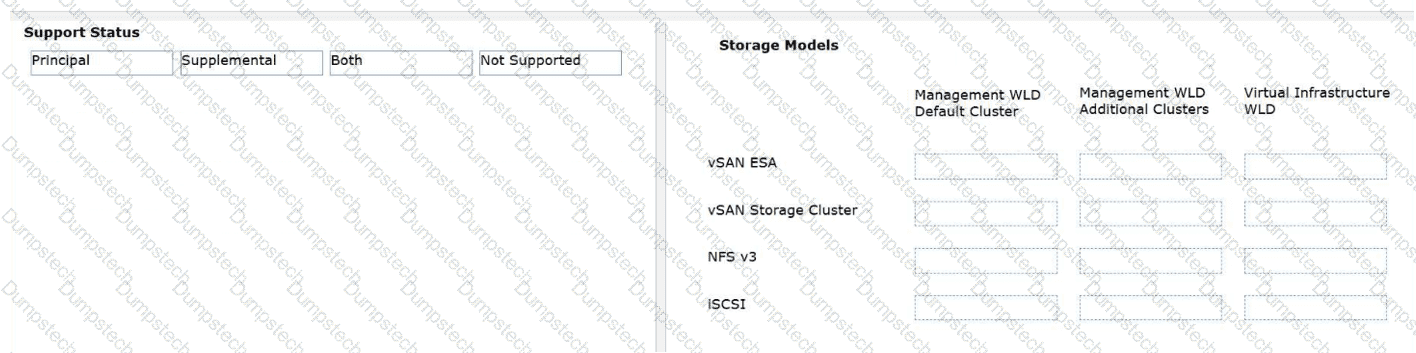
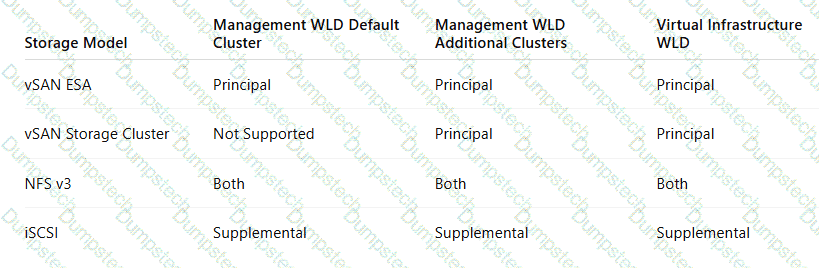
An administrator is responsible for a VMware Cloud Foundation (VCF) Private Cloud and has been tasked with identifying which storage model is supported in the different VCF Workload Domains.
Drag and drop the Support Status of each storage model on the left to each type of Workload Domain on the right.