Pre-Summer Sale Limited Time 70% Discount Offer - Ends in 0d 00h 00m 00s - Coupon code = simple70

Pass the Cisco CCNA 200-301 Questions and answers with Dumpstech

Exam 200-301 Premium Access

View all detail and faqs for the 200-301 exam

Practice at least 50% of the questions to maximize your chances of passing.
Viewing page 1 out of 8 pages
Viewing questions 1-50 out of questions
Questions # 1:

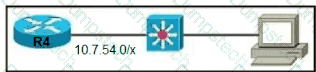
Refer to the exhibit.

Question # 1

The router has been configured with a subnet to accommodate the requirement for 380 users on a subnet. The requirement already considers 30% future growth. Which configuration verifies the IP subnet on router R4?

Options:

A.

Subnet: 10.7.54.0Subnet mask: 255.255.254.0Broadcast address: 10.7.54.255Usable IP address range: 10.7.54.1 - 10.7.55.254

B.

Subnet: 10.7.54.0Subnet mask: 255.255.128.0Broadcast address: 10.7.55.255Usable IP address range: 10.7.54.1 - 10.7.55.254

C.

Subnet: 10.7.54.0Subnet mask: 255.255.255.0Broadcast address: 10.7.54.255Usable IP address range: 10.7.54.1 - 10.7.55.254

D.

Subnet: 10.7.54.0Subnet mask: 255.255.254.0Broadcast address: 10.7.55.255Usable IP address range: 10.7.54.1 - 10.7.55.254

Questions # 2:

Drag and drop the statement about AAA services from the left to the corresponding AAA services on the right.
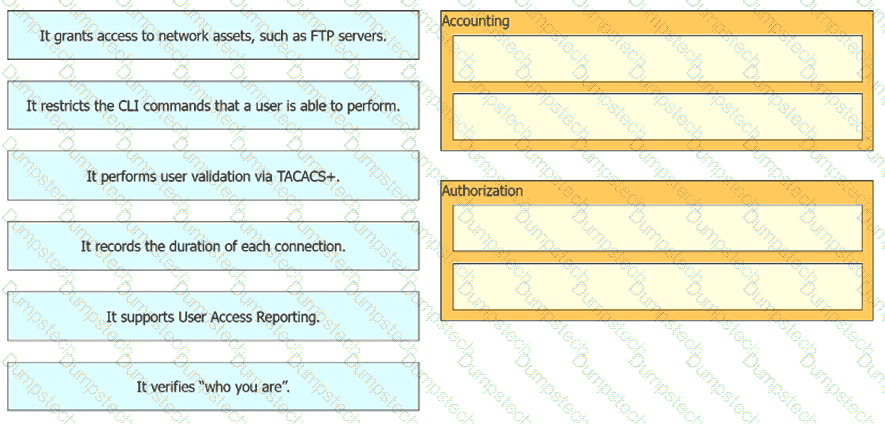
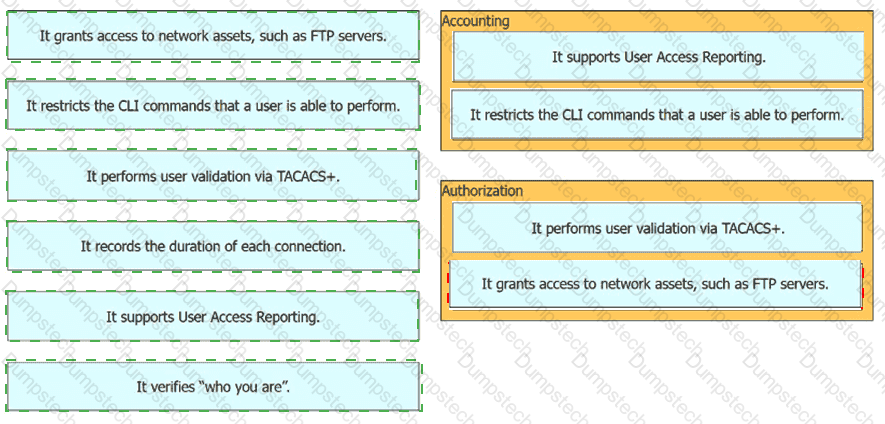
Question # 2

Options:

Questions # 3:

Question # 3

A)

Question # 3

B)

Question # 3

C)

Question # 3

D)

Question # 3

Options:

A.

Option A

B.

Option B

C.

Option C

D.

Option D

Questions # 4:

What is the main difference between traditional networks and controller-based networking?

Options:

A.

Controller-based networks increase TCO for the company, and traditional networks require less investment.

B.

Controller-based networks provide a framework for Innovation, and traditional networks create efficiency.

C.

Controller-based networks are open for application requests, and traditional networks operate manually.

D.

Controller-based networks are a closed ecosystem, and traditional networks take advantage of programmability.

Questions # 5:

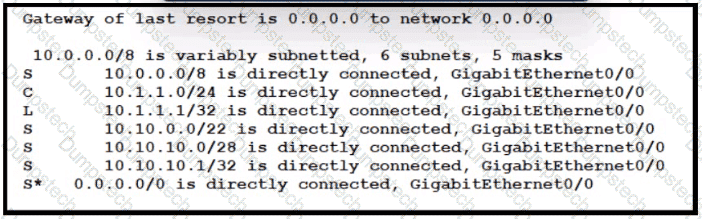
Refer to the exhibit.

Question # 5

Which IP route command created the best path for a packet destined for 10.10.10.3?

Options:

A.

ip route 10.10.0.0 255.255.252.0 g0/0

B.

ip route 10.0.0.0 255.0.0.0 g0/0

C.

ip route 10.10.10.1 255.255.255.255 g0/0

D.

ip route 10.10.10.0 255.255.255.240 g0/0

Questions # 6:

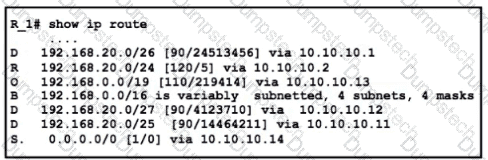
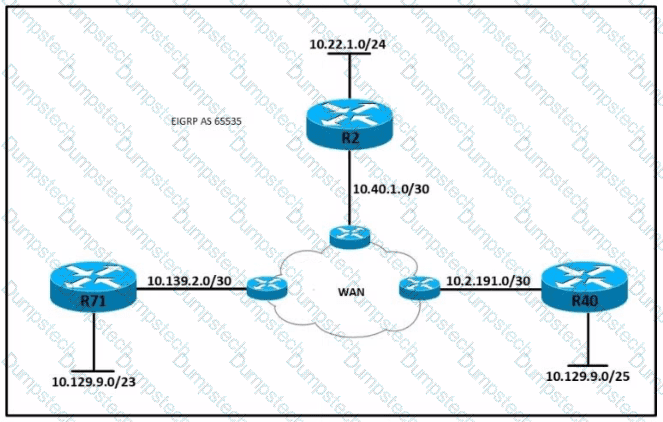
Refer to the exhibit.

Question # 6

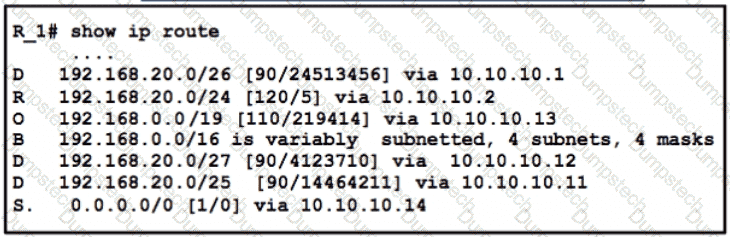
Packets are flowing from 192.168.10.1 to the destination at IP address 192.168.20.75. Which next hop will the router select for the packet?

Options:

A.

10.10.10.1

B.

10.10.10.11

C.

10.10.10.12

D.

10.10.10.14

Questions # 7:

Which two HTTP methods are suitable for actions performed by REST-based APIs? (Choose two.)

Options:

A.

REMOVE

B.

REDIRECT

C.

OPOST

D.

GET

E.

UPOP

Questions # 8:

How is a configuration change made to a wireless AP in lightweight mode?

Options:

A.

SSH connection to the management IP of the AP

B.

EolP connection via the parent WLC

C.

CAPWAP/LWAPP connection via the parent WLC

D.

HTTPS connection directly to the out-of-band address of the AP

Questions # 9:

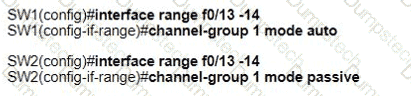
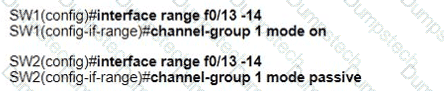
Refer to the exhibit.

Question # 9

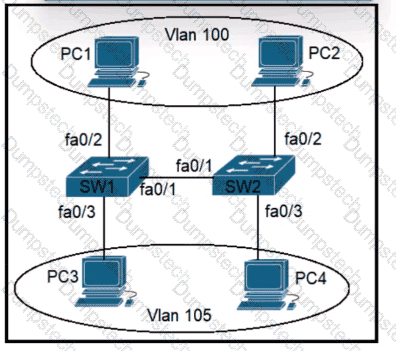
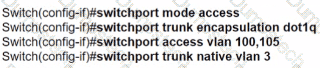
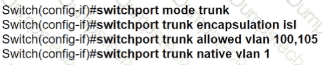
Which set of commands must be applied to the two switches to configure an LACP Layer 2 EtherChannel?

A)
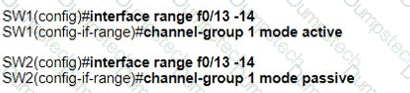
Question # 9

B)

Question # 9

C)

Question # 9

D)

Question # 9

Options:

A.

Option A

B.

Option B

C.

Option C

D.

Option D

Questions # 10:

Which command implies the use of SNMPv3?

Options:

A.

snmp-server host

B.

snmp-server community

C.

snmp-server enable traps

D.

snmp-server user

Questions # 11:

Drag and drop the characteristic from the left onto the IPv6 address type on the right.
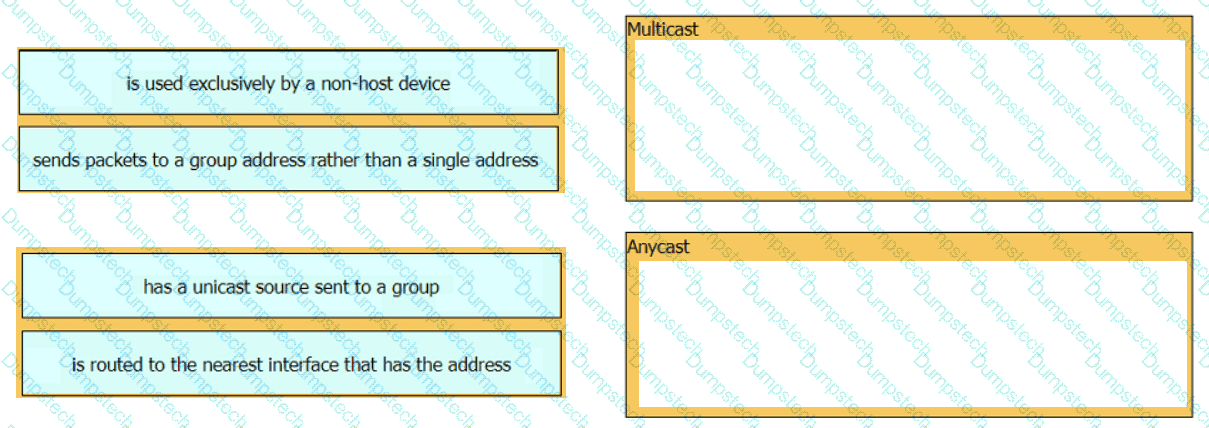
Question # 11

Options:

Questions # 12:

By default, how long will the switch continue to know a workstation MAC address after the workstation stops sending traffic?

Options:

A.

200 seconds

B.

300 seconds

C.

600 seconds

D.

900 seconds

Questions # 13:

Which channel-group mode must be configured when multiple distribution interfaces connected to a WLC are bundled?

Options:

A.

Channel-group mode passive.

B.

Channel-group mode on.

C.

Channel-group mode desirable.

D.

Channel-group mode active.

Questions # 14:

Which WAN topology has the highest degree of reliability?

Options:

A.

full mesh

B.

Point-to-point

C.

hub-and-spoke

D.

router-on-a-stick

Questions # 15:

An engineer is configuring a switch port that is connected to a VoIP handset. Which command must the engineer configure to enable port security with a manually assigned MAC address of abod-bod on voice VLAN 4?

Options:

A.

switchport port-security mac-address abcd.abcd.abcd

B.

switchport port-security mac-address abed.abed.abed vlan 4

C.

switchport port-security mac-address sticky abcd.abcd.abcd vlan 4

D.

switchport port-security mac-address abcd.abcd.abcd vlan voice

Questions # 16:

What are two characteristics of a controller-based network? (Choose two.)

Options:

A.

It uses Telnet to report system issues

B.

It uses northbound and southbound APIs to communicate between architectural layers

C.

It decentralizes the control plane, which allows each device to make its own forwarding decisions

D.

It moves the control plane to a central point

E.

The administrator can make configuration updates from the CLI

Questions # 17:

Refer to the exhibit.

Question # 17

All routers in the network are configured correctly, and the expected routes are being exchanged among the routeis. Which set or routes are learned from neighbors and Installed on router 2?

A)

Question # 17

B)

Question # 17

C)

Question # 17

D)

Question # 17

Options:

A.

Option A

B.

Option B

C.

Option C

D.

Option D

Questions # 18:

Which cable type must be used to interconnect one switch using 1000 BASE-SX GBiC modules and another switch using 1000 BASE-SX SFP modules?

Options:

A.

LC to SC

B.

SC t ST

C.

SC to SC

D.

LC to LC

Questions # 19:

Which IPv6 address range is suitable for anycast addresses for distributed services such DHCP or DNS?

Options:

A.

FF00:1/12

B.

2001:db8:0234:ca3e::1/128

C.

2002:db84:3f37:ca98:be05:8/64

D.

FE80::1/10

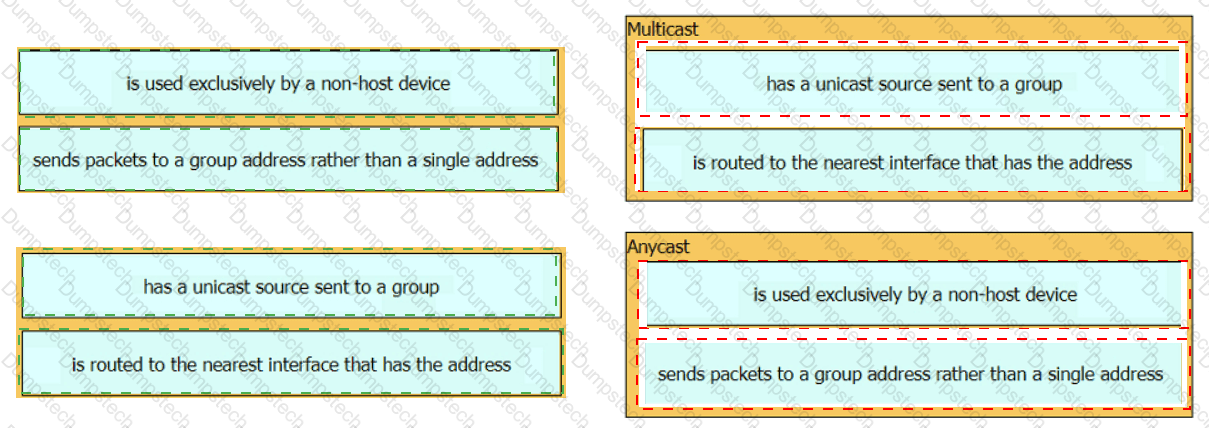
Questions # 20:

What is a difference between an IPv6 multicast address and an IPv6 anycast address?
Options:

A.

A packet sent to an IPv6 multicast address is delivered to one or more destinations at once, but a packet sent to an IPv6 anycast address is routed to the closest interface with that address.

B.

An IPv6 multicast address uses the prefix 2002::/15 and forwards to one destination, and an IPv6 anycast address uses the prefix ff00::/8 and forwards to any destination in a group.

C.

IPv6 multicast addresses are used to transition from IPv4 to IPv6, and IPv6 anycast addresses are used for address aggregation in an IPv6-only environment.

D.

An IPv6 multicast address is assigned to numerous interfaces within a subnet, but an IPv6 anycast address is used for a predefined group of nodes in an all-IPv6 routers group.

Questions # 21:

Question # 21

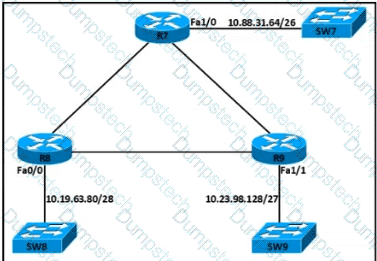
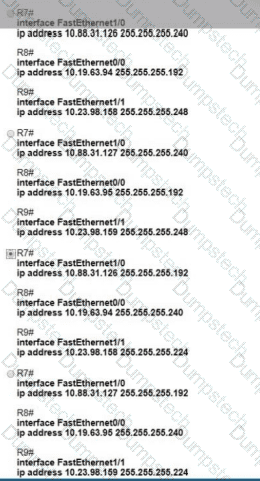
Refer to the exhibit. Each router must be configured with the last usable IP address in the subnet. Which configuration fulfills this requirement?
Question # 21

Options:

A.

Option A

B.

Option B

C.

Option C

D.

Option D

Questions # 22:

What is the advantage of separating the control plane from the data plane within an SDN network?

Options:

A.

decreases overall network complexity

B.

limits data queries to the control plane

C.

reduces cost

D.

offloads the creation of virtual machines to the data plane

Questions # 23:

The clients and OHCP server reside on different subnets. Which command must be used to forward requests and replies between clients on the 10.10.0.1/24 subnet and the DHCP server at 192.168.10.1?

Options:

A.

ip route 192.168.10.1

B.

ip default-gateway 192.168.10.1

C.

ip helper-address 192.168.10.1

D.

ip dhcp address 192.168.10.1

Questions # 24:

What are two disadvantages of a full-mesh topology? (Choose two.)

Options:

A.

It needs a high MTU between sites.

B.

It has a high implementation cost.

C.

It must have point-to-point communication.

D.

It requires complex configuration.

E.

It works only with BGP between sites.

Questions # 25:

What is an advantage of using auto mode versus static mode for power allocation when an access point is connected to a PoE switch port?

Options:

A.

All four pairs of the cable are used

B.

It detects the device is a powered device

C.

The default level is used for the access point

D.

Power policing is enabled at the same time

Questions # 26:

Which IPsec encryption mode is appropriate when the destination of a packet differs from the security termination point?

Options:

A.

tunnel

B.

transport

C.

aggressive

D.

main

Questions # 27:

What are two lacts that differentiate optical-fiber cabling from copper cabling? (Choose two.)

Options:

A.

It is less expensive when purchasing patch cables.

B.

It has a greater sensitivity to changes in temperature and moisture.

C.

It provides greater throughput options.

D.

It carries signals for longer distances.

E.

It carries electrical current further distances for PoE devices.

Questions # 28:

Refer to the exhibit. A network administrator configures the CPE to provide internet access to the company headquarters. Traffic must be load-balanced via ISP1 and ISP2 to ensure redundancy. Which two command sets must be configured on the CPE router? (Choose two.)

Options:

A.
B.

B.

C.

C.

D.

D.

E.

E.

Questions # 29:

An engineer must configure a core router with a floating static default route to the backup router at 10.200.0.2.
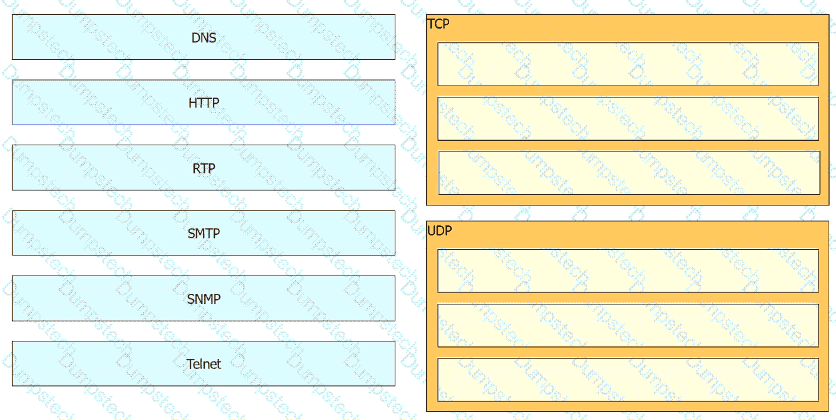
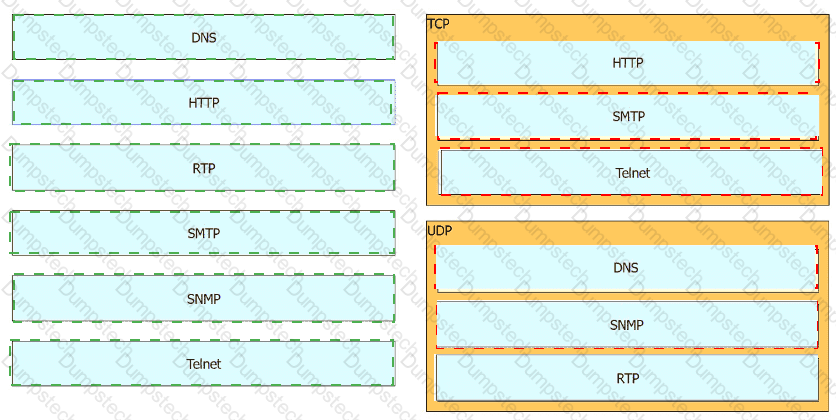
Question # 29

Options:

Questions # 30:

When should an engineer implement a collapsed-core architecture?

Options:

A.

for small networks with minimal need for growth

B.

the access and distribution layers must be on the same device

C.

for large networks that are connected to multiple remote sites

D.

only when using VSS technology

Questions # 31:

An engineer observes high usage on the 2.4GHz channels and lower usage on the 5GHz channels. What must be configured to allow clients to preferentially use 5GHz access points?

Options:

A.

Re-Anchor Roamed Clients

B.

OEAP Split Tunnel

C.

11ac MU-MIMO

D.

Client Band Select

Questions # 32:

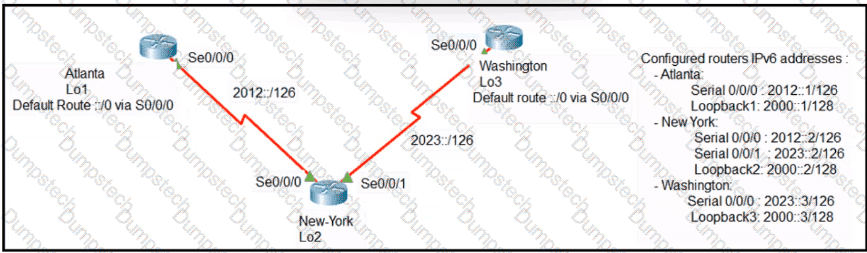
Refer to the exhibit.

Question # 32

The loopback1 interface of the Atlanta router must reach the lookback3 interface of the Washington router.

Options:

A.

ipv6 route 2000::1/128 2012::2

B.

ipv6 route 2000::1/128 2012::1

C.

ipv6 route 2000:3 123 s0/0/0

D.

ipv6 route 2000::3/128 2023::3

E.

ipv6 route 2000::1/128 s0/0/1

Questions # 33:

When is the PUT method used within HTTP?

Options:

A.

when a nonidempotent operation is needed

B.

to update a DNS server

C.

to display a web site

D.

when a read-only operation it required

Questions # 34:

What is the put method within HTTP?

Options:

A.

It is a read-only operation.

B.

It is a nonldempotent operation.

C.

It replaces data at the destination.

D.

It displays a web site.

Questions # 35:

An engineer is configuring router R1 with an IPv6 static route for prefix 2019:C15C:0CAF:E001::/64. The next hop must be 2019:C15C:0CAF:E002::1 The route must be reachable via the R1 Gigabit 0/0 interface. Which command configures the designated route?

Options:

A.

R1(config)#ipv6 route 2019:C15C:0CAF:E001::/64 2019:C15C:0CAF:E002::1

B.

R1(config-if)#ipv6 route 2019:C15C:0CAF:E001::/64 2019:C15C:0CAF:E002::1

C.

R1(config-if)#ip route 2019:C15C:0CAF:E001::/64 GigabitEthernet0/0

D.

R1(config)#ip route 2019:C15C:0CAF:E001::/64 GigabitEthernet0/0

Questions # 36:

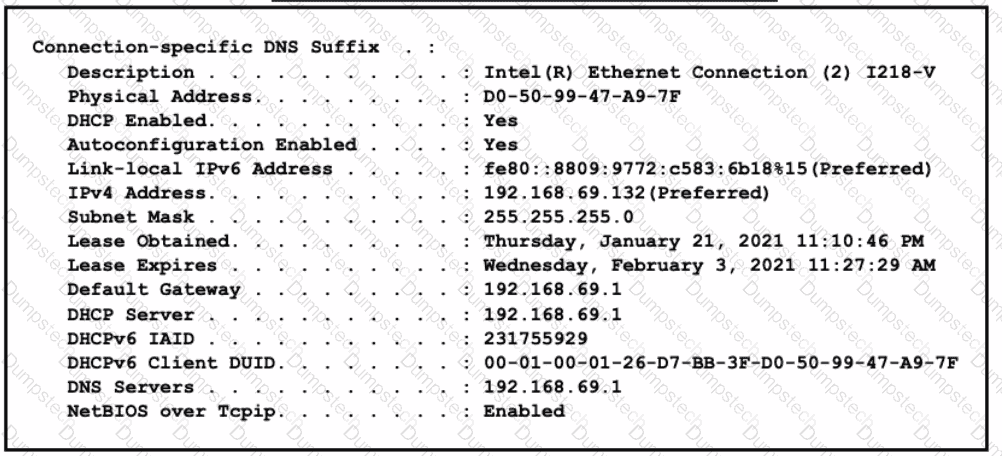
Refer to the exhibit.

Question # 36

What does the host do when using the IPv4 Preferred function?

Options:

A.

It continues to use a statically assigned IPv4 address

B.

It forces the DNS server to provide the same IPv4 address at each renewal.

C.

It requests the same IPv4 address when it renews its lease with the DHCP server.

D.

It prefers a pool of addresses when renewing the IPv4 host IP address

Questions # 37:

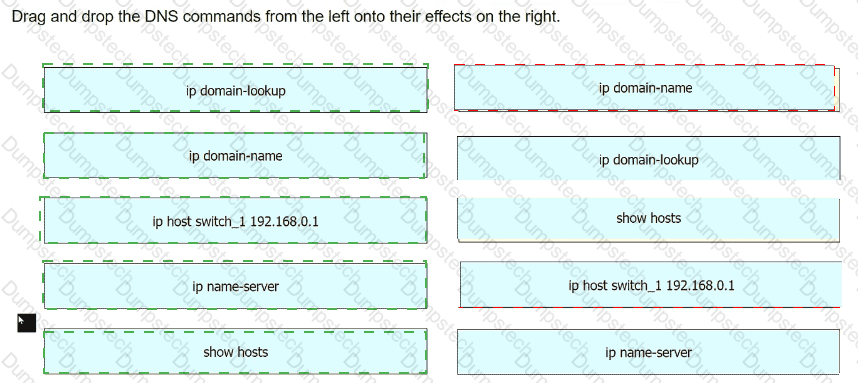
Drag and drop the DNS commands from the left onto their effects on the right.
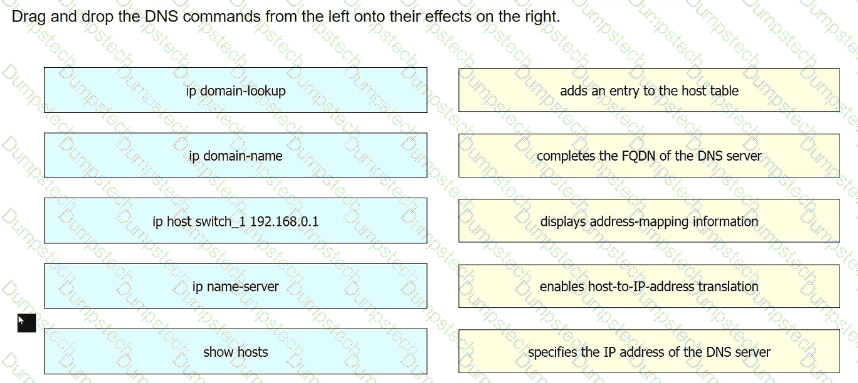
Question # 37

Options:

Questions # 38:

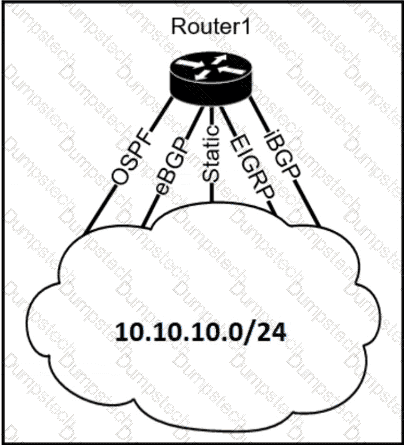
Refer to the exhibit.

Question # 38

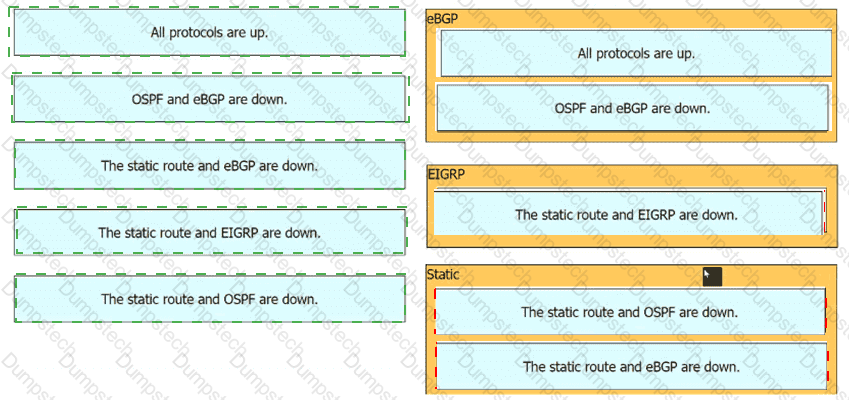
The Router1 routing table has multiple methods to reach 10.10.10.0/24 as shown. The default Administrative Distance is used. Drag and drop the network conditions from the left onto the routing methods that Router1 uses on the right.
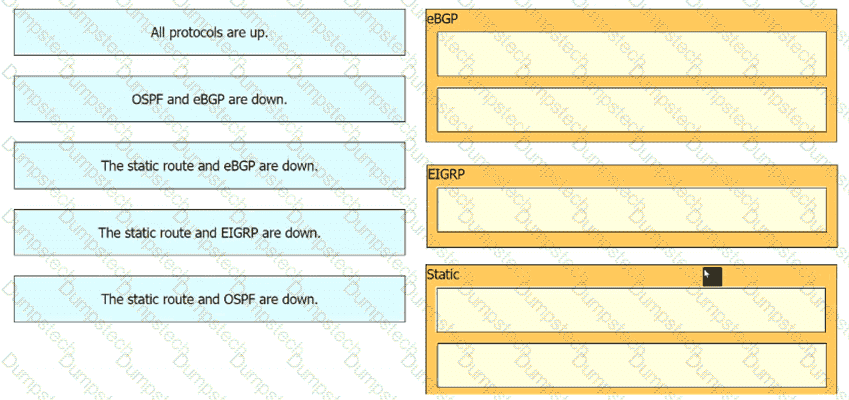
Question # 38

Options:

Questions # 39:

Question # 39

Refer to the exhibit. IPv6 must be implemented on R1 to the ISP The uplink between R1 and the ISP must be configured with a manual assignment, and the LAN interface must be self-provisioned Both connections must use the applicable IPv6 networks Which two configurations must be applied to R1? (Choose two.)

Options:

A.

interface Gi0/1ipv6 address 2001:db8:0F1B:FCCB:ACCE:FCED:ABCD:FA02:/127

B.

interface Gi0/0ipv6 address 2001:db8:1:AFFF::/64 eui-64

C.

interface Gi0/1ipv6 address 2001:db8:0F1B:FCCB:ACCE:FCED:ABCD:FA00:/127

D.

interface Gi0/0ipv6 address 2001:db8:0:AFFF::/64 eui-64

E.

interface Gi0/0ipv6 address 2001:db8:0F1B:FCCB:ACCE:FCED:ABCD:FA03;/127

Questions # 40:

Which interface IP address serves as the tunnel source for CAPWAP packets from the WLC to an AP?

Options:

A.

service

B.

trunk

C.

AP-manager

D.

virtual AP connection

Questions # 41:

Which two wireless security stewards use Counter Mode Cipher Block Chaining Message Authentication Code Protocol for encryption and data integrity ' ? (Choose two.)

Options:

A.

WPA2

B.

WPA3

C.

Wi-Fi 6

D.

WEP

E.

WPA

Questions # 42:

Refer to the exhibit.

Question # 42

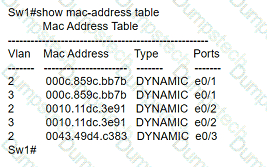
Host A switch interface is configured in VLAN 2. Host D sends a unicast packet destined for the IP address of host A.
Question # 42

What does the switch do when it receives the frame from host D?

Options:

A.

It creates a broadcast storm.

B.

It drops the frame from the MAC table of the switch.

C.

It shuts down the source port and places It In err-disable mode.

D.

It floods the frame out of every port except the source port.

Questions # 43:

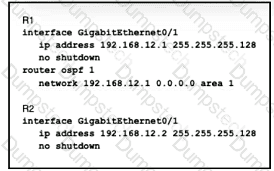
Refer to the exhibit.

Question # 43

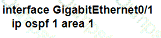
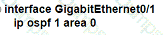
A network engineer started to configure two directly-connected routers as shown. Which command sequence must the engineer configure on R2 so that the two routers become OSPF neighbors?

A)

Question # 43

B)

Question # 43

C)

Question # 43

D)

Question # 43

Options:

A.

Option A

B.

Option B

C.

Option C

D.

Option D

Questions # 44:

Refer to the exhibit.

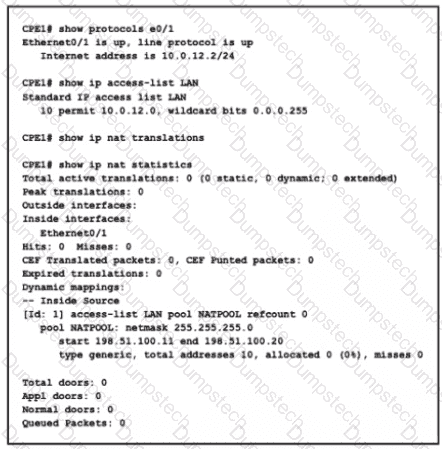
Question # 44

What is the next step to complete the implementation for the partial NAT configuration shown?

Options:

A.

Reconfigure the static NAT entries that overlap the NAT pool

B.

Configure the NAT outside interface

C.

Modify the access list for the internal network on e0/1

D.

Apply the ACL to the pool configuration

Questions # 45:

Refer to the exhibit.

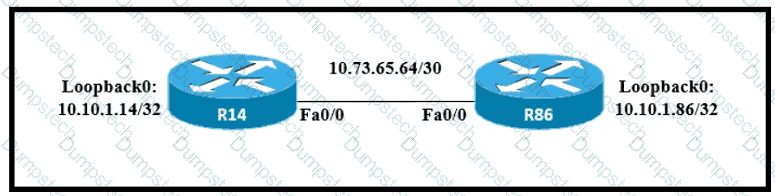
Question # 45

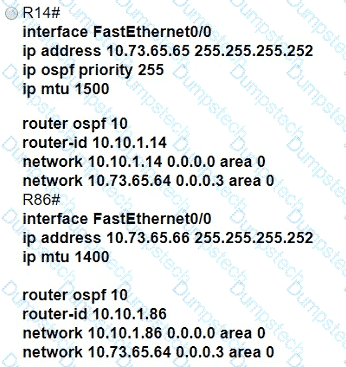
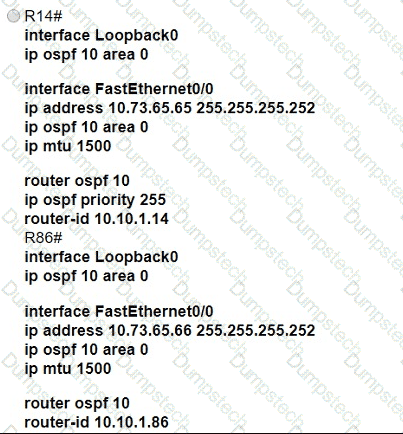
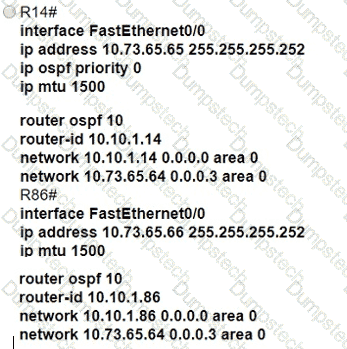
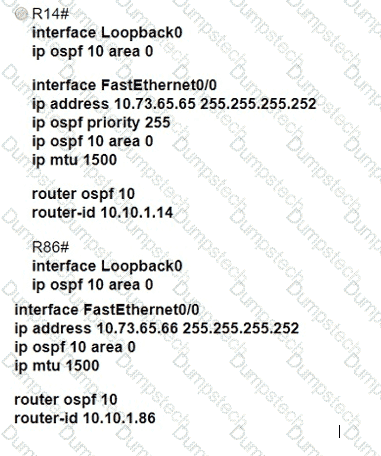
All interfaces are configured with duplex auto and ip ospf network broadcast. Which configuration allows routers R14 and R86 to form an OSPFv2 adjacency and act as a central point for exchanging OSPF information between routers?
Question # 45

Question # 45

Question # 45

Question # 45

Options:

A.

Option A

B.

Option B

C.

Option C

D.

option D

Questions # 46:

What are two advantages of implementing a controller-based architecture instead of a traditional network architecture? (Choose two.)

Options:

A.

It allows for seamless connectivity to virtual machines.

B.

It supports complex and high-scale IP addressing schemes.

C.

It enables configuration task automation.

D.

It provides increased scalability and management options.

E.

It increases security against denial-of-service attacks.

Questions # 47:

What must be considered before deploying virtual machines?

Options:

A.

location of the virtual machines within the data center environment

B.

whether to leverage VSM to map multiple virtual processors to two or more virtual machines

C.

resource limitations, such as the number of CPU cores and the amount of memory

D.

support for physical peripherals, such as monitors, keyboards, and mice

Questions # 48:

Refer to the exhibit.

Question # 48

Packets are flowing from 192.168 10.1 to the destination at IP address 192.168.20 75. Which next hop will the router select for the packet?

Options:

A.

10.10101

B.

10.10.10.11

C.

10.10.10.12

D.

10.101014

Questions # 49:

Which command creates a static NAT binding for a PC address of 10.1.1.1 to the public routable address 209.165.200.225 assigned to the PC?

Options:

A.

R1(config)#ip nat inside source static 10.1.1.1 209.165.200.225

B.

R1(config)#ip nat inside source static 209.165.200.225 10.1.1.1

C.

R1(config)#ip nat outside source static 10.1.1.1 209.165.200.225

D.

R1(config)#ip nat outside source static 209.165.200.225 10.1.1.1

Questions # 50:

What are two functions of DHCP servers? (Choose two.)

Options:

A.

prevent users from assigning their own IP addresses to hosts

B.

assign dynamic IP configurations to hosts in a network

C.

support centralized IP management

D.

issue DHCPDISCOVER messages when added to the network

E.

respond to client DHCPOFFER requests by issuing an IP address

Viewing page 1 out of 8 pages
Viewing questions 1-50 out of questions