Summer Sale Limited Time 75% Discount Offer - Ends in 0d 00h 00m 00s - Coupon code = simple75

Pass the Fortinet NSE 7 Network Security Architect NSE7_FSN_AR-7.6 Questions and answers with Dumpstech

Exam NSE7_FSN_AR-7.6 Premium Access

View all detail and faqs for the NSE7_FSN_AR-7.6 exam

Practice at least 50% of the questions to maximize your chances of passing.
Viewing page 2 out of 5 pages
Viewing questions 11-20 out of questions
Questions # 11:

Refer to the exhibit.

Question # 11

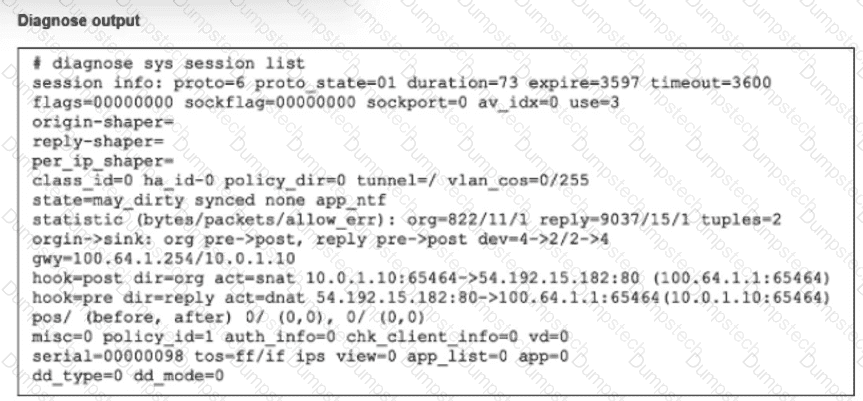
The output of diagnose sys session list command is shown.

If the HA ID for the primary device is 9, what happens if the primary fails and the secondary becomes the primary?

Options:

A.

The session is synchronized with the secondary device, however, because application control is applied. the session is marked dirty and has to be reevaluated after failover.

B.

The session will be removed from the session table of the secondary device because the TCP session is not yet fully established.

C.

The session continues to permit traffic on the new primary device after failover. without requiring the client to restart the session with the server.

D.

The session state is preserved but the kernel will re-evaluate the session because the routing information will be flushed

Questions # 12:

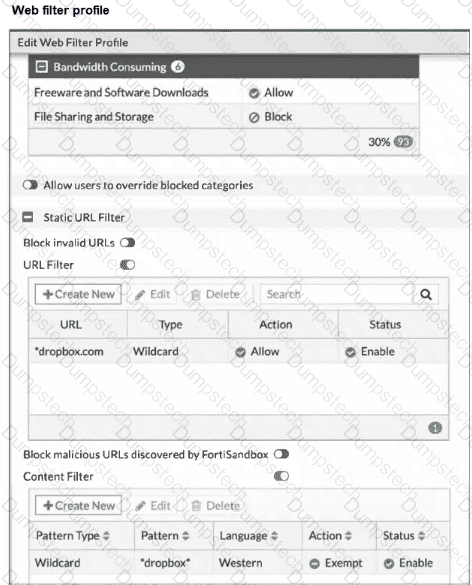
Refer to the exhibit, which shows a partial web filter profile configuration.
Question # 12

The URL www.dropbox.com is categorized as File Sharing and Storage.

Which action does FortiGate take if a user attempts to access www.dropbox.com?

Options:

A.

FortiGate blocks the connection as an invalid URL.

B.

Based on the URL Filter configuration, FortiGate allows the connection.

C.

FortiGate blocks the connection, based on the FortiGuard category-based filter configuration.

D.

Based on the Web Content filter configuration, access to www.dropbox.com would be exempted.

Questions # 13:

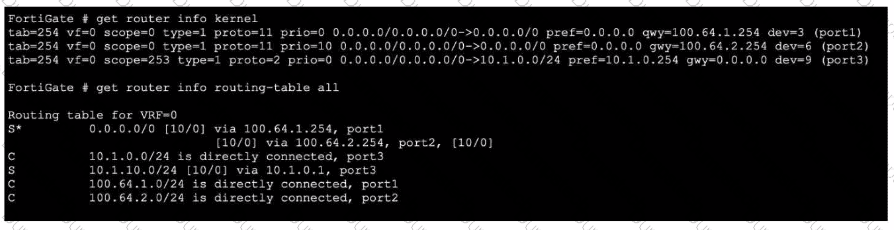
Refer to the exhibit, which shows partial outputs from two routing debug commands.
Question # 13

Which change must an administrator make on FortiGate to route web traffic from internal users to the internet, using ECMP?

Options:

A.

Set snat-route-change to enable.

B.

Set the priority of the static default route using port2 to 1.

C.

Set preserve-session-route to enable.

D.

Set the priority of the static default route using port1 to 10.

Questions # 14:

Refer to the exhibits.

Question # 14

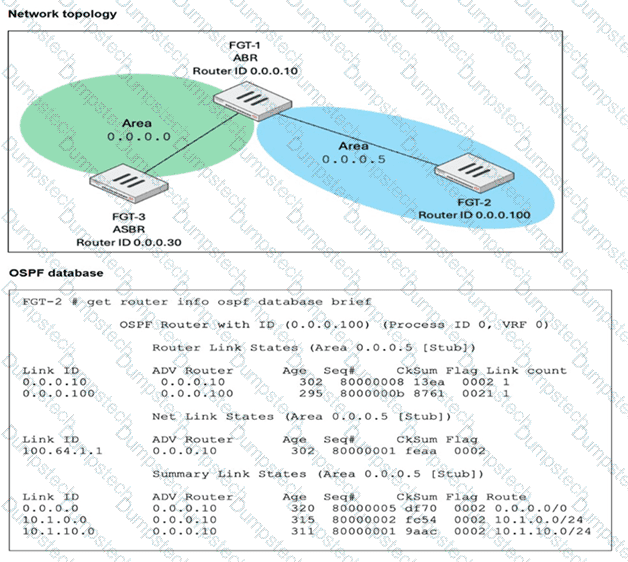
FGT-1 is an area border router (ABR) that has interfaces in OSPF areas 0.0.0.0 and 0.0.0.5. FGT-3 acts as an autonomous system border router (ASBR), importing static routes into OSPF. FGT-2 is an internal router with all its interfaces belonging to area 0.0.0.5. FGT-1 is receiving all advertised routes from FGT-2, however, FGT-3 is not receiving any of the advertised routes from FGT-1. What is the most likely reason for this? (Choose one answer)

Options:

A.

Area 0.0.0.5 is configured not to propagate type 5 LSAs.

B.

FGT-2 is configured with a distribution list to block all advertised routes from FGT-3.

C.

FGT-3 and FGT-2 have not formed an OSPF adjacency yet.

D.

IP protocol 89 is blocked between FGT-1 and FGT-3.

Questions # 15:

You configure the overlay tunnels for an SD-WAN hub-and-spoke topology defined with IPsec tunnels, BGP on loopback, and dynamic BGP.

Which two are recommended IPsec settings for this topology? (Choose two answers.)

Options:

A.

On the hub, set the tunnel type to static.

B.

On the hub, set the parameter mode-cfg to enable.

C.

On the spoke, set the parameter net-device to enable.

D.

On the spoke, configure the parameter localid.

Questions # 16:

Which statement about parallel path processing is correct (PPP)?

Options:

A.

PPP chooses from a group of parallel options lo identity the optimal path tor processing a packet.

B.

Only FortiGate hardware configurations affect the path that a packet takes.

C.

PPP does not apply to packets that are part of an already established session.

D.

Software configuration has no impact on PPP.

Questions # 17:

Which of the following regarding protocol states is true? (Choose one answer)

Options:

A.

proto_state=00 indicates that UDP traffic flows in both directions.

B.

proto_state=01 indicates an established TCP session.

C.

proto_state=10 indicates an established TCP session.

D.

proto_state=01 indicates one-way ICMP traffic.

Questions # 18:

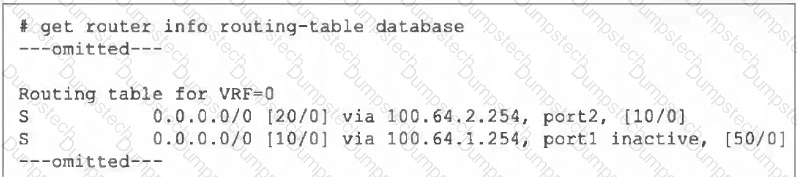
Refer to the exhibit, which shows a partial output from the get router info routing-table database command.
Question # 18

The administrator wants to configure a default static route for port3 and assign a distance of 50 and a priority of 0.

What will happen to the port1 and port2 default static routes after the port3 default static route is created?

Options:

A.

The port2 default static route will be injected into the forwarding information base (FIB).

B.

The port1 default static route will be injected into the FIB.

C.

Neither of the routes shown in the output will be injected into the FIB.

D.

Both default static routes shown in the output will be injected into the FIB.

Questions # 19:

Refer to the exhibits.

Question # 19

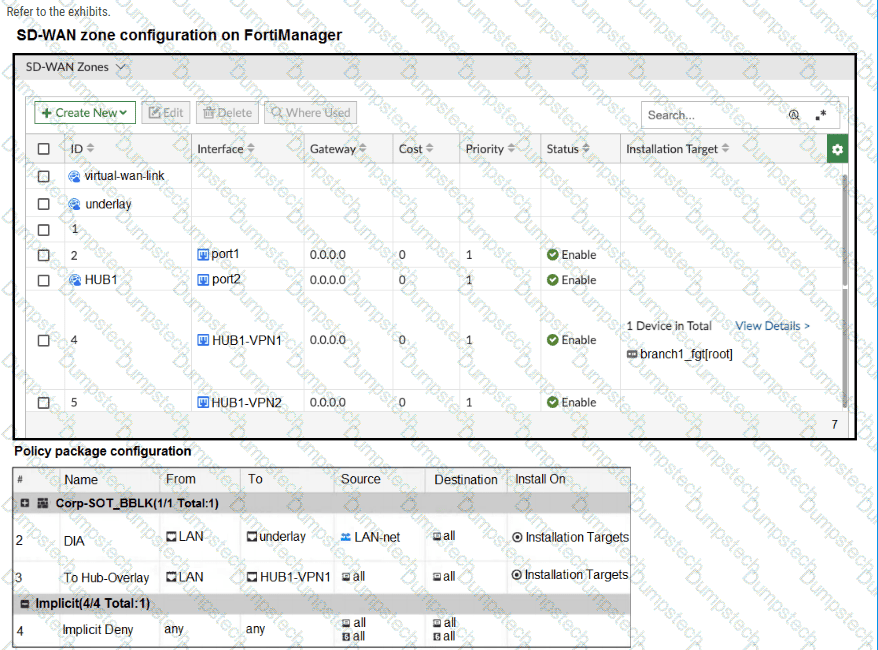
The exhibits show the SD-WAN zone configuration of an SD-WAN template prepared on FortiManager and the policy package configuration.

When the administrator tries to install the configuration changes, FortiManager fails to commit.

What should the administrator do to fix the issue?

Options:

A.

Configure branch1_fgt as the installation target for policy 3.

B.

Configure HUB1 as the destination of policy 3.

C.

Configure a normalized interface for the IPsec tunnel HUB1-VPN1.

D.

Configure both HUB1-VPN1 and HUB1-VPN2 as the destination of policy 3.

Questions # 20:

Refer to the exhibit.

Question # 20

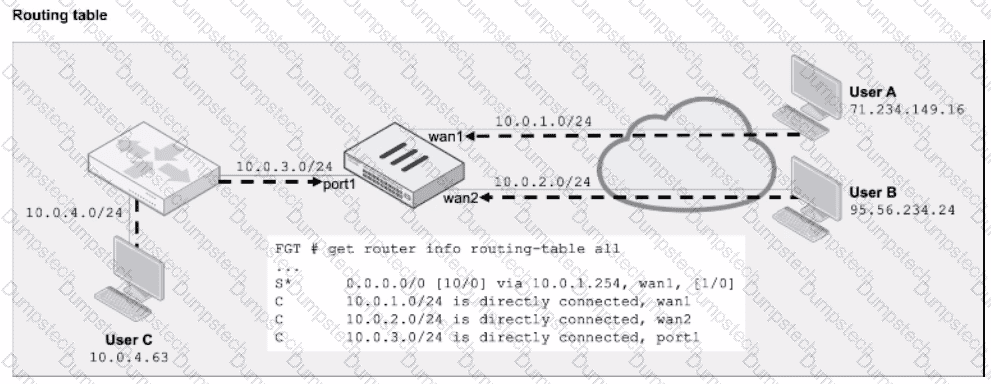
The routing table information is shown.

Assuming a default configuration, which three statements about the RPF check on FortiGate are

correct? (Choose three.)

Options:

A.

User C: Fail. There is no route to 10.0.4.63 using port1 in the routing table.

B.

User B: Pass. FortiGate will use asymmetric routing using want to reply to traffic for 95.56.234.24.

C.

User C: Pass. FortiGate will forward all incoming packets from User C using the default static route.

D.

User B: Fail. There is no route to 95.56.234.24 using wan2 in the routing table.

E.

User A: Pass. The default static route through want passes the RPF check regardless of the source IP address.

Viewing page 2 out of 5 pages
Viewing questions 11-20 out of questions