Summer Sale Limited Time 75% Discount Offer - Ends in 0d 00h 00m 00s - Coupon code = simple75

Pass the Fortinet NSE 7 Network Security Architect NSE7_FSN_AR-7.6 Questions and answers with Dumpstech

Exam NSE7_FSN_AR-7.6 Premium Access

View all detail and faqs for the NSE7_FSN_AR-7.6 exam

Practice at least 50% of the questions to maximize your chances of passing.
Viewing page 3 out of 5 pages
Viewing questions 21-30 out of questions
Questions # 21:

Question # 21

The output of a policy route table entry is shown.

Which type of policy route does the output show?

Options:

A.

A regular policy route, which is not associated with an active static route in the FIB

B.

An ISDB route

C.

An SD-WAN rule

D.

A regular policy route, which is associated with an active static route in the FIB

Questions # 22:

What can cause an IKEv2 tunnel to go down after it was initially brought up successfully?

Options:

A.

A mismatched proposal was detected during the IKE_AUTH exchange.

B.

A mismatched Diffie-Hellman group was detected during the IKE_SA_INIT exchange.

C.

A mismatched pre-shared key was detected during the IKE_AUTH exchange.

D.

Mismatched quick-mode selectors were detected during the CREATE_CHILD_SA exchange.

Questions # 23:

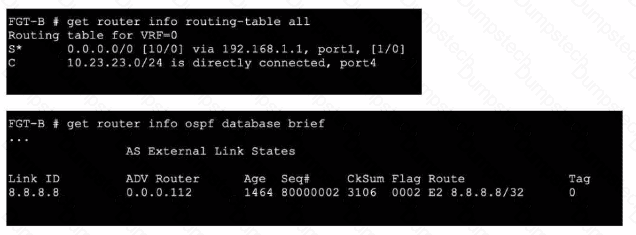
Refer to the exhibits.

Question # 23

An administrator Is expecting to receive advertised route 8.8.8.8/32 from FGT-A. On FGT-B, they confirm that the route is being advertised and received, however, the route is not being injected into the routing table. What is the most likely cause of this issue?

Options:

A.

A batter route to the 8.8.8.8/32 network exists in the routing table.

B.

FGT-B is configured with a prefix list denying the 8.8.8.8/32 network to be injected into the routing table.

C.

The administrator has misconfigured redistribution of routes on FGT-A.

D.

FGT-B is configured with a distribution list denying the 8.8.8.8/32 network to be injected into the routing table.

Questions # 24:

What are two reasons that an OSPF router does not have any type 5 tank-state advertisements (LSAs) In its link-stale database (LSD6)? (Choose two.)

Options:

A.

There is no autonomous system border router (ASBR) in the network,

B.

The peer of the local router is using a prefix-list-out. configuration to prevent all type 5 LSAs to be advertised.

C.

The local router is located in a stub area

D.

IP protocol 89 is blocked between the local router and its peer.

Questions # 25:

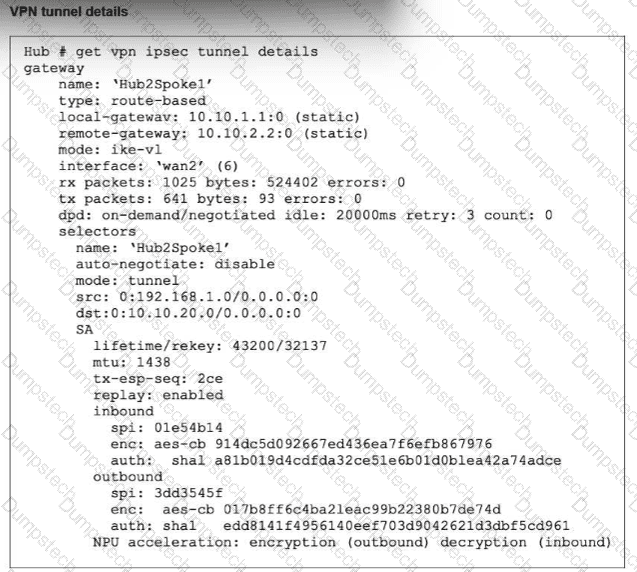
Refer to the exhibit.

Question # 25

Partial output of the get vpn ipsec tunnel details command is shown. Based on the output, which two statements are correct? (Choose two.)

Options:

A.

The npu_flag for this tunnel is 02.

B.

Different SPI values are a result of auto-negotiation being disabled for phase2 selectors.

C.

The npu_flag for this tunnel is 03.

D.

Anti-replay is enabled.

Questions # 26:

Which two statements about an auxiliary session ate true? (Choose two.)

Options:

A.

With the auxiliary session selling disabled, only auxiliary sessions are offloaded.

B.

With the auxiliary session setting enabled. ECMP traffic is accelerated to the NP6 processor.

C.

With the auxiliary session setting enabled. Iwo sessions are created in case of routing change.

D.

With the auxiliary session setting disabled, for each traffic path. FortiGate uses the same auxiliary session.

Questions # 27:

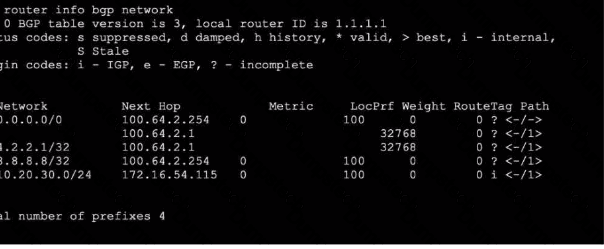
Refer to the exhibit, which shows the output o! the BGP database.
Question # 27

Which two statements are correct? (Choose two.)

Options:

A.

The advertised prefix of 10.20.30.0/24 was configured using the network command.

B.

The first four prefixes are being advertised using a legacy route advertisement.

C.

The advertised prefix of 10.20.30.0/24 is being advertised through the redistribution of another routing protocol.

D.

The output shows all prefixes advertised by all neighbors as well as the local router.

Questions # 28:

Refer to the exhibit.

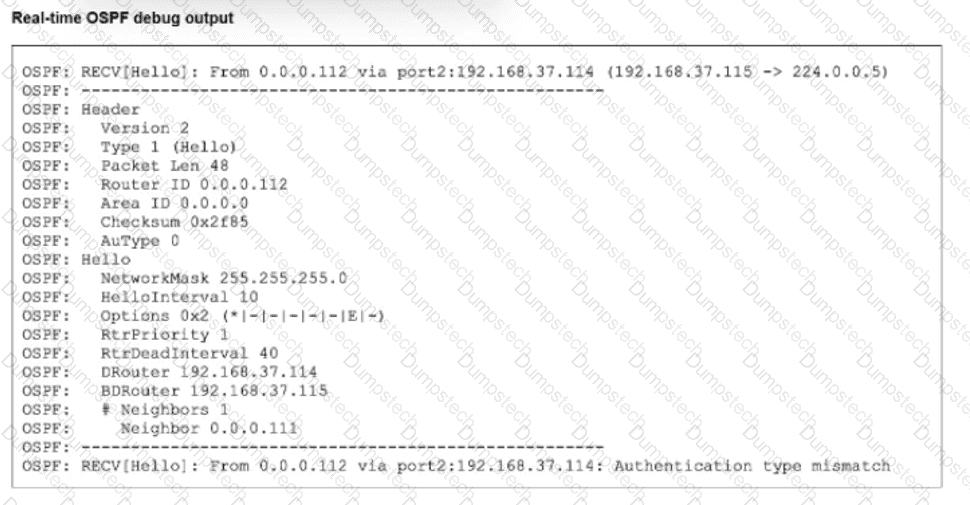
Partial output of a real-time OSPF debug is shown.
Question # 28

Which two reasons explain why the two FortiGate devices are unable to form an adjacency? (Choose two.)

Options:

A.

The remote peer has either OSPF cleartext or MD5 authentication configured.

B.

There is an OSPF authentication configuration mismatch.

C.

The local FortiGate does not have OSPF authentication configured

D.

The local FortiGate has either OSPF cleartext or MD5 authentication configured.

Questions # 29:

Question # 29

Which two observations can you make from the output? (Choose two.)

Options:

A.

The configuration was backed up

B.

A high availability (HA) failover occurred.

C.

The lest was unsuccessful.

D.

The automation stitch test is not being logged.

Questions # 30:

Refer to the exhibit.

Question # 30

An administrator has configured a firewall policy to use proxy-based inspection mode. What could explain the messages observed in the debug flow output?

Options:

A.

At least one protocol port under Protocol Options has been mapped to Any.

B.

SSL deep inspection is not configured.

C.

The FTP protocol has not yet been mapped to port 211 under Protocol Options.

D.

FortiGate does not have enough free memory to perform proxy-based inspections.

Viewing page 3 out of 5 pages
Viewing questions 21-30 out of questions