Spring Sale Limited Time 75% Discount Offer - Ends in 0d 00h 00m 00s - Coupon code = simple75

Pass the PMI Project-Management-Professional PMP Questions and answers with Dumpstech

Exam PMP Premium Access

View all detail and faqs for the PMP exam

Practice at least 50% of the questions to maximize your chances of passing.
Viewing page 3 out of 14 pages
Viewing questions 101-150 out of questions
Questions # 101:

A project manager determines that a critical path activity is going to be delayed. The team proposes a fallback plan that could get the project back on track; however, the plan would require an additional cost to an already tight budget.

What should the project manager do?

Options:

A.

Use the existing budget for executing the fallback plan and update the baseline.

B.

Add additional resources to the project to fast track certain activities and reduce delays.

C.

Evaluate the fallback plan proposed by the team and submit a change request, if required.

D.

Communicate the delay to stakeholders and maintain the existing budget baseline.

Questions # 102:

A project manager is assigned to a project that is in the execution phase that has different types of stakeholders. Some of the stakeholders are very interested in the project, whereas other do not show the same level of interest.

What should the project manager do to assure the project finishes correctly?

Options:

A.

Look at the stakeholder assessment matrix to find stakeholders' interests and make updates if necessary.

B.

Invite the most interested stakeholders to risk assessment sessions and assure the less interested stakeholders agree with the requirements.

C.

Review the user person definitions to find the interests of the stakeholders and make updates if necessary.

D.

Create a stakeholder assessment plan to manage stakeholder engagement and took at stakeholders' approvals.

Questions # 103:

A team needs to follow defined cybersecurity compliance that is mandatory for a customer project. What should the project manager do to monitor compliance in the

project?

Options:

A.

Confer with team members.

B.

Review with security experts.

C.

Schedule regular project audits.

D.

Discuss with the customer.

Questions # 104:

In an organization with good work-life balance, one team was continuously overloaded, thereby delivering the product ft quality. What should the project

manager do?

Options:

A.

Request the team to work more for on-time delivery.

B.

Request the team to focus on doing better planning.

C.

Request the replacement of certain team members.

D.

Request management for a high-performing team.

Questions # 105:

A project sponsor has approved the project charter and business case. The project manager has reviewed the artifacts to initiate the project and is unclear if the intended benefits of the project align with the strategic objectives of the business.

What should the project manager do first?

Options:

A.

Start executing the project since leadership is responsible for the business strategy.

B.

Meet with the project sponsor to better understand the strategic benefits of the project.

C.

Propose an updated business case and project charter that are more aligned with the business strategy.

D.

Conduct qualitative and quantitative risk analysis and record the results in the risk register.

Questions # 106:

A company is transitioning from a predictive approach to an agile approach. A project manager is assigned to the first pilot with an inexperienced team. Due to an unexpected event, the whole team is asked to work remotely. During the second sprint, the project manager starts to notice a lack of commitment from the team members.

What should the project manager do in this situation as a servant leader?

Options:

A.

Request an exception to allow the team to return to work on-site

B.

Allow the team to address the problem as a self-organized team

C.

Coach team members to increase their engagement and collaboration

D.

Force the team to attend the daily standups to gather the project status

Questions # 107:

A project team began working on a complex project that involves new technology as a product. The team is new to the technology and the proposed approach. Additionally, the customer is apprehensive about how the product will be received in the market.

What should the project manager do to help the team and the customer?

Options:

A.

Manage the risks associated with the proposed approach.

B.

Assist the team with identifying the minimum viable product (MVP) to validate assumptions.

C.

Coordinate with the business unit to get detailed requirements.

D.

Work closely with the marketing team on market research and product segments

Questions # 108:

A sales manager submitted a new feature request to the product owner, and the request was added to the product backlog. During the sprint planning meeting, the team struggles over which algorithm is the most efficient one to use. The team thinks that some development work is needed to decide.

What should the project manager do?

Options:

A.

Invite the sales manager to the next sprint meeting to clarify requirements.

B.

Create a new item in the sprint backlog to determine the appropriate algorithm.

C.

Ask the scrum master to choose an algorithm based on the pros and cons of each option.

D.

Request a meeting with the product owner to help clarify the user story.

Questions # 109:

During the daily standup meeting that is assessing progress against the current sprint, a team member reports some delays due to a component

managed by an external vendor. How should the project manager address the team member's concern?

Options:

A.

Ask the team member to resolve the issue independently to minimize further delays.

B.

Ask the team member to provide details to address the issue with the vendor.

C.

Implement fast tracking to reduce the impact of the delay on the sprint.

D.

Update the communications management plan to prevent future reoccurrence.

Questions # 110:

The project manager is reviewing a project's progress and notices that one of the risks has become an issue. What should the project manager do to address the situation?

Options:

A.

Schedule a high-priority meeting with the project stakeholders to discuss the issue.

B.

Initiate a change request to obtain additional funds from the management reserve.

C.

Meet with the project team and customer to brainstorm about potential solutions.

D.

Collaborate with the relevant stakeholders on implementing the risk response plan.

Questions # 111:

A project manager identifies a risk that has a high probability of occurring. How should the project manager manage this risk?

Options:

A.

Submit a change request to transfer the risk to a third party in case it becomes an issue.

B.

Remove the user stories associated to that risk and avoid the impact to the project deliverables.

C.

Assign a qualified team member to be the risk manager for the project.

D.

Ask the team to monitor the risk and provide an alert if it becomes an issue.

Questions # 112:

An agile team wants to maximize the work delivered for the upcoming project that involves considerable product complexity. What should the

project manager do to help improve the team's collaboration approach?

Options:

A.

Meet with the human resources (HR) department to ask for team support.

B.

Follow the process of the most successful team in the organization.

C.

Compare the team's velocity with other teams in the organization.

D.

Focus on the team's engagement during the next retrospective meeting.

Questions # 113:

A project manager is leading a fast-moving project with strict deadlines and minimal time to deliver each milestone. The project manager

discovers that one of the remote team members, who puts alot of effort into delivering the project, has confided in an on-site team member. The

remote team member feels they are not being adequately rewarded and recognized for their job.

What should the project manager do?

Options:

A.

Inform the human resource (HR) manager of this situation and ensure this news does not spread.

B.

Make arrangements with the resource's functional manager to relocate the team member to another existing project.

C.

Send a copy of the engagement contract to the remote team member and indicate that the team member is entitled to what is included in thecontract.

D.

Engage the remote team member, empathize with them, and let them know their contribution is appreciated regardless of their remote work status.

Questions # 114:

A project manager is assigned to a multiyear enterprise resource planning (ERP) solution project. During planning, the business sponsor emphasizes the importance of demonstrating value along the way, while maintaining the integrity of the final product.

How should the project manager establish the delivery model for this project?

Options:

A.

Organize the project into multiple subsets based on business functions and deliver each subset as a component of the final product.

B.

Reestablish the project as a program with multiple small projects, as each project will be delivered as a product of its own.

C.

Communicate the latest status to the steering committee and provide a demo of the features completed.

D.

Schedule routine demos on features completed and deliver a single product once all features are completed.

Questions # 115:

A human resources (HR) cost report was disclosed, by error, to all members of the project team. This situation generated a conflict between the team members about differences in their salaries.

What should the project manager have done to avoid this situation?

Options:

A.

Ensured reports with significant information were not included in the communications management plan

B.

Defined the appropriate recipients for the report in the communications management plan

C.

Included noncompliance punishment measures in the communications management plan

D.

Validated the information and the appropriate recipients per the communications management plan

Questions # 116:

During the development phase, a team member encounters an issue with a specific task and attempts to resolve it for the next several days. The other team members ask

the project manager to reassign the task to another team member to avoid jeopardizing the target date. The current team member assigned communicates they will feel frustrated if the task is reassigned to another team member.

How should the project manager address this situation?

Options:

A.

Seek help from experts to support the team member in fixing the problem.

B.

Facilitate a session to reach an agreement with the team as a whole.

C.

Negotiate with the customer a delay in the project delivery.

D.

Accept the team's request to reassign the team member.

Questions # 117:

A CEO of a general contracting company urgently asks the project manager to sign up two project team members to participate in a specific training course. Halfway

through the training, both team members complain that the training is too difficult, above their experience level, and that the material does not align with their tasks.

What should the project manager have done to prevent this situation?

Options:

A.

Communicated with the two team members that the purpose of the training is to provide material that might be useful to them in the future

B.

Sent an immediate request to the human resources (HR) department to replace the current team members with higher skilled candidates

C.

Observed and assessed the competencies and skills of the team members and analyzed the training material beforehand

D.

Planned a training to follow the specific course to bring the two team members to the required experience level

Questions # 118:

A project manager is leading a hybrid project. The work breakdown structure (WBS) and the schedule were developed, but the project manager is having difficulty assigning specific resources to all of the project tasks.

What should the project manager do?

Options:

A.

Escalate the issue to the project sponsor and seek their immediate intervention.

B.

Assign the unallocated tasks to the functional role and then reallocate when the resources are available.

C.

Assign the unallocated tasks to the project management office (PMO) manager and reallocate when the resources are available.

D.

Ignore the unallocated tasks for now and reallocate when the resources are available.

Questions # 119:

A project manager is newly assigned to the second phase of an ongoing project. During the implementation, a defect occurred and no one knows how to fix it, as the former engineering team has moved to another project. The customer warns that previously, this defect negatively affected the project schedule.

What should the project manager do first?

Options:

A.

Update the risk management plan.

B.

Extend the timeline of the project.

C.

Check the organizational process assets (OPAs).

D.

Acquire knowledgeable resources.

Questions # 120:

A project manager is managing a very important business transformation project. The goal of the project is to extend a desktop application with a mobile application module.

The marketing department believes that a main competitor is working on a similar product.

Which delivery approach should the project manager use for this project?

Options:

A.

Traditional delivery, to ensure high quality and that the product meets market demands

B.

Extreme Programming (XP) delivery, to mitigate the high risk related to a new product

C.

Iterative delivery, to ensure that user feedback is incorporated into the second iteration

D.

Incremental delivery, to ensure that mobile capability is released fast to the users

Questions # 121:

A project stakeholder has left the company. The new stakeholder is a family member of one of the team members. This stakeholder does not attend meetings. The project manager finds out that the stakeholder has been asking the family member for project updates.

What should the project manager do?

Options:

A.

Design an updated status report.

B.

Request a meeting with the stakeholder.

C.

Escalate this to the project sponsor.

D.

Forward the project status reports.

Questions # 122:

In a highly politicized organizational environment, the stakeholders are driven by their own operational or business goals, which results in

conflicting interests regarding the project. What should the project manager do to steer the stakeholders toward the collective project goal?

Options:

A.

Anticipate, alert, and follow the risk management process.

B.

Detect, track, and follow the issue management process.

C.

Promote, inspire, and follow the stakeholder engagement process.

D.

Discuss, educate, and follow the communications management process.

Questions # 123:

A project manager is assigned to work on a large global project. The resources for the project are dispersed among different organizations and countries. After the project kick-off meeting, the project manager learns that many virtual team members are unable to join the regular project update meetings. Their absence will impact the overall project schedule.

What immediate corrective action should the project manager take?

Options:

A.

Discuss the issue with the virtual team members and revise the communications management plan.

B.

Escalate this issue to the virtual team members' supervisors.

C.

Add this issue to the risk management plan and take action if it persists.

D.

Discuss the issue with the project sponsors and add this as an issue in the issue log.

Questions # 124:

A product owner has returned from a meeting with a few key stakeholders, who expressed interest in learning more about the project progress. The product owner is

seeking the project manager's recommendation on how to approach this request.

What should the project manager do to help the product owner?

Options:

A.

Provide an overview of the completed functionalities and release plan, and capture expectations for future stakeholder involvement.

B.

Invite the product owner to future demonstrations where they can provide feedback.

C.

Provide access to the latest user acceptance test (UAT) environment so they can see the solution.

D.

Remind the product owner of stakeholder accountability, and ask the product owner to determine the appropriate next steps.

Questions # 125:

A project manager is leading three projects in a program focused on starting product commercialization. Once the three projects fareket, the project manager stops attending the recurring team meetings. The program manager asks the project manager to continue attending these meetings to maintain those team touchpoints.

This request does not match the project manager's expectation, since a program manager is overseeing the remaining work

How should the project manager approach the situation?

Options:

A.

Attend only the program meetings where the market launch is being monitored

B.

Provide an answer via email recommending a division of tasks between both roles.

C.

Politely inform the program manager that attending these meetings is no longer required.

D.

Schedule a meeting to discuss the different perspectives and agree on a decision.

Questions # 126:

A project manager is managing a few innovation projects with a high level of uncertainty. The project manager is experiencing challenges with the large number of change

requests issued due to the nature of the project.

What should the project manager do?

Options:

A.

Add a fixed number of change requests allowed by the client on the project baseline.

B.

Request sponsor approval for all change requests to reduce the number of changes.

C.

Initiate the number of iterations to reduce the number of change requests.

D.

Reduce the number of approvers required to implement a change request.

Questions # 127:

A project manager has been assigned to an important project that will help set the future of the company. Meanwhile, the project management office (PMO) is implementing

adaptive tools in a mostly predictive environment and has requested that the project manager follow this process as well. However, the functional manager has expressed concerns about the use of new tools on such an important project.

What should the project manager do?

Options:

A.

Review the adaptive tools' impact and obtain agreement from the functional manager.

B.

Follow the functional manager's recommendation to implement only predictive tools in the project.

C.

Make the decision on which project approach to use that would best fit the project.

D.

Follow the project management office's (PMOs) request to implement the adaptive tools in the project.

Questions # 128:

The testing backlog for a hybrid project has increased significantly and is becoming a bottleneck. The team has researched a tool that could

resolve the bottleneck, and the project manager has been informed.

What should the project manager do next?

Options:

A.

Add developers to remove the backlog.

B.

Escalate the issue with the product owner.

C.

Reduce the testing scope of the backlog.

D.

Enroll team members in training on the tool.

Questions # 129:

An organization is struggling to start an important project. The project manager has identified that the scope definition is the main item preventing

the project from starting. Although most of the scope items are defined and agreed upon among the stakeholders, there are a few items that are hard to grasp and very complex to define at this stage.

What should the project manager do?

Options:

A.

Recommend splitting the project into two smaller projects in order to work exclusively in an agile environment without interference from a predictive approach.

B.

Propose that the well-defined scope items be delivered using a predictive approach and use an agile approach to deal with the complexitems.

C.

Maintain stakeholder momentum in working on the scope definition until a full detailed scope is achieved prior to starting the project.

D.

Update the risk register and escalate the issue to the project management office (PMO), requesting more resources be added to help definethe project scope.

Questions # 130:

An innovation project with a budget of over US$30 million is expected to have a large impact on the technology industry. The business area is concerned if the project will meet stakeholder expectations and raised this concern with the project manager.

What should the project manager do to manage business concerns and expectations before starting the project?

Options:

A.

Meet with the project finance team to measure market variations and product impact.

B.

Direct the project team to estimate user stories in greater detail.

C.

Ask the product owner to prioritize the backlog items based on the return on investment (ROI).

D.

Request that the project team develop a release plan and roadmap for the project.

Questions # 131:

In a project, one core team member tends to do all the work and ensures all tasks are completed. This core team member is soon leaving the project, which may make the project vulnerable.

What should the project manager do?

Options:

A.

Ensure the activities of this team member are distributed across the project team.

B.

Assess a mechanism for knowledge transfer among the team members.

C.

Motivate the team member to stay by providing them with incentives.

D.

Ask human resources (HR) to counsel the team member to balance the workload.

Questions # 132:

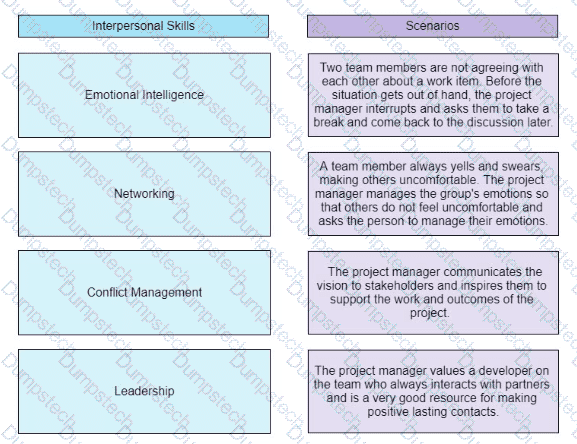
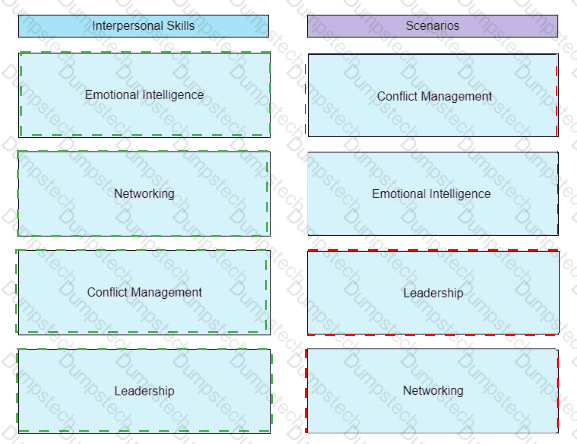
A company has created a cross-functional team to drive the digital transformation project for the business. The team is expected to deliver the minimum viable product (MVP) that addresses market need in the shortest possible time.

Match the roles for the team on the left to their corresponding responsibilities on the right.

Question # 132

Options:

Questions # 133:

A key team member has recently gone through some personal issues that has affected their performance. The project manager noticed that the

team member's emotional situation has affected the rest of the team's performance.

How should the project manager handle this situation?

Options:

A.

Help all team members learn to deal with their emotions by building a culture of empathy.

B.

Separate the key team member and replace them while they emotionally recover.

C.

Meet with the team to discuss how to handle the performance problem.

D.

Ask the human resources (HR) department for their support providing emotional help.

Questions # 134:

A project manager has been assigned as the servant leader for an ongoing project that historically has presented unexpected problems. The main stakeholder is hesitant to continue with the rest of the sprints even though there are no open issues or indications of risks at this stage.

What should the project manager do to address this problem?

Options:

A.

Increase the contingency reserves to cover unknown-unknowns.

B.

Implement short cycles for inspection and provide feedback.

C.

Increase the management reserves to convert the known-unknowns.

D.

Create a new risk entry to identify the stakeholder as a detractor.

Questions # 135:

A newly formed project team includes team members who have been working in the company for a long time as well as team members who are new to the company. The

project team members discovered that there is a gap in communication between these two groups, and they are finding it hard to collaborate with one another.

What should the project manager do?

Options:

A.

Ask the experienced members to lead the junior members to facilitate skill transfer.

B.

Encourage team members to focus on delivering results with their specialized skills.

C.

Organize networking sessions to allow the team members to get to know one another.

D.

Ask the team to self-organize and escalate any issues to the project manager.

Questions # 136:

An organization initiated a project in a complex program. The project lead notices that the team is demotivated because the current project framework implemented by the project management office (PMO) is not compatible with agile delivery

What should the project lead do?

Options:

A.

Escalate the problem to the product owner.

B.

Ask the PMO to review the framework

C.

Request the PMO to define a new framework.

D.

Plan a brainstorming session with the project team

Questions # 137:

A key customer stakeholder asks the project team to include new tasks in the backlog and begin analyzing new requests. The customer expects results as soon as possible and pressures the team to attend noncritical meetings. The team is frustrated by this situation.

How should the project manager approach this situation?

Options:

A.

Understand the customer's perspective and provide mentoring on agile mindsets.

B.

Call for an internal team retrospective and create an improvement action plan.

C.

Ask the customer to work with the product owner to prioritize all requests.

D.

Work with the team to receive customer directions and improve the process.

Questions # 138:

A project manager is working on a project with three virtual teams. Team A is in a different time zone than teams B and C. The project was going

well, but recently team A has started feeling left out. Information reaches team A late or is sometimes missed, and teams B and C give preference

to each other's problems over team A. The project manager has already set project guidelines, but realizes they need to be improved.

Which two things should the project manager do to help the teams collaborate better? (Choose two)

Options:

A.

Schedule weekly progress meetings with all three teams and have them take turns as key players.

B.

Plan for team members to temporarily work at each other's locations to better provide a sense of community.

C.

Update the communications management plan and encourage the teams to review it promptly and proactively.

D.

Create a status reporting template and share it with all team members before the day ends.

E.

Schedule daily meetings with each team to understand their progress and concerns in detail.

Questions # 139:

A project manager is working with a colocated agile project team that has worked together long enough to be in the performing phase of team development. An unforeseen event has caused the team to be dispersed and they are now unable to colocate.

What should the project manager do to keep the team performing as effectively as possible?

Options:

A.

Ask the project sponsor and executive stakeholders to encourage the team to maintain their performance,

B.

Transition the team from an agile approach to a predictive approach for better performance cantral.

C.

Provide the team with virtual collaboration software and training on the software to minimize disruption,

D.

Evaluate project performance and step in if performance decreases to. an unacceptable level,

Questions # 140:

An agile project team is working on an infrastructure product to be delivered incrementally over several iterations. Midway through the third iteration, the whole company is

informed that the operating systems supported by the infrastructure will be terminated in the upcoming quarter. Several thousand machines will be impacted by this change.

What should the project manager do first?

Options:

A.

Prioritize the upgrade of project machines with the IT department.

B.

Inform the product owner and request more project resources.

C.

Schedule a session with stakeholders to understand the impact.

D.

Add product backlog items to prioritize operating system stories.

Questions # 141:

A key stakeholder who is frustrated by the lack of transparency of IT projects declines an invitation to participate in the new project meetings.

What should the agile project manager do to engage the stakeholder in the project?

Options:

A.

Present the project management plan to the stakeholder and reassure them that they will receive regular project updates.

B.

Introduce the stakeholder to the project team and invite them to the next iteration review meeting with the IT team.

C.

Build trust with the stakeholder by keeping project commitments and use demo sessions to gather feedback and realign goals.

D.

Use stakeholder mapping to document the level of influence and interest for the next iteration planning meeting.

Questions # 142:

After a project status meeting, the project manager realizes that the project is under budget, quality checks are positive, and the schedule variance is negative. How should the project manager qualify the project status?

Options:

A.

On schedule

B.

Ahead of schedule

C.

Stopped

D.

Behind schedule

Questions # 143:

Just as a team reaches a mutual consensus on a preferred design, a stakeholder submits a request to add new features that enhance the

company’s competitive advantage. What should the project manager do?

Options:

A.

Reject all requested changes and bypass the company's change control process.

B.

Encourage the project team to add premium features to impress the client.

C.

Start the process to include the new features of the product on the next iteration.

D.

Allow all requested changes and bypass the company's change control process.

Questions # 144:

A scrum team's daily meetings are conducted by teleconference between three teams, each located in different countries. The meetings typically

last 45 minutes with many misunderstandings due to language barriers.

How should the project manager resolve this issue for the next iteration?

Options:

A.

Transfer half of the backlog items to the next iteration to allow more time to complete the meetings.

B.

Extend the meeting to 1 hour and request that all of the participants bring up all of the issues.

C.

Instruct the meeting participants to speak only about blockers during the meeting.

D.

Train the three team leads to conduct a local meeting, then run an overall status meeting.

Questions # 145:

A project manager is working with several junior engineers on a project. The project manager noticed that when the junior engineers are asked questions, they defer te more senior team members on the team for answers. Having worked with the junior engineers on another project, the project manager knows they are capable of making these minor decisions correctly.

This uncertainty from the junior engineers is now slowing progress.

‘What should the project manager do?

Options:

A.

Update the risk register to reflect the possible impact of the projects slower progress,

B.

Ensure the junior engineers make decisions within a certain responsibility level and commit to it,

C.

Remove the junior engineers from any decision-making activity until further trained.

D.

Pair senior engineers to shadow the junior engineers and correct them throughout.

Questions # 146:

A project manager is overseeing a project as part of a program geared toward a major technology disruption. The team is comprised of brilliant young professionals who have worked on different projects for the organization in the past. However, the team complained that they previously experienced a lack of direction during project execution and are a traid of the same issue in this project.

Which two actions should the project manager take to ensure that this issue does not occur in this project? (Choose two)

Options:

A.

Keep the team engaged and focused on the project's direction.

B.

Encourage the team to do a brainstorming session and provide a mitigation plan.

C.

Focus on the resource management plan and track project progress,

D.

Set a clear vision for the project and ensure it is visible to all stakeholders.

E.

Organize a team-bonding activity and invite an external manager to speak to the team.

Questions # 147:

A project manager has been assigned to a new digital product line, which the company hopes will boost their revenue. The product is complex and requires customer feedback to continually refine the product. The project is being handled by a cross-functional agile team.

What should the project manager do to ensure value is delivered quickly?

Options:

A.

Plan the project to deliver value incrementally with regular releases.

B.

Request a budget increase to pay the subject matter experts (SMEs) more overtime

C.

Identify tasks that can run in parallel to deliver the project faster.

D.

Ask the project sponsor to provide additional resources to fast track the project.

Questions # 148:

During the last two iterations of a project, one of the team members had low performance. The project manager conducted two feedback sessions with the team member and escalated the issue to the resource manager and project sponsor, but there has been no improvement.

What should the project manager do next?

Options:

A.

Escalate the situation again to the project sponsor.

B.

Review this obstacle during the daily standup meeting.

C.

Request a new resource to execute the activities.

D.

Provide feedback to the resource at the sprint review.

Questions # 149:

A project is about to start. The project manager has found that the client does not have an appropriate knowledge management system and does

not have a requirement for it.

What should the project manager do?

Options:

A.

Ask the team to collect the knowledge locally and share it at the end of the project.

B.

Utilize the cloud wiki to collect the necessary knowledge.

C.

Coordinate with the team and the project stakeholders to collect the knowledge.

D.

Provide just-in-time knowledge to the client, upon request.

Questions # 150:

A project manager in one country is reporting to a lead project manager for a new software development project in another country. The lead project manager constantly

requests updates from the project manager, often demanding information via multiple communication channels if the project manager does not respond within a few minutes

of a request. Both of them are equal in seniority and both report to the same functional manager.

How should the project manager proceed?

Options:

A.

Update the communications management plan and the stakeholder engagement plan.

B.

Escalate the issue to the functional manager and explain the situation to them.

C.

Negotiate a mutually agreeable feedback cycle with acceptable timelines.

D.

Refer the lead project manager to the communications management plan.

Viewing page 3 out of 14 pages
Viewing questions 101-150 out of questions