Spring Sale Limited Time 75% Discount Offer - Ends in 0d 00h 00m 00s - Coupon code = simple75

Pass the PMI Project-Management-Professional PMP Questions and answers with Dumpstech

Exam PMP Premium Access

View all detail and faqs for the PMP exam

Practice at least 50% of the questions to maximize your chances of passing.
Viewing page 4 out of 14 pages
Viewing questions 151-200 out of questions
Questions # 151:

A product owner has added new high-priority work to the backlog, A project manager is working with a dedicated agile team that does not specialize in this specific area of work. The team reviewed the work and wants to accept it but acknowledges it may not have the same level of efficiency as another team having specialization in this area.

What should the project manager do In this scenario?

Options:

A.

Add temporary members with the specialized skill set to the team to accomplish the work with a high level of confidence.

B.

Assess the impact of a possible delay to the project and encourage the team to take the work if the impact is tolerable.

C.

Accept the work and outsource it to another team that has the specialized skill set; then integrate the solution,

D.

Reject the work from this team's backlog and ask the product owner to add It to another team's backlog.

Questions # 152:

A project manager has been assigned to a new project that is similar to a project that was closed last year. There is no schedule baseline, but the project manager received the activity list and wants to prepare a reasonable schedule.

What should the project manager do?

Options:

A.

Adopt the same timeframe as the closed project for the current project.

B.

inform the sponsor that the activity list is not adequate for creating a schedule baseline.

C.

Create a draft schedule based on the activity list and the historical data from the closed project.

D.

Evaluate each activity duration and build a new project schedule.

Questions # 153:

A project manager is leading a cross-organizational project that is replacing a platform on which various solutions used by 15 business units were built. The project is part of a large program of work, and some of the resources are shared with other projects outside of the program initiated by the respective business units.

Which stakeholders should the project manager consult with first to manage interdependencies?

Options:

A.

Project sponsors

B.

Other project managers

C.

Business unit managers

D.

Program managers

Questions # 154:

A team is entering into a forming stage after kickoff, with project objectives identified and team members assigned with roles and responsibilities. However, during the team meetings, a team member does not agree on project documents and makes comments that could affect the performance of other team members.

What should the project manager do?

Options:

A.

Escalate the team member's disruptive behavior to their functional manager.

B.

Collaborate with the team to arrive at team ground rules and publish the rules to the team.

C.

Observe to ensure this typical forming stage behavior does not escalate beyond what is acceptable.

D.

Request team members document their decisions independently and share with each other.

Questions # 155:

A company changed the product owner on an existing project. The new product owner has less knowledge of the product than everybody else on the team. Due to the product owner's lack of knowledge, the team does not consider the opinions of the product owner seriously and mostly relies on the project manager's opinion.

What should the project manager do?

Options:

A.

Assume the role of the product owner while the product owner gets familiar with the product.

B.

Schedule time to share insights with the new product owner about the product and project information.

C.

Work with the project management office (PMO) manager to generate an onboarding plan for the new product owner.

D.

Organize a team-building activity and ask the team to respect the opinions of the new product owner.

Questions # 156:

A new marketing vice president just joined a software startup and is concerned that the agile model does not provide the needed accountability for their role. What should the responsible project manager do to ensure the vice president is comfortable with the project meeting its agreements?

Options:

A.

Require proper approval of all requirements from the marketing vice president and formally document the agreements.

B.

Foster an environment of open communication where all parties can discuss issues and agree on objectives.

C.

Establish an executive review board where all stakeholders discuss and approve features and requirements.

D.

Leverage the use of the review/demo sessions with the vice president to acknowledge that the agreements were met.

Questions # 157:

During a project status meeting with senior managers, the project manager gives an update about the status of a deliverable. Some of the senior managers claim not to Know about the deliverable.

What should the project manager do next?

Options:

A.

Validate if the project charter changed from the original one.

B.

Meet with these stakeholders to review the project charter.

C.

Check if these stakeholders attend regular project meetings.

D.

Review the project charter to validate this claim.

Questions # 158:

A project manager is managing a new development program to automate some technical functions. During project kickoff, the project manager

expresses the need for a technical architect to support the project for a moderate amount of time. The project sponsor informs the project

manager about an existing technical architect who possesses valuable knowledge but is already assigned at the portfolio level.

What engagement model should the project manager use for the technical architect role to ensure project success?

Options:

A.

Hire a new technical architect who would be solely dedicated to the current project.

B.

Share the existing technical architect so they can be allocated to the current project and other projects.

C.

Hire a new technical architect who would be shared between the current project and other projects.

D.

Assign the existing technical architect to solely be dedicated to the current project.

Questions # 159:

A project manager is assigned to a project with a long timeline and complex scope. The client requires a high-level, long-term plan as well as

something that will work immediately, adding features to the product as the project progresses.

How should the project manager plan and deliver this project?

Options:

A.

Plan the project with a predictive approach with a work breakdown structure (WBS) and then execute it using an agile approach to delivervalue incrementally.

B.

Plan the project with a predictive approach and a work breakdown structure (WBS) following the plan and deliver value at the end of theproject.

C.

Agree on a minimum viable product (MVP) first to be delivered immediately with the client and then release the rest of the scope at the endof the project.

D.

Select an agile approach and manage the project according to best practices to ensure value is delivered to the client.

Questions # 160:

At the end of a workshop to review project deliverables, a number of follow-up action items were generated. What should the project manager do next?

Options:

A.

Defer all actions until the next workshop to keep the team focused on other higher priorities

B.

Follow up on each item as soon as possible to ensure timely completion and report the status to management.

C.

Review the critical path and update the project schedule with the newly identified tasks.

D.

Prioritize the actions with the team, assign individuals who will be responsible for completion, and monitor progress.

Questions # 161:

A healthcare organization hired a new compliance specialist to ensure that the healthcare compliance needs are met. The feedback about the new compliance specialist

from the team was average.

What should the project manager do to help the new compliance specialist improve?

Options:

A.

Escalate this situation to the manager of the area for a possible solution.

B.

Provide time for the specialist to adjust to the pace of the project.

C.

Coordinate a one-to-one meeting with the specialist to assess the situation.

D.

Contact the human resources (HR) manager about the team's feedback.

Questions # 162:

A project manager is assigned to a project team midway through execution. Several dependencies are impacting the project, and the project manager feels the team is not adequately informed of the impacting changes.

What should the project manager do first?

Options:

A.

Convene an impact analysis meeting.

B.

Escalate the issue to the product owner.

C.

Consult the communications management plan.

D.

Review the stakeholder register.

Questions # 163:

A project manager just completed the planning phase when a new stakeholder was assigned to the project. The deliverables were discussed with the customer, but the new stakeholder is still concerned about the benefits of two of the deliverables.

What should the project manager do next to address this stakeholder’s concerns?

Options:

A.

Review the benefits realization plan with the stakeholder.

B.

Provide the stakeholder with regular updates on project progress.

C.

Add the stakeholder to the stakeholder engagement plan.

D.

Review the prior analysis results with the stakeholder.

Questions # 164:

During project planning, a development team is assigned an agreed-upon work package to determine the appropriate pattern for integrating a new service with a legacy system. The lead developer has requested a meeting with the project manager and Is looking for direction as to which technology to select.

How should the project manager help guide the lead developer?

Options:

A.

Advise the lead developer and team to consult with the project architect and for their development team leader.

B.

Reassign this work package to another area given the lead developer's concerns,

C.

Direct the lead developer to conduct a weighted evaluation of all products and solutions.

D.

Listen to the concerns and suggest that the lead developer and the team be empowered to recommend the best approach.

Questions # 165:

A project manager is working directly with a vice president who is also the project sponsor. The project is an organizational transformation for a company that primarily works on predictive projects. The project manager has been asked to use a hybrid approach to deliver before a defined date by using sprints.

What should the project manager do first?

Options:

A.

Formalize the product owner assignment.

B.

Review similar projects in the company.

C.

Set the project's purpose, mission, and vision.

D.

Carry out the product backlog creation.

Questions # 166:

A project manager implementing a hybrid project is dealing with multiple stakeholders in a rapidly changing business environment. How should the

project manager ensure that the needs of stakeholders are consistently met?

Options:

A.

Assign one team member to one stakeholder to ensure that the responsible team member is conversant with the needs of the stakeholder.

B.

Add more iterative techniques to improve stakeholder learning.

C.

Identify all the critical stakeholders during the project initiation.

D.

Use iterative life cycles involving stakeholders to enable the team to improve the product end result through successive prototypes.

Questions # 167:

The project manager of a high-risk project is concerned about a delay in the schedule that might force the project to ‘move its go-live date. What should the project manager do next?

Options:

A.

Ensure that the project meets the committed time lines as this is the core objective and purpose of the project.

B.

Raise a change request to the change control board (CCB) to ask for funds to onboard new resources to expedite the project.

C.

Capture the risk in the risk register and monitor it to prevent it from becoming an issue by taking the proper response action.

D.

Ask the sponsor to start a new project to support the existing project and help it meet the original time line.

Questions # 168:

An agile project team received an assignment to develop an industrial system that interfaces with robots. The project team does not have any previous experience

performing this type of work. Team members are interested in acquiring such expertise but it may result in a project delay.

How should this situation be handled?

Options:

A.

Use a robotics vendor company to develop the interfaces so the team will not be held back by a lack of expertise in this type of work,

B.

Add an experienced professional to the team to reinforce knowledge sharing and help grow team expertise in the new product

C.

Create a separate team with experienced members who understand the technology and split the product backlog according to team specialization.

D.

Hire a consulting company to address the robotic interface questions, when necessary, and to help avoid delays and quality issues.

Questions # 169:

A project manager collects various pieces of information and consolidates metrics in an agile project. The project manager finds that there is slack in the team in terms of productivity. The number of items sent to development per person has decreased by 10%, and the project manager used a root cause analysis (RCA) and discovered the reason is a lack of knowledge in one of the frameworks used for modeling.

What should the project manager do next?

Options:

A.

Foster knowledge sharing and coaching among team members.

B.

Arrange for external training amid the tight project schedules.

C.

Add new members for the underperforming team.

D.

Seek an external expert to review the framework.

Questions # 170:

A project manager is leading a project that has been in execution for 1 year. An experienced team member is performing well, but often disagrees with the project manager and refuses to implement their decisions. Part of the team supports the team member's defiance, while the other team members do not.

What should the project manager do?

Options:

A.

Conduct a performance review and define and document the goals for the team member.

B.

Clarify decisions and request that the project team follows the project manager's decisions.

C.

Understand what the team member wants and find possible opportunities to address it.

D.

Remove existing ground rules and create new ground rules that support the project manager.

Questions # 171:

In the planning phase of a software implementation project, two of the team members disagree on how to approach end-user training. The

discussion has intensified and the team members are not able to agree.

What should the project manager do next?

Options:

A.

Remove one of the team members from the project to improve team dynamics.

B.

Make a decision based on expert judgment as a project manager.

C.

Consider the view of each team member about the issue in order to reach consensus.

D.

Remove both team members since they are not productively adding to the team.

Questions # 172:

A company is running a project to eliminate a sales channel that has been unprofitable for the past 3 years. A key stakeholder from another area, who has legacy ties to that sales channel, objects to the project.

What should the project manager do in this situation?

Options:

A.

Assess the impact of the stakeholder and engage properly.

B.

Escalate the stakeholder issue to the project sponsor.

C.

Develop a specific communications strategy for this stakeholder.

D.

Use interpersonal skills to gain stakeholder engagement.

Questions # 173:

During the project planning phase, a project manager is informed that they cannot start one activity before another department implements the

required IT system. What should the project manager do?

Options:

A.

Fast track this dependency to avoid delaying the project.

B.

Perform Integrated Change Control.

C.

Include the dependency in the project schedule.

D.

Ask IT to prioritize the needed system to meet the schedule.

Questions # 174:

A flagship project is sponsored by the CEO and has a critical go-live date. The project's product requires a regulatory review and approval before it can go live. The CEO instructed to allow only 2 weeks for regulatory approval in the schedule; however, the director for the regulatory liaison indicated 6 weeks was a more realistic timeline.

What should the project manager do?

Options:

A.

Proceed with the direction given by the director for the regulatory liaison, as they are the subject matter expert (SME).

B.

Follow the CEO's directive, as they are the highest authority in the company and are the ultimate decision maker.

C.

Meet with the CEO and the director to discuss and register it as a major risk if agreement cannot be made.

D.

Schedule final testing activities in parallel with the regulatory approval activities to compensate for lost time.

Questions # 175:

An agile team is in the early phases of the development cycle for a project; however, they have already begun to deliver functionality to the customer. The team has identified risks to the project and are working on developing the mitigation strategy.

What should the project manager do next?

Options:

A.

Incorporate and prioritize the risks in the risk register according to impact.

B.

Escalate the risk to the project sponsor and steering committee.

C.

Implement the risk mitigation strategy according to the highest impact.

D.

Determine if any of the new risks have any financial impact.

Questions # 176:

A company is implementing a growth strategy by constructing a new production facility, which will soon move into the operation phase. Although a governance policy was already in place, the company must comply with new financial regulations that have been recently implemented. Compliance with the regulations will cause a major change

in project scope.

How should the project manager respond to this requirement?

Options:

A.

Proceed with the existing company governance policy.

B.

Perform an analysis to assess the impact on the project.

C.

Directly comply with the financial regulations.

D.

Escalate the issue to upper management and let them decide.

Questions # 177:

A project manager is managing a project in the execution phase, which was agreed upon with the sponsor. However, the sponsor is constantly micromanaging and requesting iterations that are affecting the team's effectiveness. The sponsor indicates that as long as the project scope is not affected, these iterations are needed to simplify the project.

How should the project manager handle the situation?

Options:

A.

Review validation and control procedures.

B.

Discuss reducing interruptions with the sponsor.

C.

Perform stakeholder requirements activities.

D.

Approach the sponsor about using an agile approach.

Questions # 178:

A project manager is working with the same project team as in the last two construction projects. The project manager managed this team on a micro level for the last two

projects. However, now the project manager would like to use a different leadership style to allow the team to make their own decisions.

What kind of leadership style should the project manager utilize for the current project?

Options:

A.

Transformational

B.

Interactional

C.

Laissez-faire

D.

Charismatic

Questions # 179:

A project has completed design activities ahead of schedule. Suddenly, the project manager is informed by a vendor that a deliverable may not meet the agreed delivery time frame due to a resource shortage. The internal team asked if they should continue to deliver as per the schedule.

What should the project manager do?

Options:

A.

Discuss with the team the need for longer hours to minimize the impact.

B.

Inform the project team that they may proceed at a more relaxed pace.

C.

Inform the project team that some of them will work for the vendor.

D.

Discuss with the project team alternative options to deliver as planned.

Questions # 180:

An internal virtual team is meeting daily to review iteration progress, as well as to conduct other technical and followup calls with key stakeholders. The team seems to be disengaged.

How should the project manager approach this situation?

Options:

A.

Give the team members a few days off to reduce stress.

B.

Reduce the number of internal and external meetings.

C.

Review team assignments and reduce the workload.

D.

Schedule one-to-one meetings and team-building meetings.

Questions # 181:

A project team strongly encourages the project manager to purchase an application that will significantly reduce work time. Without the application, the deadline might be missed. However, the purchase will impact the project cost. The sponsor would like to explore a less expensive application that will save the team's time.

What should the project manager do?

Options:

A.

Raise a change request.

B.

Purchase the application.

C.

Create a decision tree.

D.

Analyze assumptions and constraints.

Questions # 182:

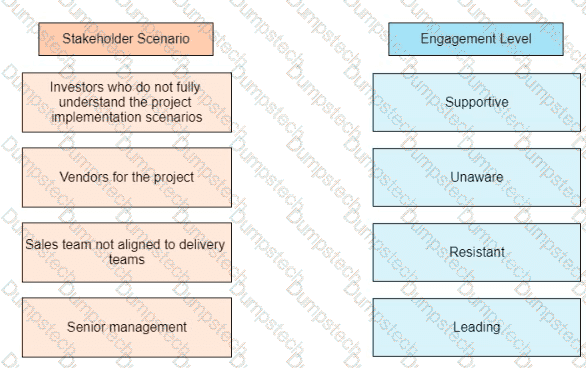
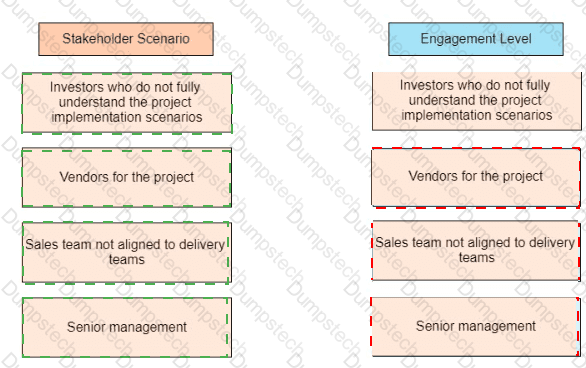
Drag the communication event on the left to the main subject discussed during the event on the right.

Question # 182

Options:

Questions # 183:

A team is focusing on quickly developing and shipping new product features due to very aggressive market demands. The team is setting aside long-term work not directly related to the current business objective, which affects product performance and generates more customer support requests.

How can the team minimize the impact of the reduced focus on quality?

Options:

A.

Adapt the management plan to reduce the quality constraints.

B.

Reduce complexity to focus on the minimum viable product (MVP).

C.

Consider implementing test-driven methodology.

D.

Work on the technical debt at a later stage in the project.

Questions # 184:

During sprint planning, the product owner wants to prioritize items with high business value. However, the project team is concerned about technical debt and infrastructure dependencies to deliver the expected value.

How should the project manager handle this issue?

Options:

A.

Support the project sponsor so the decision is made top-down and the team follows the provided direction.

B.

Support a voting exercise so all team members can express their opinion and the reason behind their vote.

C.

Support the product owner so only items with high business value are included in the next sprint.

D.

Support the project team so technical debt and infrastructure dependencies are included in the next sprint.

Questions # 185:

A project manager is working on a financial system implementation project for a government company. One of the key stakeholders, who uses

predictive approaches, does not like virtual tools such as chats, task trackers, and so forth. They prefer email, telephone calls, and face-to-face

meetings.

How should the project manager approach this situation?

Options:

A.

Use regular screen-sharing sessions to show the progress to the stakeholder.

B.

Align and agree with the stakeholder on the communication approach.

C.

Ask the manager to use virtual communication tools and online dashboards.

D.

Create a digital dashboard to meet the manager's information needs.

Questions # 186:

A company has appointed a supplier to deliver software and has assigned an internal project manager. The supplier states that no technical development or testing is required from the customer. The project manager would like to confirm this with all of the stakeholders.

What should the internal project manager do first?

Options:

A.

Distribute the project plan to all of the interested parties.

B.

Host an alignment session with stakeholders to formalize the project requirements.

C.

Communicate to the supplier that customer testing is required.

D.

Develop a user acceptance testing plan to ensure the quality of the deliverables.

Questions # 187:

A project manager is leading a project that has a dependency on the client's vendor management system for critical requirements. The vendor

management team will not derive any benefits from the project. However, the project requires support from the vendor management head.

What should the project manager do next?

Options:

A.

Get support from the sponsor to hire a subject matter expert (SME) from the vendor management team to work on the project.

B.

Review the terms of reference of the steering committee to include the vendor management head.

C.

Work with the sponsor on a communications management plan to obtain support from the vendor management head.

D.

Obtain help from the sponsor to highlight any nonfinancial benefits for the vendor management team.

Questions # 188:

A project manager is acting as a servant leader and is struggling to make deadlines on a critical roadway construction project that is falling behind schedule due to a lowperforming team. In order to get the project back on track, what should the project manager do first?

Options:

A.

Empower the team members to conduct their job activities and hold each person accountable to improve the schedule.

B.

Notify the project sponsor that the team is underperforming and request additional resources to compress the schedule,

C.

Contact each team member to inform them that further schedule slips will not be tolerated by the project sponsor.

D.

Begin holding daily meetings to assign each team member discrete tasks with specific due dates.

Questions # 189:

A project is ending its fifth out of six iterations. During the iteration review, a customer adds a new regulatory feature that exceeds the capacity of the remaining iteration.

What should the project lead do?

Options:

A.

Register an issue and escalate it to the project sponsor.

B.

Invite the stakeholders to discuss a new prioritization.

C.

Estimate the management to replace the customer service manager.

D.

Increase the team capacity to finish the project on time.

Questions # 190:

A project to build a new energy plant was just completed. However, a few days before operation of the plant, the local community protested and closed access to the plant. They argue that an important natural reserve was impacted and prior consultation was not done by the project team.

What should the project manager verify first?

Options:

A.

Stakeholder engagement plan

B.

Risk management plan

C.

Business case

D.

Cost-benefit analysis

Questions # 191:

A project manager is assigned to deliver a development project with subcontracted resources from a sister company. What should the project manager do to ensure a smooth inclusion of the new subcontracted resources?

Options:

A.

Organize a team-bonding exercise with the subcontractors.

B.

Facilitate a working session to review the ground rules.

C.

Share the project team ground rules with the subcontractors.

D.

Schedule a formal meeting to cover the mission and vision.

Questions # 192:

Midway through the execution of an agile project, there is a shift in the strategic objectives at the organization level to promote digital transformation. What should the project manager do next?

Options:

A.

Prepare a user story to handle the change and assign it to the next iteration.

B.

Escalate to the product owner and cancel the upcoming iterations.

C.

Update the risk-prioritized backlog with the strategic change.

D.

Schedule a meeting with the team to assess the impact of the change.

Questions # 193:

During iteration planning, team A identifies that an important deliverable is dependent upon a deliverable from team B. What should the project manager do?

Options:

A.

Inform team B of the dependency and ensure that the deliverable is planned.

B.

Make team Aa part of team B and ensure that the deliverable is ready.

C.

Request team B to immediately start this activity and deliver to team A.

D.

Ask team B to focus on their backlog and deliver based on their priority,

Questions # 194:

A hybrid project has just deployed, and the project manager is planning project closure with lessons learned workshops. A key stakeholder informs the project manager that having the Scrum team in the workshops is a waste of time because the project was delivered successfully.

What should the project manager do?

Options:

A.

Ask the Scrum team members to share retrospectives.

B.

Ask the scrum master to attend the workshops.

C.

Invite the Scrum team members as optional participants.

D.

Invite the Scrum team members as mandatory participants.

Questions # 195:

A company plans to initiate a project involving a new technology. Approval for the project is required. What should the project manager do?

Options:

A.

Review the cost and schedule baselines for execution.

B.

Define change management for the new technology.

C.

Analyze the cost and identify the project benefits.

D.

Identify the risks in implementing the new technology.

Questions # 196:

A project manager is working on multiple building construction projects using a predictive project management approach. Senior leadership within

the organization is promoting the inclusion of more agile practices into the current project methodologies. The project sponsor now wants the

projects to use more agile methodologies.

Before mandating any agile methods to be used in a project, what should the project manager do first?

Options:

A.

Provide agile training to those who will be part of the project team.

B.

Shift all existing projects to agile methodologies with a strict timeline.

C.

Pause the current projects to align them to the new agile cadence.

D.

Assess the organizational culture and readiness for the transformation.

Questions # 197:

A project manager has just received communication from an operational functional manager to complete an additional scope item for a project that was formally closed a few weeks ago. The scope looks relatively small and simple to handle as part of the daily operations activity.

How should the project manager deal with this request?

Options:

A.

Submit a change request and allocate the budget and resources needed for execution.

B.

Confirm that the budget and resources are available to execute the work request.

C.

Check the alternative resources available in the organization for the request.

D.

Evaluate the nature of the request and plan communication accordingly.

Questions # 198:

During the early phase of a project, the requirements documentation was not approved. It was identified that the leader of a user party was not included in any of the requirements collection communications.

Which of the documents was likely missed or outdated?

Options:

A.

Business Documentation

B.

Stakeholder Register

C.

Risk Register

D.

Project Charter

Questions # 199:

A project is implementing an agile strategy, and a minimum viable product (MVP) was agreed upon. After the first iteration review, the customer explained that the first deliverable is not of great value.

What should the project manager have done differently?

Options:

A.

Invited the customer to the daily meetings

B.

Helped the team redefine the MVP

C.

Changed the duration of iterations to deliver more value

D.

Validated the iteration goals with the customer

Questions # 200:

A project team created user stories after understanding the customer requirements. As the project progresses, the project manager observes that

there are too many change requests. The team feels that the outcomes they are working on are not aligned with the customer requirements.

What should the project manager do?

Options:

A.

Refer to the configuration management knowledge base for similar projects delivered in the past.

B.

Arrange for a workshop with the customer to understand the business values expected from the outcomes.

C.

Include a representative from the customer to work collaboratively with the team.

D.

Acknowledge that the current team needs improvement and hire more qualified team members.

Viewing page 4 out of 14 pages
Viewing questions 151-200 out of questions