
Pre-Winter Sale Limited Time 75% Discount Offer - Ends in 0d 00h 00m 00s - Coupon code = simple75
Pass the Cisco CCNP Enterprise 300-420 Questions and answers with Dumpstech
A company wants to enable several third-party video conferencing networks based on multicast services. The video conferencing platform can accommodate numerous and dispersed senders and receivers in third-party networks The interior routing protocol is OSPF and the exterior routing protocol is BGP Which multicast mode must be selected to achieve this goal?
At which layer does Cisco Express Forwarding use adjacency tables to populate addressing information?
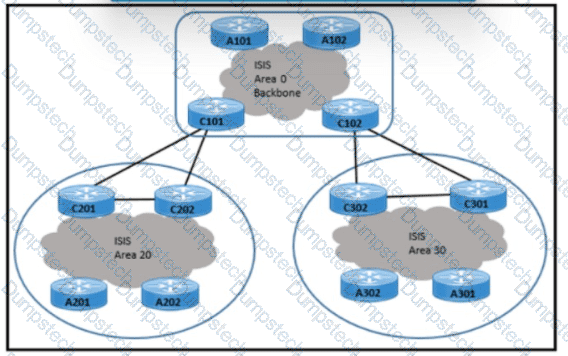
Refer to the exhibit. An architect is designing a hierarchical ISIS solution for a customer with these requirements:
Routers will double In all areas within the next 24 months.
Link flaps within areas 20 and 30 must not impact the backbone area.
Traffic originating from A201 and A302 routers must connect to application servers in the backbone.
Which design must the architect select?
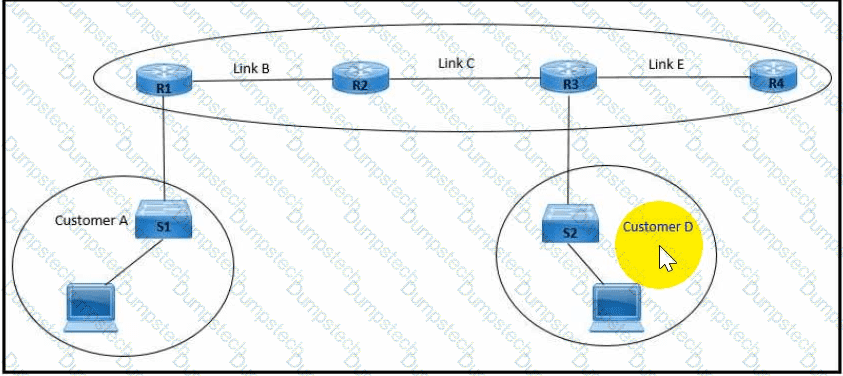
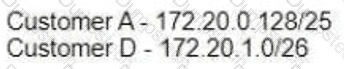
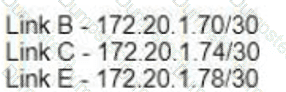
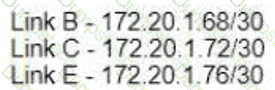
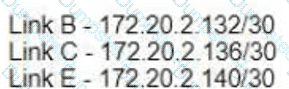
Refer to the exhibit An architect is designing an IPv4 plan using the 172 20 0.0/16 network The design must maximize the number of subnets and minimize the number of wasted IP addresses In addition, the plan must allocate a subnet to these customers and links
Customer A, which supports 125 hosts
Customer D, which supports 62 hosts
Links B C. and E
Which two configuration sets meet these requirements ' ? (Choose two)
A)
B)
C)

D)
E)
An engineer is designing a Layer 3 campus network running EIGRP between the core, aggregation, and access layers. The access layer switches will be connected to the aggregation layer using Layer 3 copper connections. The engineer wants to improve convergence time for access layer switch failures. Which technique must the design include?
An architect must develop a campus network solution that includes:
logically segmented and isolated networks
ability to communicate between network segments when required
support for overlapping IP addresses
widely available technologies to avoid purchasing specialized equipment
Which solution must the architect select?
An engineer must configure EIGRP to ensure that all WAN routes are not advertised to the routers in a data center. Which action must be taken?
An architect is working on a design to connect a company ' s main site to several small to medium-sized remote branches. The solution must include redundant WAN links, but the customer has a limited budget and wants the ability to increase the link speed easily in the future. QoS will not on the branch routers so there is no need for consistent end-to-end QoS. Which solution does the architect propose?
Which two overlay network design considerations must be made for a Cisco SD-Access network? (Choose two.)
What is the purpose of the fabric management plane in a Cisco SD-Access architecture?
