
Spring Sale Limited Time 75% Discount Offer - Ends in 0d 00h 00m 00s - Coupon code = simple75

Pass the Cisco CCNP Enterprise 300-420 Questions and answers with Dumpstech

Exam 300-420 Premium Access

View all detail and faqs for the 300-420 exam

Practice at least 50% of the questions to maximize your chances of passing.
Viewing page 8 out of 12 pages
Viewing questions 71-80 out of questions
Questions # 71:

Which type of rendezvous point deployment is standards-based and support dynamic RP discovery?

Options:

A.

Auto-RP

B.

Anycast-RP

C.

bootstrap router

D.

static RP

Questions # 72:

An engineer is designing a multicast network for a financial application Most of the multicast sources also receive multicast traffic (many-to-many deployment model). To better routing tables, the design must not use source trees. Which multicast protocol satisfies these requirements?
Options:

A.

BIRDIR-PIM

B.

PIM-SM

C.

MSDP

D.

PIM-SSM

Questions # 73:

Question # 73

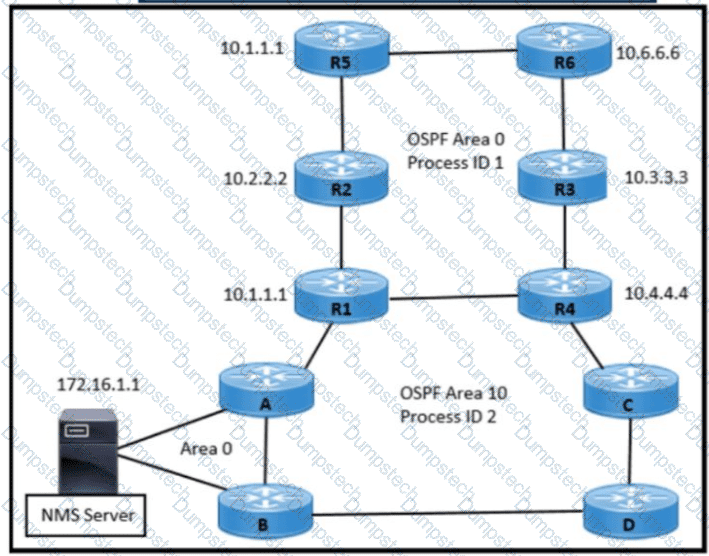
Refer to the exhibit An engineer is designing an OSPF solution with these requirements:

    NMS server will manage R5 and R6.

    Upon failure of R1. all NMS traffic should be routed through R4.

    Upon failure of the link between R5 and R6. all traffic destined for 10.6.6.6 should be routed through R4

Which solution must the engineer choose?

Options:

A.

Advertise 172.16.1.1 into OSPF process 1 with high cost on R1.

B.

Apply static routes on R2 and R3 with IP SLA tracking toward R5 and R6.

C.

Enable the default-Information originate command with a higher metric on R2 to R1.

D.

Redistribute OSPF process 1 into process 2 on R1 and R4.

Questions # 74:

A company requested that an architect propose a new IPv4 and IPv6 deployment strategy. The company wants a solution that is straightforward, with no information hiding or forwarding overhead. Which solution meets these requirements?

Options:

A.

LISP

B.

NAT64

C.

dual-stack

D.

GRE tunnels

Questions # 75:

Which design element should an engineer consider when multicast is included in a Cisco SD-Access architecture?

Options:

A.

PIM SSM must run in the underlay.

B.

Multicast clients reside in the underlay, and the multicast source is outside the fabric or

in the overlay.

C.

Rendezvous points must be used in a PIM SSM deployment.

D.

Multicast traffic is transported in the overlay and the EID space for wired and wireless clients.

Questions # 76:

What is a benefit of using VRRPv3 as compared to VRRPv2?

Options:

A.

VRRPv3 supports IPv4 and IPv6

B.

VRRPv3 supports authentication

C.

VRRPv3 supports preemption

D.

VRRPv3 supports stateful switchover

Questions # 77:

A company is expanding its headquarters to support the relocation of several departments. The network has been running RIP, but as the company has grown, the engineering team has determined that it needs to support a more robust routing protocol. The team is working to design a routing solution that:

    supports network segregation, with summarization between segments

    ensures fast convergence

    provides scalability

Which design must the network team deploy?

Options:

A.

Deploy EIGRP with stub areas.

B.

Deploy OSPF with multiple areas.

C.

Deploy OSPF with a virtual link that connects at least two segments.

D.

Deploy EIGRP with modified K values.

Questions # 78:

Which encoding languages are supported in NETCONF compared to RESTCONF?

Options:

A.

NETCONF supports XML and JSON, and RESTCONF supports XML.

B.

NETCONF supports XML, and RESTCONF supports JSON.

C.

NETCONF supports JSON, and RESTCONF supports XML.

D.

NETCONF supports XML, and RESTCONF supports XML and JSON.

Questions # 79:

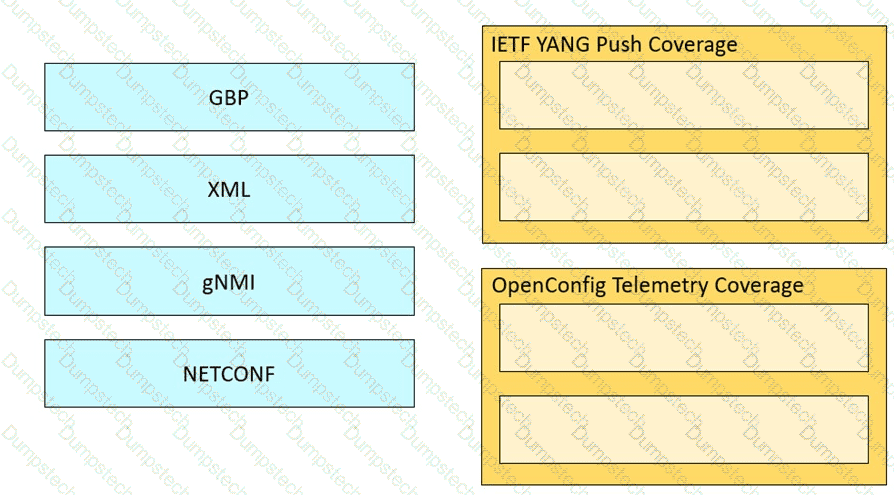
Drag and drop the elements from the left onto the YANG models where they and used on the right.
Question # 79

Options:

Questions # 80:

An engineer is upgrading a company’s main site to include a connection to a second ISP. The company will receive full Internet routing tables from both ISPs via BGP. The engineer must ensure that the company does not become a transit autonomous system. Which solution should be included in this design?

Options:

A.

Tag incoming routes from both ISPs with BGP community no-export.

B.

Lower the MED for updates sent to the secondary ISP.

C.

Use a route-map to prevent all prefixes from being advertised to either ISP.

D.

Modify the local-preference for routes incoming from the primary ISP.

Viewing page 8 out of 12 pages
Viewing questions 71-80 out of questions