75only - Ends in 0d 00h 00m 00s - Coupon code = 75only

Pass the Fortinet Network Security Expert NSE5_FSW_AD-7.6 Questions and answers with Dumpstech

Exam NSE5_FSW_AD-7.6 Premium Access

View all detail and faqs for the NSE5_FSW_AD-7.6 exam

Practice at least 50% of the questions to maximize your chances of passing.
Viewing page 2 out of 4 pages
Viewing questions 11-20 out of questions
Questions # 11:

Which three are valid actions that a FortiSwitch access control list (ACL) can apply to matching traffic? (Choose three answers)

Options:

A.

Assign the VLAN ID

B.

Quarantine devices

C.

Traffic processing

D.

Set outer VLAN tags

E.

QoS

Questions # 12:

(Full question statement start from here)

You are planning to deploy FortiSwitch devices on your network. Your goal is to simplify management and ensure integration with the Security Fabric. Which deployment approach should you choose? (Choose one answer)

Options:

A.

Use the FortiSwitch-Manager device for centralized management.

B.

Manage FortiSwitch from FortiManager for large-scale enterprise deployments.

C.

Use FortiEdge Cloud for centralized management with advanced analytics.

D.

Manage FortiSwitch on FortiGate using FortiLink.

Questions # 13:

Which interfaces on FortiSwitch send out FortiLink discovery frames by default in order to detect a FortiGate with an enabled FortiLink interface?

Options:

A.

All ports have auto-discovery enabled by default.

B.

No ports are enabled by default for auto-discovery. This must be configured under config switch interface.

C.

The ports with auto-discovery enabled by default are dependent upon the FortiSwitch model.

D.

The last four switch ports on FortiSwitch have auto-discovery enabled by default.

Questions # 14:

You are managing FortiSwitch ports from a FortiGate device with multiple VDOMs. Which two methods can you use to assign FortiSwitch ports to VDOMs? (Choose two answers)
Options:

A.

Assigning the port directly to a specific VDOM for dedicated physical isolation

B.

Use FortiGate policies to control inter-VDOM traffic for FortiSwitch ports

C.

Use interface role mapping to dynamically assign FortiSwitch ports to VDOMs based on Dynamic Host Configuration Protocol (DHCP) scope

D.

Using a virtual port pool (VPP) to create virtualized ports that can be assigned to different VDOMs

Questions # 15:

Which QoS mechanism maps packets with specific CoS or DSCP markings to an egress queue?

Options:

A.

Queuing for egress traffic

B.

Classification for ingress traffic

C.

Rate limiting for egress traffic

D.

Marking for ingress traffic

Questions # 16:

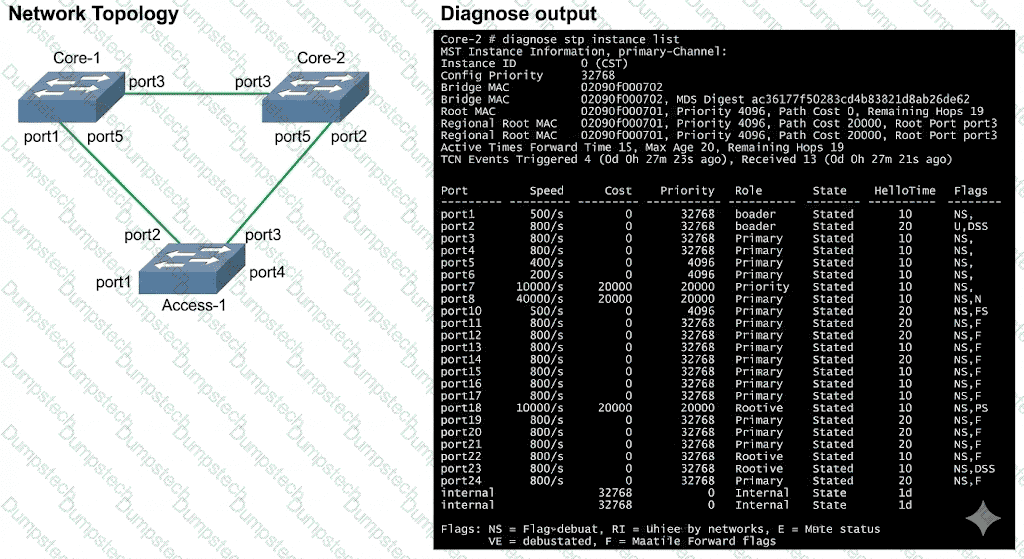
Refer to the exhibits.

Question # 16

Three FortiSwitch devices in standalone mode are interconnected. The CLI command diagnose stp instance list is executed on Core-2. Based on the output shown in the exhibit, what can you conclude about Core-2? (Choose one answer)

Options:

A.

Core-2 has received Bridge Protocol Data Unit (BPDU) from the root bridge.

B.

Core-2 is the designated bridge for all VLANs.

C.

Core-2 is blocking all ports in the Spanning Tree Protocol (STP) topology.

D.

Core-2 provides an alternate path to the root bridge.

Questions # 17:

Your team is deploying a single FortiGate and a single FortiSwitch across 100 branch offices. The goal is to expedite deployment while avoiding manual configuration errors. Which method would allow you to achieve this goal most efficiently? (Choose one answer)

Options:

A.

Push FortiGate and FortiSwitch configurations through FortiEdge Cloud.

B.

Use the cloud Model-as-a-Service (MaaS) to push the configuration of both FortiGate and FortiSwitch.

C.

Use zero-touch provisioning (ZTP) through FortiManager.

D.

Ensure that devices engage FortiSwitch Manager to retrieve their configurations.

Questions # 18:

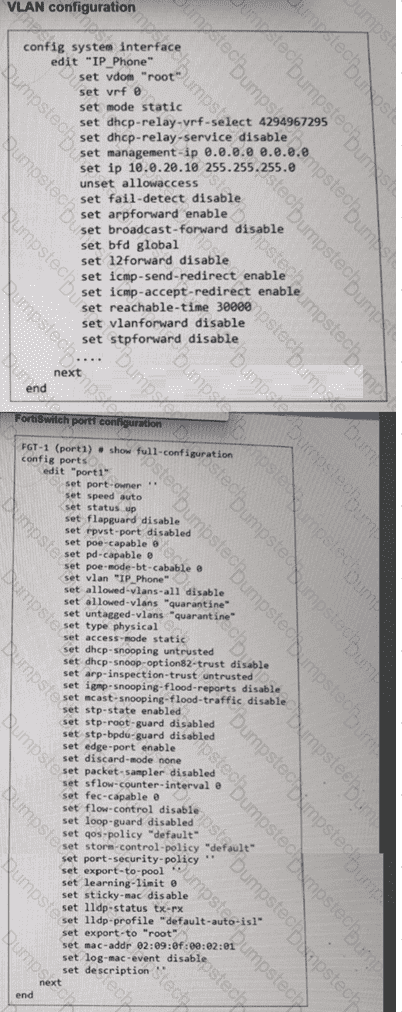
Exhibit.

Question # 18

What conditions does a FortiSwitch need to have to successfully configure the options shown in the exhibit above? (Choose two.)

Options:

A.

The FortiSwitch model is equipped with a maximum of 54 interfaces.

B.

The CLI commands are enabling a splitpo rt into four 10Gbps interfaces.

C.

The port full speed prior the split was 100G SFP+

D.

The split port can be assigned to native VLAN

Questions # 19:

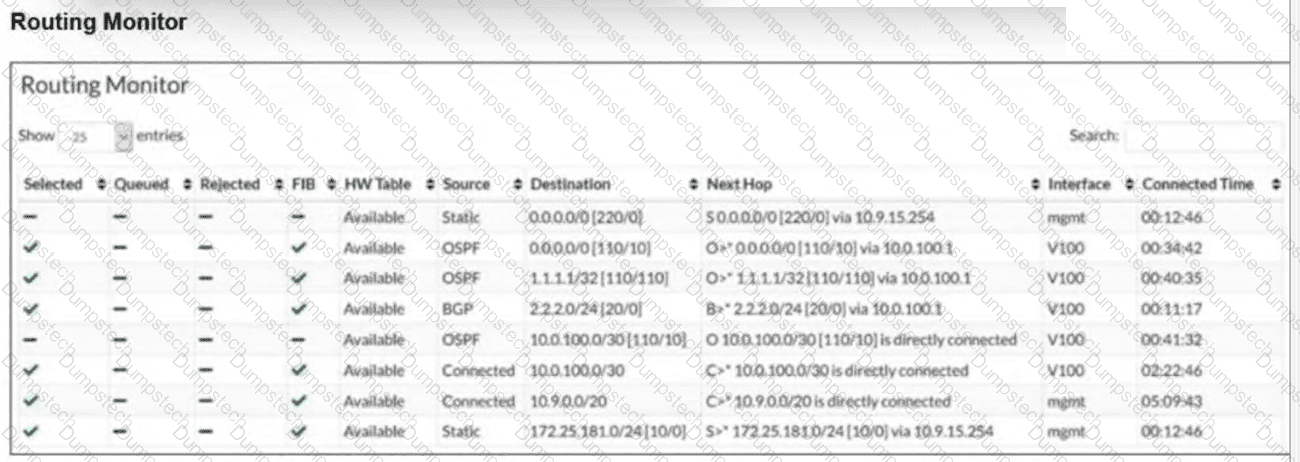
Refer to the exhibit.

Question # 19

and an OSPF route with destination 0.0.0.0/0 [110/10]. The OSPF route is marked with a checkmark in the FIB column, while the Static route has a dash.]

The routing monitor displays multiple route entries, but only some are installed in the forwarding information base (FIB). After analyzing the two route entries with the destination 0.0.0.0/0, which statement correctly describe why one of these routes is not installed in the FIB? (Choose one answer)

Options:

A.

The OSPF route has a higher metric, making it less preferred than the static route.

B.

The interface V100 for the OSPF route is down, preventing its installation.

C.

The OSPF route with a lower administrative distance is preferred over the static route.

D.

The two routes have identical destination prefixes, causing a conflict where only one is selected.

Questions # 20:

On supported FortiSwitch models, which access control list (ACL) stage is recommended for applying actions before the switch performs any layer 2 or layer 3 processing? (Choose one answer)

Options:

A.

Ingress

B.

Forwarding

C.

Egress

D.

Prelookup

Viewing page 2 out of 4 pages
Viewing questions 11-20 out of questions