75only - Ends in 0d 00h 00m 00s - Coupon code = 75only

Pass the Cisco CCNP Security 350-701 Questions and answers with Dumpstech

Exam 350-701 Premium Access

View all detail and faqs for the 350-701 exam

Practice at least 50% of the questions to maximize your chances of passing.
Viewing page 1 out of 16 pages
Viewing questions 1-15 out of questions
Questions # 1:

Which type of DNS abuse exchanges data between two computers even when there is no direct connection?

Options:

A.

Malware installation

B.

Command-and-control communication

C.

Network footprinting

D.

Data exfiltration

Questions # 2:

Which technology provides the benefit of Layer 3 through Layer 7 innovative deep packet inspection,

enabling the platform to identify and output various applications within the network traffic flows?

Options:

A.

Cisco NBAR2

B.

Cisco ASAV

C.

Account on Resolution

D.

Cisco Prime Infrastructure

Questions # 3:

A healthcare organization is deploying Cisco Secure Access to prevent protected health information from being shared with generative AI services. The security team requires real-time DLP inspection only for traffic destined for AI applications, with minimal false positives during general web browsing. The policy must permit tuning based on the proximity and match counts of PHI identifiers. Which configuration action must the engineer perform?

Options:

A.

Configure a real-time DLP rule referencing a built-in PHI data classification with default thresholds, scoped to a web profile that includes all Internet traffic.

B.

Implement an API-based DLP rule referencing a custom PHI data classification with tuned proximity and match-count thresholds, scoped to the generative AI application category.

C.

Deploy a real-time DLP rule referencing a built-in PHI data classification with tuned match-count thresholds, scoped to a web profile filtered by destination lists for known AI vendors.

D.

Apply a real-time DLP rule referencing a custom PHI data classification with tuned proximity and match-count thresholds, scoped to a web profile filtered by the generative AI application category.

Questions # 4:

Which category includes DoS Attacks?

Options:

A.

Virus attacks

B.

Trojan attacks

C.

Flood attacks

D.

Phishing attacks

Questions # 5:

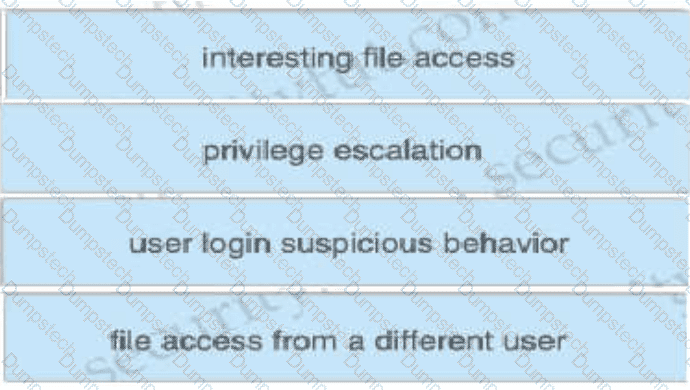
Drag and drop the suspicious patterns for the Cisco Tetration platform from the left onto the correct definitions on the right.
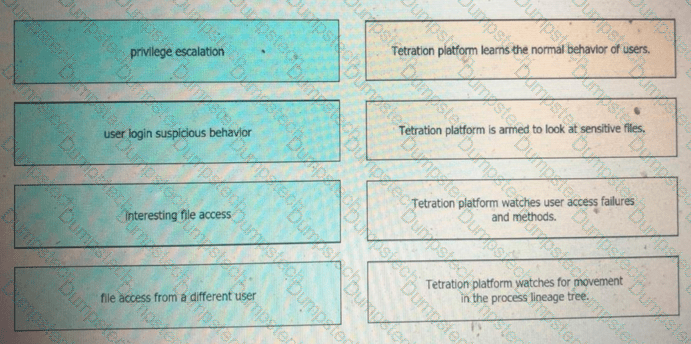
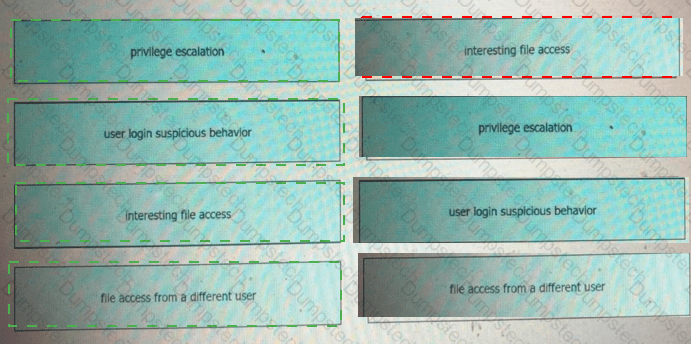
Question # 5

Options:

Questions # 6:

An engineer needs to configure a Cisco Secure Email Gateway (SEG) to prompt users to enter multiple forms of identification before gaining access to the SEG. The SEG must also join a cluster using the preshared key of cisc421555367. What steps must be taken to support this?

Options:

A.

Enable two-factor authentication through a RADIUS server, and then join the cluster via the SEG GUI.

B.

Enable two-factor authentication through a TACACS+ server, and then join the cluster via the SEG CLI.

C.

Enable two-factor authentication through a RADIUS server, and then join the cluster via the SEG CLI

D.

Enable two-factor authentication through a TACACS+ server, and then join the cluster via the SEG GUI.

Questions # 7:

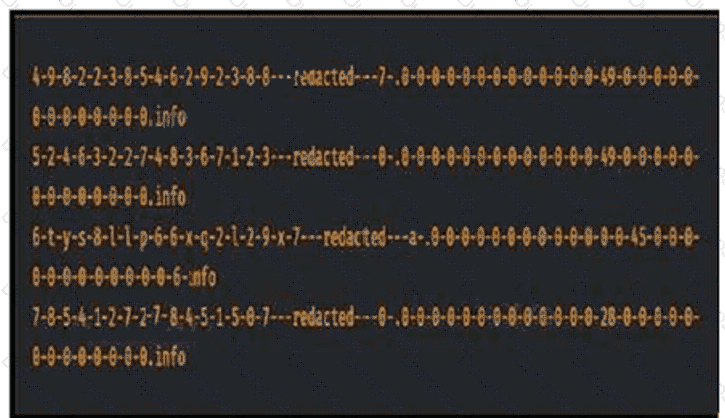
Refer to the exhibit.

Question # 7

Consider that any feature of DNS requests, such as the length off the domain name

and the number of subdomains, can be used to construct models of expected behavior to which

observed values can be compared. Which type of malicious attack are these values associated with?

Options:

A.

Spectre Worm

B.

Eternal Blue Windows

C.

Heartbleed SSL Bug

D.

W32/AutoRun worm

Questions # 8:

Drag and drop the NetFlow export formats from the left onto the descriptions on the right.
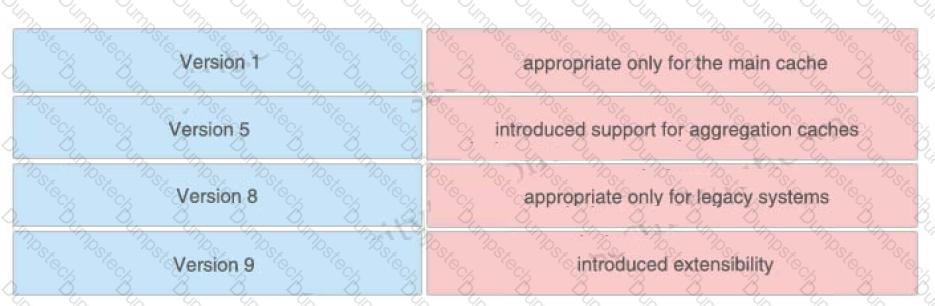
Question # 8

Options:

Questions # 9:

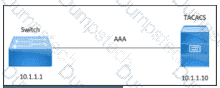
Refer to the exhibit.

Question # 9

An engineer must configure a Cisco switch to perform PPP authentication via a TACACS server located at IP address 10.1.1.10. Authentication must fall back to the local database using the username LocalUser and password C1Sc0451069341l if the TACACS server is unreachable.

Drag and drop the commands from the left onto the corresponding configuration steps on the right.
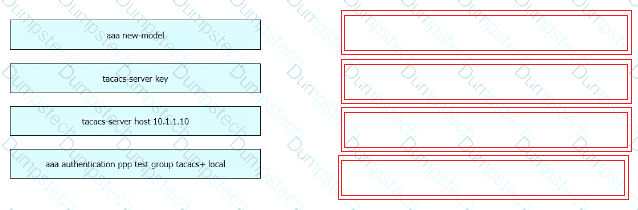
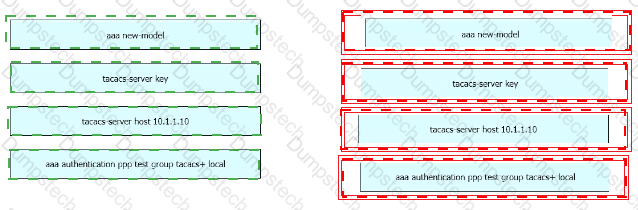
Question # 9

Options:

Questions # 10:

Which threat intelligence standard contains malware hashes?

Options:

A.

structured threat information expression

B.

advanced persistent threat

C.

trusted automated exchange or indicator information

D.

open command and control

Questions # 11:

Which CoA response code is sent if an authorization state is changed successfully on a Cisco IOS device?

Options:

A.

CoA-NCL

B.

CoA-NAK

C.

СоА-МАВ

D.

CoA-ACK

Questions # 12:

What is a functional difference between Cisco Secure Endpoint and Cisco Umbrella Roaming Client?

Options:

A.

Secure Endpoint authenticates users and provides segmentation, and the Umbrella Roaming Client allows only for VPN connectivity.

B.

Secure Endpoint stops and tracks malicious activity on hosts, and the Umbrella Roaming Client tracks only URL-based threats.

C.

The Umbrella Roaming Client authenticates users and provides segmentation, and Secure Endpoint allows only for VPN connectivity.

D.

The Umbrella Roaming client stops and tracks malicious activity on hosts, and Secure Endpoint tracks only URL-based threats.

Questions # 13:

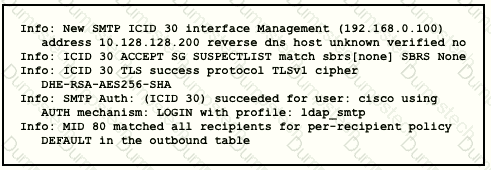
Refer to the exhibit.

Question # 13

Which type of authentication is in use?

Options:

A.

LDAP authentication for Microsoft Outlook

B.

POP3 authentication

C.

SMTP relay server authentication

D.

external user and relay mail authentication

Questions # 14:

What is the most common type of data exfiltration that organizations currently experience?

Options:

A.

HTTPS file upload site

B.

Microsoft Windows network shares

C.

SQL database injections

D.

encrypted SMTP

Questions # 15:

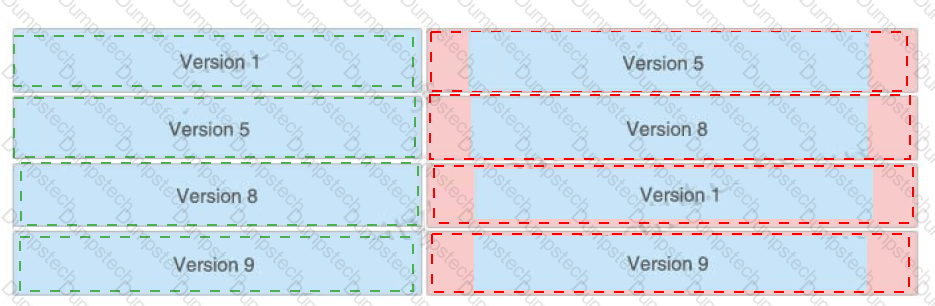
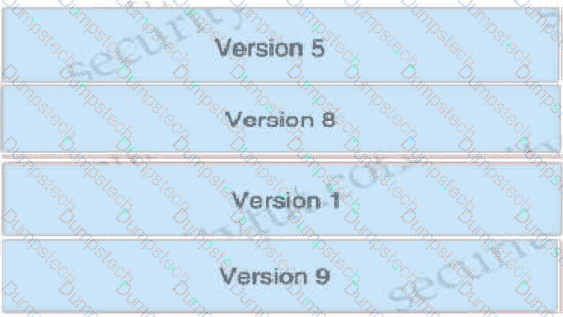
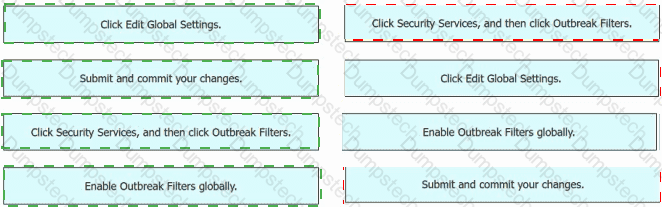
An engineer must enable Outbreak Filters globally on an AsyncOS for Cisco Secure Email Gateway to protect the network from large-scale malware attacks. Drag and drop the steps from the left into the sequence on the right to complete the configuration.
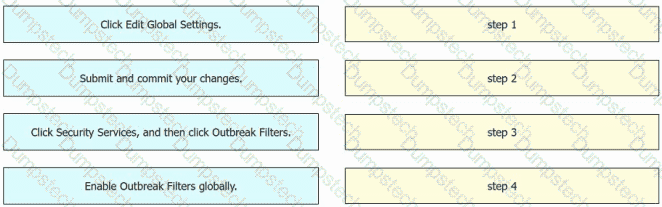
Question # 15

Options:

Viewing page 1 out of 16 pages
Viewing questions 1-15 out of questions