Winter Sale Limited Time 75% Discount Offer - Ends in 0d 00h 00m 00s - Coupon code = simple75

Pass the Fortinet NSE 7 Network Security Architect NSE7_FSN_AR-7.6 Questions and answers with Dumpstech

Exam NSE7_FSN_AR-7.6 Premium Access

View all detail and faqs for the NSE7_FSN_AR-7.6 exam

Practice at least 50% of the questions to maximize your chances of passing.
Viewing page 6 out of 6 pages
Viewing questions 51-60 out of questions
Questions # 51:

Which two statements about application-layer test commands are true? (Choose two answers)

Options:

A.

Some of them display statistics and configuration information about a feature or process.

B.

Some of them display real-time application debugs.

C.

Some of them display output only after you run the diagnose debug console enable command.

D.

Some of them can be used to restart an application.

Questions # 52:

Refer to the exhibit.

Question # 52

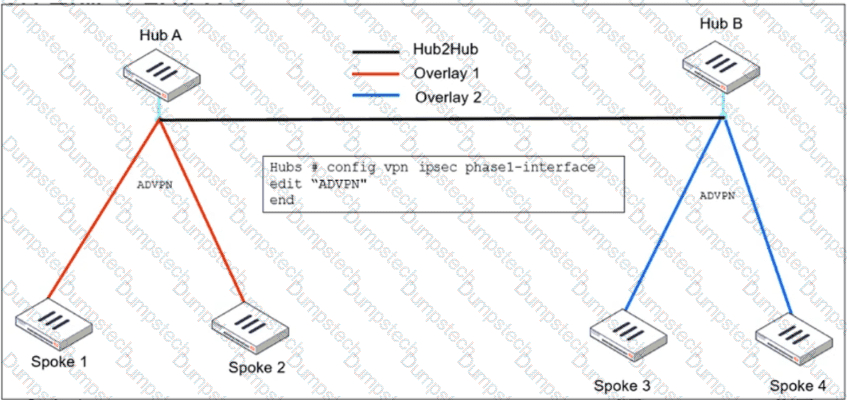
The ADVPN IPsec interface represents the VPN IPsec phase 1 from Hub A to Spoke 1 and Spoke 2, and from Hub B to Spoke 3 and Spoke 4.

You must configure an ADVPN using iBGP and eBGP to connect Overlay 1 with Overlay 2.

Which parameters must you configure in the phase 1 IPsec VPN configuration of the ADVPN tunnels?

Options:

A.

set auto-discovery-receiver enable and set remote-ip x

B.

set auto-discovery-sender enable and set network-id x

C.

set auto-discovery-crossover enable and set enforce-multihop enable

D.

set auto-discovery-forwarder enable and set remote-as x

Questions # 53:

In which two slates is a given session categorized as ephemeral? (Choose two.)

Options:

A.

A UDP session with only one packet received

B.

A UOP session with packets sent and received

C.

A TCP session waiting for the SYN ACK

D.

A TCP session waiting for FIN ACK

Questions # 54:

Refer to the exhibit.

Question # 54

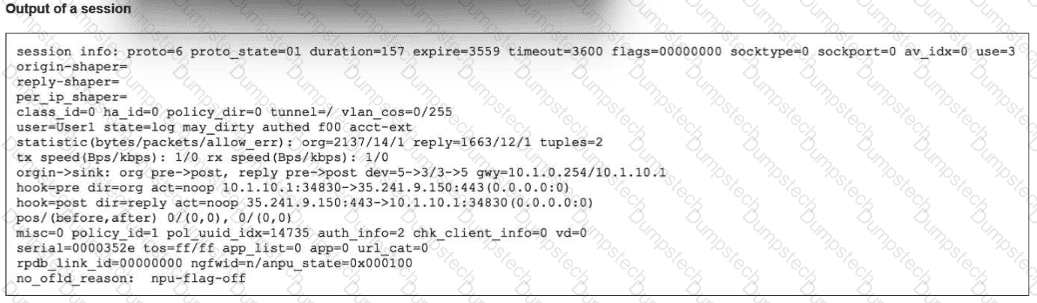
The exhibit shows the output of a session. Which two statements are correct? (Choose two.)

Options:

A.

The session did not match a firewall policy.

B.

The gateway to the destination is 10.1.10.1.

C.

The session was initiated from an authenticated user.

D.

The TCP session has been successfully established.

Questions # 55:

You have a FortiGate configuration with three user-defined SD-WAN zones and two members in each of these zones. One SD-WAN member is no longer in use in health-check and SD-WAN rules. You want to delete it.

What happens if you delete the SD-WAN member from the FortiGate GUI?

Options:

A.

FortiGate accepts the deletion and places the member in the default SD-WAN zone.

B.

FortiGate displays an error message. SD-WAN zones must contain at least two members.

C.

FortiGate accepts the SD-WAN member deletion with no further action.

D.

FortiGate accepts the deletion and removes static routes as required.

Questions # 56:

Refer to the exhibit, which shows the port1 interface configuration on FortiGate and partial session information for ICMP traffic.

Question # 56

What happens to the session information if a routing change occurs that affects this session?

Options:

A.

Only the interface and gateway information for dev=7 will be removed.

B.

The session information will not change unless the current route has been removed from the routing table.

C.

The session will be flagged as dirty but no route lookups will be performed.

D.

Sessions involving port7 or port19 will not have their routing information flushed.

Questions # 57:

Refer to the exhibit.

Question # 57

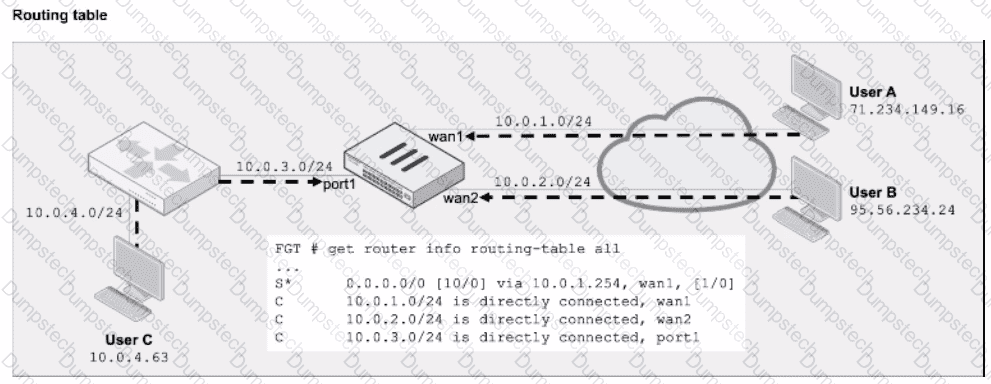
The routing table information is shown.

Assuming a default configuration, which three statements about the RPF check on FortiGate are

correct? (Choose three.)

Options:

A.

User C: Fail. There is no route to 10.0.4.63 using port1 in the routing table.

B.

User B: Pass. FortiGate will use asymmetric routing using want to reply to traffic for 95.56.234.24.

C.

User C: Pass. FortiGate will forward all incoming packets from User C using the default static route.

D.

User B: Fail. There is no route to 95.56.234.24 using wan2 in the routing table.

E.

User A: Pass. The default static route through want passes the RPF check regardless of the source IP address.

Questions # 58:

Exhibit.

Question # 58

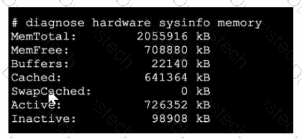
Refer to the exhibit, which shows a partial output of diagnose hardware aysinfo memory.

Which two statements about the output are true? (Choose two.)

Options:

A.

There are 98908 kB of memory that will never be used.

B.

The user space has 708880 kB of physical memory that is not used by the system.

C.

The I/O cache, which has 641364 kB of memory allocated to it.

D.

The value indicated next to the inactive heading represents the currently unused cache page.

Questions # 59:

Refer to the exhibit, which shows a partial output of the fssod daemon real-time debug command.

Question # 59

What two conclusions can you draw from the output? (Choose two.)

Options:

A.

The workstation with IP 10.124.2.90 will be polled frequently using TCP port 445 to see if the user is still logged on.

B.

The logon event can be seen on the collector agent installed on Windows.

C.

FSSO is using DC agent mode to detect logon events.

D.

FSSO is using agentless polling mode to detect logon events.

Questions # 60:

Which two statements are true regarding heartbeat messages sent from an FSSO collector agent to FortiGate? (Choose two.)

Options:

A.

The heartbeat messages can be seen using the command diagnose debug authd fsso list.

B.

The heartbeat messages can be seen in the collector agent logs.

C.

The heartbeat messages can be seen on FortiGate using the real-lime FSSO debug.

D.

The heartbeat messages must be manually enabled on FortiGate.

Viewing page 6 out of 6 pages
Viewing questions 51-60 out of questions