
Pre-Winter Sale Limited Time 75% Discount Offer - Ends in 0d 00h 00m 00s - Coupon code = simple75
Pass the PMI CAPM CAPM Questions and answers with Dumpstech
When planning communications management what input identifies key stakeholders?
Options:
Work performance information
Project schedule
Project charter
Work performance reports
According to the PMBOK® Guide, the Plan Communications Management process requires specific inputs to determine the communication needs of the project. Among the options provided, the Project Charter is the correct input for identifying key stakeholders.
Identifying Key Stakeholders: The Project Charter is one of the first formal documents created in a project. It contains a high-level list of key stakeholders, including the sponsor, the project manager, and major influencers. While the Stakeholder Register is the more detailed list, the Charter serves as the foundational input that defines who the primary parties are before the full register is even completed.
Relationship to Communications: To plan how to communicate, you must first know who you are communicating with. The Project Charter provides the initial context regarding stakeholder roles and responsibilities, which helps the project manager determine the appropriate level and method of communication required for the project ' s success.
Other Planning Inputs: Other typical inputs to this process include the Project Management Plan (specifically the Stakeholder Engagement Plan) and the Stakeholder Register.
Why other options are incorrect:
Option A: Work performance information: This is data collected during the execution of the project (e.g., actual vs. planned progress). It is an output of the Control processes, not an input used to plan communications at the start.
Option B: Project schedule: While the schedule tells you when activities occur (which might influence communication timing), it does not identify the stakeholders themselves.
Option D: Work performance reports: These are physical or electronic representations of work performance information used to generate decisions or actions. Like work performance information, these are produced during the monitoring and controlling phase, long after the initial communications planning has occurred.
A newly developed project team is working together, building trust and adjusting its work habits to support the team What stage of the Tuckman ladder does this describe?
Options:
Forming
Norming
Storming
Performing
According to the PMBOK® Guide and the Tuckman Ladder model of team development, teams go through a predictable series of stages as they grow, face challenges, and deliver results.
Norming: This stage is characterized by team members beginning to work together, building trust, and adjusting their work habits and behaviors to support the team. During this phase, team members resolve their differences, appreciate colleagues ' strengths, and respect the authority of the leader. The team develops a sense of cohesion and a common goal.
Focus on Collaboration: In the Norming stage, communication becomes more open and constructive. The team establishes " norms " (internal rules and expectations) for how they will function, which leads to increased productivity compared to previous stages.
Why other options are incorrect:
Option A: Forming: This is the initial stage where the team meets and learns about the project and their formal roles. Team members tend to be independent and not very open. Trust has not yet been established.
Option C: Storming: In this stage, the team begins to address the work, but there is often conflict or competition as individual personalities and work styles clash. If the team cannot resolve these conflicts, they remain stuck in this stage.
Option D: Performing: Teams that reach this stage function as a well-organized unit. They are interdependent and work through issues smoothly and effectively. In " Performing, " the focus is on over-achieving goals rather than the " habit-adjusting " and " trust-building " found in Norming.
Which Define Activities output extends the description of the activity by identifying the multiple components associated with each activity?
Options:
Project document updates
Activity list
Activity attributes
Project calendars
In accordance with the PMBOK® Guide (Project Schedule Management), specifically within the Define Activities process, Activity Attributes serve as an extension of the activity list. While the activity list provides the names of the tasks, the activity attributes provide the detailed information required for scheduling and resource management.
Function and Components: Activity attributes identify the multiple components associated with each activity. This includes, but is not limited to:
Activity Identifiers (IDs) and codes.
Predecessor and Successor activities, including leads and lags.
Resource requirements and constraints.
Logical relationships (Finish-to-Start, Start-to-Start, etc.).
Imposed dates and assumptions.
Evolution of Detail: During the initial stages of the project, these attributes are limited. As the project progresses through Progressive Elaboration, the attributes become more detailed, providing the necessary data for the Sequence Activities and Develop Schedule processes.
Relationship to Activity List: The activity list is a documented tabulation of schedule activities, whereas the attributes provide the " meta-data " or descriptive depth for each item on that list.
Analysis of Distractors:
A. Project document updates: While the Define Activities process can result in updates to various project documents (such as the risk register), this is a general category of output and does not specifically describe the detailed components of an activity.
B. Activity list: This is a primary output of Define Activities, but it is merely a list of the schedule activities. It does not " extend the description " with multiple components in the way that the Activity Attributes do.
D. Project calendars: These are typically an output of the Develop Schedule process. They identify working days and shifts available for scheduled activities and are not a description of the activities themselves.
What can increase the complexity of the Manage Stakeholder Engagement process?
Options:
The project must be of high quality.
The stakeholders are from different countries.
The project must comply with strict local government regulations.
The project has a tight budget and timeline.
According to the PMBOK® Guide, the Manage Stakeholder Engagement process involves communicating and working with stakeholders to meet their needs/expectations and foster appropriate stakeholder involvement. Several factors can increase the complexity of this process, but geographic and cultural diversity are among the most significant.
When stakeholders are from different countries, the project manager must navigate:
Cultural Diversity: Differences in communication styles, decision-making processes, and business etiquette.
Communication Barriers: Differences in primary languages and nuances in interpretation.
Time Zone Differences: Challenges in scheduling real-time interactions and maintaining a consistent information flow.
Global Virtual Teams: The added complexity of managing engagement through technology rather than face-to-face interaction.
The PMI Lexicon and 7th Edition Standard emphasize that " Complexity " is often a result of human behavior and ambiguity. Diverse stakeholder groups increase the number of communication channels and the potential for misunderstood expectations.
Analysis of Distractors:
A (High Quality): Quality requirements are a technical constraint. While they require careful management, they do not inherently make the engagement process of stakeholders more complex in the same way that cultural and geographic barriers do.
C (Local Government Regulations): While strict regulations add complexity to the Compliance and Risk domains, they often provide a clear, documented framework for what must be done. Stakeholder engagement complexity usually stems from the unpredictability of human variables.
D (Tight Budget and Timeline): These are standard project constraints (the " Iron Triangle " ). While they increase the pressure on the project manager, they represent a lack of resources rather than an increase in the complexity of the interpersonal engagement process itself.
The process to ensure that appropriate quality standards and operational definitions are used is:
Options:
Plan Quality.
Perform Quality Assurance.
Perform Quality Control.
Total Quality Management.
According to the PMBOK® Guide, specifically within the Project Quality Management knowledge area, Perform Quality Assurance (often referred to as Manage Quality in newer editions) is the process of auditing the quality requirements and the results from quality control measurements to ensure that appropriate quality standards and operational definitions are used.
The Focus of Quality Assurance: Unlike Quality Control, which focuses on the product or the output, Quality Assurance focuses on the process. It is an executing process that uses data from the controlling process to confirm that the project is following the " rules " and standards set during the planning phase.
Operational Definitions: These are the specific descriptions of a project or product attribute and how the quality control process will measure it. Quality Assurance ensures these definitions are being applied correctly during the work.
Key Tool - Quality Audit: A structured, independent process to determine if project activities comply with organizational and project policies, processes, and procedures. The objective of a quality audit is to identify inefficient or ineffective policies and processes being used on the project.
Analysis of Other Options:
A. Plan Quality: This is the process where you identify which quality standards are relevant to the project and determine how to satisfy them. It creates the standards, but it is not the process that ensures they are being used during execution.
C. Perform Quality Control: This process is focused on monitoring and recording results of executing the quality activities to assess performance and recommend necessary changes. It is concerned with finding defects in the final deliverables rather than ensuring process standards.
D. Total Quality Management (TQM): This is an organizational philosophy and a management approach to long-term success through customer satisfaction. While TQM influences project quality management, it is not a specific process within the PMBOK® Guide framework.
Which provides the basic framework for managing a project?
Options:
Project life cycle
Work breakdown structure (WBS)
Enterprise environmental factors
Project initiation
According to the PMBOK® Guide, the Project Life Cycle provides the basic framework for managing a project, regardless of the specific work involved.
Definition: A project life cycle is the series of phases that a project passes through from its start to its completion. It provides the high-level map for project execution.
Structural Role: It defines the beginning and the end of a project, determines which transitional activities take place at the end of a phase (phase gates), and facilitates management and control. By breaking a project into phases (such as Starting, Organizing/Preparing, Carrying out the work, and Closing), the project manager can maintain better oversight of the project ' s health.
Flexibility: The life cycle can be managed through various methodologies, such as Predictive (Waterfall), Iterative, Incremental, or Adaptive (Agile), but the concept of the life cycle remains the essential framework.
Comparison with Other Options:
Work breakdown structure (B): While the WBS is a fundamental tool for defining and organizing the scope of the project, it does not provide the temporal framework or the phase-based management structure for the entire project life cycle.
Enterprise environmental factors (C): These are external or internal factors that influence or constrain project management (such as company culture or government regulations). They are inputs to processes, not the framework for management itself.
Project initiation (D): This is a specific phase or process group within the framework, but it is not the framework itself. Initiation is just the starting point of the broader life cycle.
Which of the following is a project constraint?
Options:
Twenty-five percent of staff turnover is expected.
The technology to be used is cutting-edge.
Project leadership may change due to a volatile political environment.
The product is needed in 250 days.
According to the PMBOK® Guide, a Constraint is a limiting factor that affects the execution of a project, program, portfolio, or process. Constraints are often imposed by the organization or by external factors and must be managed by the project manager.
Schedule Constraint: A specific deadline or milestone, such as " The product is needed in 250 days, " is a classic example of a schedule constraint. It limits the project team ' s options regarding duration and resource allocation.
Common Constraints (The Triple Constraint):
Scope: What must be done.
Time/Schedule: Deadlines (like the 250-day requirement).
Cost/Budget: Spending limits.
Other constraints include resources, quality, and risk.
Contrast with Assumptions: While a constraint is a known limitation, an Assumption is a factor that is considered to be true, real, or certain without proof or demonstration.
Analysis of Other Options:
A. Twenty-five percent staff turnover is expected: This is an Assumption or a Risk. It is a factor the team expects to be true, but it is not a predefined limit on how the project must be run.
B. The technology to be used is cutting-edge: This is a Project Characteristic or a Risk. While it influences the project, the " newness " itself isn ' t a restrictive boundary like a budget or a deadline.
C. Project leadership may change...: This is a Risk. It is an uncertain event or condition that, if it occurs, has a positive or negative effect on one or more project objectives.
Which behavior relates to team leadership ' ?
Options:
Centering on systems and structure
Providing guidance using the power of relationships
Accepting the status quo
Focusing on operational issues and problem solving
According to the PMBOK® Guide, there is a distinct difference between Management and Leadership. While both are necessary for project success, they utilize different skill sets and behaviors.
Leadership and Relationships: Leadership is focused on people and the future. It involves the ability to guide, influence, and collaborate with a team to achieve a common goal. A leader uses referent power and relational power to inspire others, rather than relying solely on their position or title.
Influencing and Alignment: Team leadership relates to aligning people toward a vision and motivating them to overcome hurdles. It prioritizes soft skills—such as emotional intelligence and conflict resolution—to build trust within the project team.
Management vs. Leadership: As per the PMI Talent Triangle®, the project manager must balance technical management (process) with leadership (people). Leadership is about doing the " right things, " while management is about doing " things right. "
Why other options are incorrect:
Option A: Centering on systems and structure: This is a core Management behavior. Management focuses on the organizational hierarchy, processes, and the structural integrity of the project environment.
Option C: Accepting the status quo: Leadership is fundamentally about challenging the status quo to find better ways to deliver value. Management is more concerned with maintaining stability and the current state of operations.
Option D: Focusing on operational issues and problem solving: While leaders do solve problems, a strict focus on " operational issues " is a Management trait. Management handles the day-to-day tactical hurdles, whereas leadership looks at the long-term inspiration and direction of the human resources involved.
Which Control Scope input is compared to actual results to determine if corrective action is required for the project?
Options:
Scope baseline
Scope management plan
Change management plan
Cost baseline
According to the PMBOK® Guide, the Control Scope process is the process of monitoring the status of the project and product scope and managing changes to the scope baseline.
Scope Baseline: This is the primary input used for comparison. To determine if the project is " on track " or if corrective action is needed, the project manager compares the actual work performed (Work Performance Data) against the Scope Baseline.
The Baseline Components: The scope baseline includes the Project Scope Statement, the WBS, and the WBS Dictionary. If the work being completed does not align with these three documents, it indicates a variance.
Variance Analysis: This tool and technique is used to determine the cause and degree of difference between the baseline and actual performance. If the variance is significant (e.g., " scope creep " where unauthorized work is being added), a change request for corrective action must be initiated through the Perform Integrated Change Control process.
Analysis of Other Options:
B. Scope management plan: This document describes how the scope will be defined, developed, monitored, controlled, and validated. It provides the " instructions " for managing scope, but it does not contain the specific " yardstick " (the baseline) used for performance comparison.
C. Change management plan: This plan defines the process for managing changes across the entire project. While it tells you how to process a corrective action once identified, it is not the document used to identify the need for that action via result comparison.
D. Cost baseline: This is used in the Control Costs process. While scope and cost are related (the " Triple Constraint " ), you would not use a cost baseline to determine if the scope of the project requires corrective action.
How can a project manager represent a contingency reserve in the schedule?
Options:
Additional weeks of work to account for unknown-unknowns risks
Task duration estimates of the best case scenarios
Addition Duration estimates in response to identified risks that have been accepted
Milestones representing the completion of deliverables
According to the PMBOK® Guide, specifically within the Develop Schedule and Estimate Activity Durations processes, reserves are essential for maintaining a realistic schedule baseline.
Contingency Reserve (Choice C): This is the amount of time (or cost) allocated for " known-unknowns. " These are identified risks for which a response has been planned or which have been accepted. In a schedule, this is often represented as a " buffer " or a specific duration added to individual activities or as a separate work package at the end of a sequence of activities. It is part of the Schedule Baseline.
Unknown-Unknowns (Choice A): This refers to Management Reserve, not Contingency Reserve. Management reserves are held for unforeseen risks that were not identified during risk management. They are not part of the schedule baseline but are included in the total project duration/budget.
Best Case Scenarios (Choice B): Using only best-case scenarios leads to an unrealistic schedule. Contingency reserves are specifically designed to account for the uncertainty and potential delays (the " worst-case " or " most likely " adjustments) identified during risk analysis.
Milestones (Choice D): While milestones mark significant events or the completion of deliverables, they have zero duration. They cannot " hold " a reserve of time; they simply indicate a point in time.
By explicitly including Contingency Reserves, the project manager ensures the schedule is robust enough to handle the impact of identified risks without needing to constantly request formal changes to the baseline every time a predicted risk occurs.
Who determines which dependencies are mandatory during the Sequence Activities process?
Options:
Project manager
External stakeholders
Internal stakeholders
Project team
According to the PMBOK® Guide, specifically within the Sequence Activities process, dependencies are identified to define the logical relationship between project activities.
Mandatory Dependencies: Also known as " hard logic " or " hard dependencies, " these are relationships that are inherent in the nature of the work being performed or required by a contract. They often involve physical limitations (e.g., you cannot put a roof on a house until the walls are built).
Responsibility for Identification: The project team is responsible for identifying which dependencies are mandatory during the process of sequencing. They use their technical expertise and knowledge of the specific work packages to determine the necessary order of operations.
Types of Dependencies:
Mandatory External: Legal or contractual requirements from outside the project.
Mandatory Internal: Logic required by the nature of the work itself within the project ' s control.
The Goal: By correctly identifying these dependencies, the project team ensures the schedule is realistic and reflects the actual constraints of the project environment.
Analysis of Other Options:
A. Project manager: While the PM facilitates the sequencing process and manages the schedule, the technical determination of mandatory work sequences relies on the expertise of the entire project team.
B. External stakeholders: While they may impose External dependencies (like a regulatory permit), the broad category of " Mandatory Dependencies " includes internal technical logic that external stakeholders would not typically define.
C. Internal stakeholders: This is a broad group that includes people not involved in the day-to-day work (like functional managers). The Project Team (the people actually performing or directly managing the work) is the specific group cited in PMI standards for identifying these technical relationships.
Which quality control technique illustrates the 80/20 principle?
Options:
Ishikawa diagram
Control chart
Run chart
Pareto chart
According to the PMBOK® Guide, specifically within the Control Quality process, the Pareto chart is a specific type of vertical bar chart used to identify the primary sources that are responsible for the majority of issues or defects.
The 80/20 Principle: The Pareto chart is based on Pareto’s Law (the 80/20 rule), which posits that a relatively small number of causes (20%) typically result in the majority (80%) of the problems or defects.
Functionality: In a Pareto chart, categories are ordered by the frequency of occurrence. This helps the project team focus their corrective actions on the " vital few " problems that are having the greatest impact, rather than the " useful many " minor issues.
Visual Representation: It usually displays both bars (representing individual frequencies) and a line graph (representing the cumulative percentage of the total).
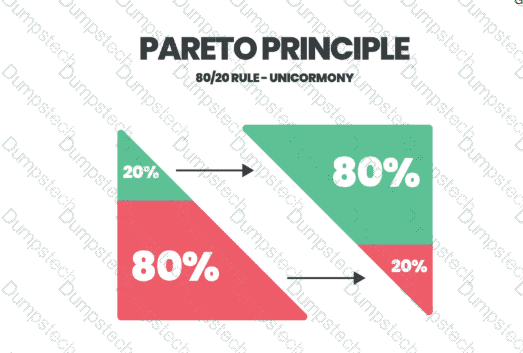
Analysis of Other Options:
A. Ishikawa diagram: Also known as a Fishbone or Cause-and-Effect diagram. It is used to identify the root causes of a problem by mapping out various contributing factors, but it does not rank them by frequency or illustrate the 80/20 rule.
B. Control chart: Used to determine whether or not a process is stable or has predictable performance. It uses " Control Limits " to identify " Special Cause " variation.
C. Run chart: A line graph that shows data points plotted in the order in which they occur. It is used to identify trends and shifts in a process over time but does not categorize or rank causes of defects.
A team member, who is close to an influential stakeholder, has joined the project team. The stakeholder is routing requests for multiple reports through the new team member, and the team member reaches out to the project manager regarding this. What should the project manager do first?
Options:
Forward the status reports to the stakeholder.
Manage stakeholder engagement.
Consult the communications management plan.
Update the communications management plan.
According to the PMBOK® Guide, when a project manager faces requests for information or reports that fall outside the typical workflow, they must look to the established project governance documents.
Consulting the Plan: The Communications Management Plan is the primary document that defines who needs what information, when they need it, and how they will receive it. In this scenario, the project manager is being bypassed by an influential stakeholder. Before taking any action (like sending reports or updating plans), the PM must first verify what was originally agreed upon.
Establishing Authority: By consulting the plan, the project manager can determine if the stakeholder is already on the distribution list or if these are " ad hoc " requests. This provides the PM with the necessary framework to address the team member and the stakeholder professionally.
Preventing Scope/Communication Creep: If the project manager simply starts forwarding reports (Option A) without checking the plan, they risk violating confidentiality or overloading the team with unplanned work.
Analysis of other options:
Forward the status reports (Option A): This is a reactive approach. It sets a dangerous precedent that stakeholders can bypass the project manager to get information, which can lead to confusion and " noise " in communication.
Manage stakeholder engagement (Option B): This is a broad process, not a specific " first " step. While the PM will eventually need to manage this stakeholder ' s engagement, the specific tool used to handle information requests is the Communications Management Plan.
Update the communications management plan (Option D): You should never update a plan before consulting the current version and understanding the need for the change. Updates happen after a gap is identified and, if necessary, processed through change control.
Per PMI standards, the project manager must ensure that communication is efficient (providing only the information needed) and effective (providing information in the right format at the right time). Consulting the plan first ensures that the PM maintains control over the project ' s communication channels.
Which piece of information is part of the WBS Dictionary?
Options:
Responsible organization
Change requests
Validated deliverables
Organizational process assets
According to the PMBOK® Guide, the WBS Dictionary is a document that provides detailed delivery information about each component in the Work Breakdown Structure (WBS). It supports the WBS by providing the narrative description of the work required to produce the deliverable.
Content of the WBS Dictionary: Because the WBS itself is usually a graphic hierarchy with limited text, the dictionary captures the specific details for each " work package. " Key elements typically include:
Code of account identifier (linking the WBS to the accounting system).
Description of work.
Responsible organization (the department or unit accountable for the work).
List of schedule milestones.
Associated schedule activities.
Resources required and Cost estimates.
Quality requirements and Acceptance criteria.
Technical references and Contract information.
Purpose: It prevents " scope creep " by clearly defining the boundaries of each work package. If a task is not described in the WBS Dictionary, it is considered out of scope.
Comparison with Other Options:
Change requests (B): These are formal proposals to modify any document, deliverable, or baseline. While a change request might result in an update to the WBS Dictionary, it is not a component of the dictionary itself.
Validated deliverables (C): These are an output of the Control Quality process. They are the actual completed products that have been inspected and found to be correct. The dictionary defines how to make them, but is not the deliverable itself.
Organizational process assets (D): These are the plans, processes, policies, procedures, and knowledge bases used by the performing organization. The WBS Dictionary may be archived as an OPA at the end of a project, but OPAs are an input to the creation of the dictionary, not a piece of information contained within it.
How can you describe the role of the project.... of influence concept?
Options:
The proiect manager proactivnly interacfS with other project managers creating a positive influence Km fulfilling project needs, working with other managers and sponsor to address internal political and strategic issues and ensunng that the project managemenl plan aligns with the portfolio or program plan
The project manager leads the team, performs communication roles between stakeholders, and uses interpersonal sills to balance conflicting goals
The proiect manager stays informed about current technology developments lakes into account new quality management standards, and uses relevant technical support tools
The proiect manager participates in project management trainings, contributes to the organization professional community sharing knowledge, and maintains subied matter expertise
According to the PMBOK® Guide, the Project Manager ' s Sphere of Influence describes the various groups and entities with which the project manager interacts and the reach of their influence within the organization and the industry.
The Sphere of Influence (Choice A): This choice accurately summarizes the multi-layered influence of a project manager. Beyond leading the immediate project team, the PM operates within a broader organizational context. This includes:
Other Project Managers: Interacting to share or compete for limited resources and to coordinate dependencies between projects.
Sponsors and Governance: Working with the project sponsor and steering committees to navigate internal politics, secure support, and address strategic hurdles.
Portfolio/Program Alignment: Ensuring that the project ' s tactical execution remains aligned with the higher-level strategic goals of the program or portfolio to which it belongs.
Team Leadership and Communication (Choice B): While these are core activities of a project manager, this description is limited primarily to the " Project Team " and " Stakeholders " layers of the sphere. It does not fully capture the organizational and strategic " influence " aspect described in Choice A.
Technology and Standards (Choice C): This refers to the Technical Project Management and Continuous Improvement aspects of the role. While a PM should stay informed, this is more about personal competency than the " Sphere of Influence " concept.
Professional Development (Choice D): This relates to the Industry and Professional Discipline layers of the sphere of influence. While important, it represents only the outermost layer and ignores the critical internal organizational influence required to manage a project successfully.
By understanding and navigating this sphere, the project manager acts as an integrator, ensuring that the project does not exist in a vacuum but is supported by and aligned with the entire organization.
A project team is working on a new driverless vehicle and is organizing a workshop with experts to analyze the data received from the prototype. Who should the project manager invite to provide expert advice?
Options:
The subject matter experts (SMEs) identified in the stakeholder register
The senior experts with high status in the academic community
The major stakeholders nominated by the project sponsor
The usual review participants holding recognized certifications
According to the PMBOK® Guide (specifically the Identify Stakeholders and Develop Project Management Plan processes), the Stakeholder Register is the primary project document used to record all individuals, groups, or organizations that have an interest in, or can influence, the project.
Why Choice A is correct: During the planning phase, the Project Manager performs a stakeholder analysis to identify who possesses the specialized knowledge or expertise (Expert Judgment) required for specific project activities. In the case of a highly technical project like a " driverless vehicle, " the specific SMEs needed for data analysis should have already been identified, categorized, and documented in the Stakeholder Register with their specific roles and areas of expertise noted. This ensures that the workshop is populated by people whose skills have been vetted as relevant to the project ' s unique technical requirements.
Analysis of other options:
B (Senior experts with high status): Academic status does not always equate to project-specific relevance. While they may be experts, if they are not relevant to the specific prototype ' s data or the organization ' s goals, they may not be the right fit.
C (Major stakeholders nominated by the sponsor): Sponsors often nominate high-level stakeholders (executives), but these individuals may lack the deep technical expertise required to " analyze data received from the prototype. "
D (Usual review participants with certifications): Having a certification does not automatically make one a Subject Matter Expert in driverless vehicle data. Relying on " usual " participants ignores the specialized nature of this specific project.
The PMI Standard for Project Management emphasizes that " Expert Judgment " should be sought from individuals or groups with specialized training or knowledge. By referring to the Stakeholder Register, the Project Manager ensures a structured and documented approach to engaging the correct expertise.
One of the objectives of a quality audit is to:
Options:
highlight the need for root cause analysis.
share the process documentation among stakeholders.
offer assistance with non-value-added activities.
identify all of the gaps or shortcomings.
According to the PMBOK® Guide, a Quality Audit is a structured, independent process used to determine if project activities comply with organizational and project policies, processes, and procedures. It is a key tool and technique of the Manage Quality process (formerly Perform Quality Assurance).
Objectives of a Quality Audit: The primary goal is to identify inefficient and ineffective policies, manuals, and procedures being used on the project. By identifying all of the gaps or shortcomings, the audit ensures that the project team is following the required standards and that any non-compliance is documented.
Continuous Improvement: Beyond just finding gaps, quality audits aim to:
Identify all good and best practices being implemented.
Share best practices introduced or implemented in similar projects in the organization and/or industry.
Proactively offer assistance in a positive manner to improve the implementation of processes to help raise team productivity.
Highlight the need for Corrective Actions or Preventive Actions to bridge the identified gaps.
Analysis of Other Options:
A. highlight the need for root cause analysis: While an audit might uncover a problem that eventually requires a Root Cause Analysis (RCA), the audit ' s direct objective is to find the gap (non-compliance), whereas RCA is a separate technique used to understand why the gap occurred.
B. share the process documentation among stakeholders: This is a function of the Communications Management Plan or general project transparency, rather than a specific objective of a formal Quality Audit.
C. offer assistance with non-value-added activities: This is a distractor. The objective of an audit is actually to identify non-value-added activities so they can be eliminated, not to assist with them. Quality audits help " lean " the process by removing waste.
In the project charter process, which three of the following are discussed during meetings held with stakeholders? (Choose three)
Options:
High-level deliverables
Phase transitions
Project objectives
Success criteria
Cost
According to the PMBOK® Guide, specifically the Develop Project Charter process, the project charter is the document that formally authorizes the existence of a project and provides the project manager with the authority to apply organizational resources to project activities.
During meetings to develop this document, the focus is on high-level strategic alignment rather than granular tactical details. The three correct elements discussed are:
Project Objectives (C): These are the measurable goals the project is intended to achieve. Meetings with stakeholders are crucial to ensure that the project ' s purpose is clearly defined and aligned with the business case and strategic goals of the organization.
Success Criteria (D): Stakeholders must agree on what constitutes project success. This includes defining the measurable standards (such as KPIs, quality levels, or specific business outcomes) that will be used to determine if the project has met its objectives upon completion.
High-level Deliverables (A): The charter outlines the main products, services, or results that the project will produce. While a detailed Work Breakdown Structure (WBS) comes later during planning, the " big picture " deliverables must be identified in the charter to define the project ' s boundaries.
Analysis of other options:
Phase transitions (Option B): Discussions regarding how to move from one phase to another (Kill Points or Stage Gates) are typically part of the Project Management Plan or the Project Life Cycle definition during the planning phase, not the initial chartering process.
Cost (Option E): While a High-level Budget or " Summary Budget " is included in a charter, " Cost " (the detailed estimation of all resources and activities) is a specific output of the Determine Budget process during planning. The charter deals with the " order of magnitude " funding, while detailed costs are discussed much later.
Per PMI standards, the meetings held during the initiation phase are designed to capture the Sponsor’s vision, define Project Objectives, and establish Success Criteria to ensure all key stakeholders are in agreement before the project moves into detailed planning.
During project execution, a team member has identified and then analyzed an opportunity that
will yield a net saving of 10% and reduce time in the schedule by 20%
Which strategy should the project manager adopt to accommodate this opportunity?
Options:
Escalate to upper management to build awareness of the opportunity.
Exploit the opportunity immediately, since the cost saving makes it worthwhile.
Transfer the opportunity to a partner and start a partner contract.
Create a trail of the opportunity before full adoption, because of the risk associated.
According to the PMBOK® Guide, specifically the Plan Risk Responses process, risks are categorized as either " Threats " (negative) or " Opportunities " (positive). When an opportunity is identified that has a high impact and high probability of success, specific strategies are applied.
Exploit (Choice B): The " Exploit " strategy is used for high-priority opportunities where the organization wants to ensure that the opportunity is realized. By identifying a net saving of 10% and a schedule reduction of 20%, the team has found a significant positive impact. To " exploit " this means to eliminate the uncertainty associated with the opportunity by ensuring it definitely happens (e.g., by assigning the most talented resources to it or utilizing new technology). Given the specific, quantified benefits, the project manager should take definitive action to capture these gains.
Escalate (Choice A): Escalation is used when an opportunity is outside the scope of the project or beyond the project manager’s authority. A 10% cost saving and 20% time reduction are typically within the project manager ' s mandate to manage the project successfully, so escalation is unnecessary unless it impacts the entire organization ' s portfolio.
Transfer (Choice C): " Transfer " (or " Share " ) involves giving ownership of the opportunity to a third party who is better able to capture the benefit. If the team has already identified and analyzed the opportunity successfully, there is no need to give the benefits to a partner.
Create a Trial / Enhance (Choice D): While " Enhancing " is a valid strategy (increasing the probability/impact), " creating a trail " because of " associated risk " suggests a hesitant approach. In PMI terminology, if an opportunity is analyzed and found to be clearly beneficial with specific percentages, moving to Exploit it is the proactive leadership choice.
By choosing to Exploit this opportunity, the project manager directly improves the project ' s performance metrics, contributing to the " Value " delivery principle emphasized in the Standard for Project Management.
Which knowledge area includes the processes to identify, define, and unify the various project management processes?
Options:
Project Integration Management
Project Communications Management
Project Qualify Management
Project Risk Management
According to the PMBOK® Guide, Project Integration Management is the core knowledge area that includes the processes and activities to identify, define, combine, unify, and coordinate the various processes and project management activities within the Project Management Process Groups.
The " Glue " of Project Management: While other knowledge areas focus on individual components (like schedule, cost, or risk), Integration Management is responsible for ensuring that all those components work together seamlessly.
Key Responsibilities:
Resource Allocation: Balancing resources across competing requirements.
Balancing Competing Objectives: Making trade-offs among alternative goals (e.g., if a project is behind schedule, Integration Management decides whether to increase the budget or reduce the scope).
Process Coordination: Ensuring that the outputs of one process (like the Risk Register) are properly used as inputs for another (like the Cost Baseline).
Key Processes: This knowledge area spans the entire project life cycle, from Develop Project Charter in Initiation to Close Project or Phase in Closing.
Analysis of Other Options:
B. Project Communications Management: This knowledge area is specifically focused on the timely and appropriate generation, collection, distribution, storage, and retrieval of project information. It does not unify the other project management processes.
C. Project Quality Management: This area focuses on incorporating the organization’s quality policy into the project to ensure project requirements are met and validated. It is a specialized area rather than a unifying one.
D. Project Risk Management: This focuses on the identification, analysis, and response planning for risks. While it influences other areas, its primary purpose is managing uncertainty, not unifying the project management framework.
When would resource leveling be applied to a schedule model?
Options:
Before constraints have been identified
Before it has been analyzed by the critical path method
After it has been analyzed by the critical path method
After critical activities have been removed from the critical path
According to the PMBOK® Guide, specifically within the Develop Schedule process, Resource Leveling is a resource optimization technique used to adjust the start and finish dates of activities to address resource constraints.
Sequential Application: In the standard flow of schedule development, the project manager first performs Critical Path Method (CPM) analysis to determine the theoretical shortest duration of the project based on logical dependencies and constraints.
Addressing Over-allocation: Once the critical path is identified, the project manager often finds that certain resources are " over-allocated " (assigned to multiple tasks at the same time) or that resource demand exceeds available supply. Resource leveling is then applied to resolve these conflicts.
Impact on the Schedule: Because resource leveling prioritizes resource availability, it often results in the original critical path changing or the project duration increasing. It is essentially the process of making the " ideal " schedule (the CPM) " realistic " based on the actual people and equipment available.
Resource Smoothing: A related technique, resource smoothing, is also applied after CPM analysis but only adjusts activities within their " float " so as not to affect the critical path or the completion date.
Comparison with other options:
A. Before constraints have been identified: This is illogical. Resource leveling is the response to resource constraints. You cannot level resources until you know what those constraints are.
B. Before it has been analyzed by the critical path method: If you level before CPM analysis, you won ' t know which activities are critical versus which ones have flexibility (float). You need the CPM " baseline " to understand the impact of your leveling decisions.
D. After critical activities have been removed from the critical path: Critical activities are not " removed " from the critical path; the path itself is a calculation of the longest sequence. While leveling might change which activities are on the critical path, you don ' t remove activities to perform leveling.
The following is a network diagram for a project.
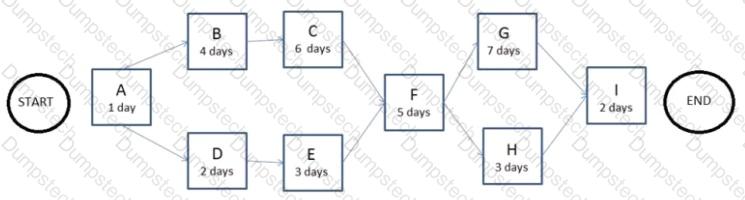
What is the critical path for the project?
Options:
A-B-C-F-G-I
A-B-C-F-H-I
A-D-E-F-G-I
A-D-E-F-H-I
The Critical Path Method (CPM) is used to estimate the minimum project duration and determine the amount of scheduling flexibility on the logical network paths within the schedule model.
Definition of Critical Path: According to PMI, the critical path is the longest sequence of activities through a project network diagram that determines the shortest possible project duration.
Total Float: Activities on the critical path have zero total float. Any delay in a critical path activity will delay the project finish date.
Calculation Steps:
Identify all possible paths from the start node (A) to the finish node (I).
Sum the durations of the activities along each specific path.
The path with the highest numerical total is the Critical Path.
How to solve this specific question:
Path A: A + B + C + F + G + I
Path B: A + B + C + F + H + I
Path C: A + D + E + F + G + I
Path D: A + D + E + F + H + I
To verify the answer, simply add the numbers associated with each letter in your diagram. The option (A, B, C, or D) that results in the largest sum is the verified critical path.
Why is tailoring required in a project?
Options:
Because a one-size-fits-all approach avoids complications and saves time.
Because every project is unique and not every tool, technique, input, or output identified in the PMBOK Guide is required.
Because tailoring allows us to identify the techniques, procedures, and system practices used by those in the project.
Project managers should apply every process in the PMBOK Guide to the project, so tailoring is not required.
According to the PMBOK® Guide, tailoring is a fundamental responsibility of the project manager and the project management team. The guide is a standard, not a rigid methodology. It provides a global set of best practices, but it explicitly states that not every process, tool, or technique is appropriate for every project.
The Principle of Uniqueness: Every project exists in a unique context—varying by size, complexity, risk, stakeholder needs, and organizational culture. Applying a " heavy " project management framework to a small, low-risk project would create unnecessary bureaucracy and waste.
Tailoring for Success: The project manager must select only the processes that are necessary to manage the project effectively. This involves choosing the right:
Life Cycle and Development Approach: (e.g., Predictive, Adaptive, or Hybrid).
Processes: Deciding which of the 49 processes are relevant.
Tools and Techniques: Selecting those that will provide the most value for that specific project environment.
The Tailoring Process: This typically involves analyzing the project ' s internal and external environments, the organizational culture, and the project ' s complexity to ensure the " level of governance " matches the project ' s needs.
Analysis of Other Options:
A. Because a one-size-fits-all approach avoids complications and saves time: This is the opposite of reality. A " one-size-fits-all " approach often causes complications by forcing a team to follow irrelevant steps or use tools that don ' t fit the work, ultimately wasting time.
C. Because tailoring allows us to identify the techniques, procedures, and system practices used by those in the project: While tailoring involves identifying these things, this is a descriptive statement of the action, not the reason why tailoring is required. The requirement stems from the inherent uniqueness of project work.
D. Project managers should apply every process in the PMBOK Guide to the project, so tailoring is not required: This is a common misconception. The PMBOK® Guide explicitly states that the project management team is responsible for determining which processes are appropriate for any given project. Applying all processes indiscriminately is considered poor practice.
The process of defining how the project scope will be validated and controlled is known as:
Options:
Define Scope.
Develop Project Management Plan.
Plan Scope Management.
Plan Quality Management.
According to the PMBOK® Guide (Project Management Body of Knowledge), specifically within the Project Scope Management knowledge area and the Plan Scope Management process:
Plan Scope Management (Option C): This is the process of creating a scope management plan that documents how the project and product scope will be defined, validated, and controlled. The key benefit of this process is that it provides guidance and direction on how scope will be managed throughout the project. It explicitly outlines the procedures for preparing the scope statement, creating the WBS, formalizing the acceptance of completed deliverables (Validate Scope), and processing change requests to the scope baseline (Control Scope).
Define Scope (Option A): This is the process of developing a detailed description of the project and product. Its primary output is the Project Scope Statement. While it defines what is in scope, it does not define the administrative process for how that scope will be validated or controlled.
Develop Project Management Plan (Option B): This is a high-level integration process that defines, prepares, and coordinates all plan components. While the Scope Management Plan eventually becomes a subsidiary part of this larger plan, the specific act of defining scope validation and control happens within the Plan Scope Management process.
Plan Quality Management (Option D): This process identifies quality requirements and/or standards for the project and its deliverables, and documents how the project will demonstrate compliance. It focuses on correctness and " fit for use " rather than the formal acceptance and boundary management of the scope.
In the PMI framework, the Scope Management Plan acts as a roadmap. By defining how the project scope will be validated (through the Validate Scope process) and controlled (through the Control Scope process), the Project Manager ensures that there is a clear, pre-approved methodology for handling scope creep and securing formal sign-off from the customer.
Which item is an input to the Define Activities process?
Options:
Schedule data
Activity list
Risk register
Scope baseline
According to the PMBOK® Guide, specifically within the Project Schedule Management knowledge area, the Define Activities process is the process of identifying and documenting the specific actions to be performed to produce the project deliverables.
Scope Baseline: This is a primary input to the Define Activities process. The scope baseline consists of the Project Scope Statement, the Work Breakdown Structure (WBS), and the WBS Dictionary. Since the goal of Define Activities is to break down work packages into specific activities, the project manager must start with the WBS (found within the scope baseline) to ensure all required work is accounted for.
The Breakdown Process: In the hierarchy of project planning, you first define the scope, then decompose that scope into work packages (Create WBS), and finally decompose those work packages into activities (Define Activities). Therefore, the baseline containing those work packages is a mandatory starting point.
Why the other options are incorrect:
A. Schedule data: This is an output of the Develop Schedule process. It includes items such as schedule milestones, activity attributes, and documentation of assumptions and constraints. It is created much later in the planning sequence.
B. Activity list: This is the primary output of the Define Activities process itself. It is the comprehensive list of all schedule activities required to be performed on the project.
C. Risk register: While risks can influence activity durations or resource requirements, the Risk Register is not a standard formal input for the initial identification of activities in the Define Activities process. It becomes more relevant during Estimate Activity Durations and Develop Schedule.
A project manager proactively meets with other project managers who manage other projects in the same program. To minimize the impact that other projects within the program may have on their project of what should the project manager be aware?
Options:
Demands on the same resources
Requirements that impact the scope
Uncertainty of emerging issues
Project charter
According to the PMBOK® Guide, specifically within the context of Program Management and Project Resource Management, projects existing within the same program are often interdependent. The most common point of friction and risk between these projects is the competition for shared resources.
Resource Constraints: In a program environment, multiple projects often draw from the same pool of specialized personnel, equipment, or facilities. If one project falls behind or requires more resources than planned, it can create a " ripple effect, " causing delays for all other projects in the program.
Proactive Coordination: By meeting with other project managers, the PM is engaging in Resource Leveling or Resource Smoothing at a program level. Being aware of these demands allows the project manager to identify potential resource bottlenecks early and negotiate schedules or priorities with the Program Manager.
Interdependencies: Managing these interdependencies is a key part of the project manager’s role in a multi-project environment to ensure that " Resource Scarcity " does not become a major issue for the project ' s critical path.
Why other options are incorrect:
Option B: Requirements that impact the scope: While scope changes can occur, they are typically managed through the Integrated Change Control process specific to that project. While there are " program-level " requirements, the immediate day-to-day impact from neighboring projects is most frequently felt in the resource pool.
Option C: Uncertainty of emerging issues: This is a general definition of risk. While a PM should always be aware of uncertainty, it is too broad. The specific reason for meeting with colleagues in the same program is to address the tangible, shared constraints like resource availability.
Option D: Project charter: The Project Charter is a document that authorizes the project and defines high-level objectives. It is an internal foundational document and is not a dynamic factor that a PM needs to " watch out for " in relation to other projects in the program.
What is one of the objectives of Project Risk Management?
Options:
Decrease the probability and impact of an event on project objectives.
Distinguish between a project risk and a project issue so that a risk mitigation plan can be put in place.
Increase the probability and impact of positive events.
Removal of project risk.
According to the PMBOK® Guide, specifically within the Project Risk Management knowledge area, the fundamental objective of project risk management is to increase the probability and/or impact of positive risks (opportunities) and to decrease the probability and/or impact of negative risks (threats).
Opportunities vs. Threats: In PMI methodology, " risk " is an uncertain event or condition that, if it occurs, has a positive or negative effect on one or more project objectives. Therefore, risk management is not just about avoiding bad things; it is equally about capturing good things.
Managing Opportunities: Strategies for positive risks include Escalate, Exploit, Share, Enhance, and Accept. By " Enhancing " a risk, the project manager actively works to increase the chance of the opportunity occurring or the magnitude of the benefit it provides.
Optimizing Project Success: By focusing on both sides of the risk spectrum, the project manager maximizes the likelihood of project success. For example, finishing a project early (a positive risk) is just as much a subject of risk management as a potential delay (a negative risk).
Continuous Process: Risk management is iterative. Throughout the project life cycle, new opportunities may emerge that require the team to shift resources or change tactics to " Increase the impact " of those positive events.
Comparison with other options:
A. Decrease the probability and impact of an event...: This statement is incomplete. While we want to decrease the impact of negative events (threats), we want to increase the impact of positive events.
B. Distinguish between a project risk and a project issue...: While distinguishing between the two is an important administrative task (risks are uncertain future events, issues are current certainties), it is a step in the process, not a primary objective of the entire Risk Management knowledge area.
D. Removal of project risk: It is virtually impossible to " remove " all project risk. Even if specific risks are avoided, the act of doing a project inherently involves uncertainty. The goal is to manage and optimize risk, not necessarily eliminate it entirely.
Which document includes the project scope, major deliverables, assumptions, and constraints?
Options:
Project charter
Project scope statement
Scope management plan
Project document updates
According to the PMBOK® Guide, specifically the Define Scope process, the Project Scope Statement is the primary output that provides a documented description of the project scope, major deliverables, and the work required to create those deliverables.
Detailed Content: While the Project Charter contains high-level information, the Project Scope Statement contains a much more detailed description of the scope components. It explicitly includes:
Product scope description: Progressively elaborates the characteristics of the product, service, or result.
Deliverables: Any unique and verifiable product, result, or capability.
Acceptance criteria: A set of conditions that is required to be met before deliverables are accepted.
Project Exclusions: Explicitly states what is excluded from the project to manage stakeholder expectations (the " out of scope " list).
Assumptions: Factors in the planning process that are considered to be true, real, or certain without proof.
Constraints: Limiting factors that affect the execution of a project, such as budget, schedule, or resources.
Comparison with other options:
A. Project charter: The charter is a high-level document. While it may contain a summary of scope and major deliverables, the " detailed " and " typical " repository for specific assumptions, constraints, and granular deliverables is the Scope Statement.
C. Scope management plan: This is a component of the Project Management Plan that describes how the scope will be defined, developed, monitored, controlled, and validated. It does not contain the actual scope itself.
D. Project document updates: This is a generic output category. While the scope statement is a project document, this option is too broad to be the correct answer for a document defined by these specific contents.
During the project planning process, which three of the following stakeholders are required to take part in the risk assessment meeting? (Choose three)
Options:
End user
Product owner
Subject matter experts (SMEs)
Project sponsor
Project team
According to the PMBOK® Guide (specifically the Plan Risk Management and Identify Risks processes), risk assessment requires a diverse group of participants who possess the knowledge of the project ' s technical details, its strategic importance, and its operational execution.
Why Choice C (SMEs) is correct: Subject Matter Experts provide " Expert Judgment, " which is a primary tool and technique for identifying and analyzing risks. They understand the technical nuances and external factors that could impact specific work packages or deliverables.
Why Choice D (Project Sponsor) is correct: The Project Sponsor is responsible for the project ' s high-level success and provides the Risk Appetite and Risk Thresholds. Their participation is crucial for determining which risks are acceptable and which require significant mitigation resources or contingency funds.
Why Choice E (Project Team) is correct: The Project Team is responsible for the day-to-day execution of the project. They have the most intimate knowledge of the project ' s constraints, dependencies, and assumptions. Their involvement ensures " bottom-up " identification of risks that management might otherwise overlook.
Analysis of other options:
A (End user): While end users are critical for defining requirements and performing UAT, they are not typically required participants in a formal risk assessment meeting during the planning process unless the project specifically involves high user-interface risk.
B (Product owner): In a traditional project management context (which this question ' s phrasing suggests), the Product Owner is an Agile-specific role. While they perform risk management in Agile, in a general PMI risk assessment meeting, the Sponsor and Team take precedence. If the question implies a Hybrid or Agile environment, the Product Owner would be involved, but in a " choose three " scenario, the core triad for risk remains the Sponsor (Authority), Team (Execution), and SMEs (Technical Knowledge).
By involving these three groups, the Project Manager ensures a comprehensive Risk Register that balances technical feasibility, executive risk tolerance, and practical execution challenges.
What specific quality considerations should be examined while completing Quality Management plan?
Options:
Risk registerB Stakeholder engagement
Continuous improvement
Standards and regulatory compliance
According to the PMBOK® Guide, the Plan Quality Management process involves identifying quality requirements and/or standards for the project and its deliverables, and documenting how the project will demonstrate compliance with these quality requirements.
Standards and Regulatory Compliance: This is a fundamental consideration because every project operates within a specific environment that may have legal, industry, or organizational standards.
Standards: These can be internal (company-wide quality levels) or external (ISO standards, IEEE, etc.).
Regulatory Compliance: This involves mandatory laws or regulations that the project ' s product must adhere to. Failure to examine these during the planning phase can lead to significant rework, legal issues, or project failure.
Impact on the Plan: By examining these considerations early, the project manager defines the " Quality Metrics " and " Quality Checklists " that will be used during the Control Quality process.
Analysis of other options:
Risk register / Stakeholder engagement (Option A): While these are inputs to the Plan Quality Management process (the risk register contains threats that may impact quality, and stakeholders define the quality requirements), they are not the quality considerations themselves that define the plan ' s criteria.
Continuous improvement (Option B): Also known as Kaizen, this is an overarching philosophy or a technique used within the Manage Quality process. While important, the specific considerations used to build the plan focus on the requirements and rules the project must follow (standards/compliance).
Per PMI standards, ensuring Standards and regulatory compliance is part of the " Cost of Quality " (specifically, the Cost of Conformance), ensuring the project avoids the high costs associated with non-conformance and failure.
A project manager is reporting the project performance as 25 days worth of work completed against 13 days originally planned. What is the schedule variance (SV)?
Options:
-12
1.15
38
12
In Earned Value Management (EVM), as defined by the PMBOK® Guide, the Schedule Variance (SV) is a measure of schedule performance expressed as the difference between the earned value and the planned value.
Formula:
$$SV = EV - PV$$
EV (Earned Value): The value of work actually performed expressed in terms of the budget assigned to that work. In this case, it is 25 days worth of work.
PV (Planned Value): The authorized budget assigned to scheduled work. In this case, it is 13 days worth of work.
Calculation:
$$SV = 25 - 13 = 12$$
Analysis of the result:
Positive SV (+12): A positive value indicates that the project is ahead of schedule because the team has completed more work than was originally planned for this point in time.
Negative SV: A negative value would indicate that the project is behind schedule.
Zero SV: Indicates that the project is exactly on schedule.
Analysis of other options:
A (-12): This would occur if the team had only completed 1 day of work against 13 planned ($1 - 13$). It represents a project that is significantly behind schedule.
B (1.15): This does not match any direct EVM calculation for this data. (Note: The Schedule Performance Index (SPI), which is $EV / PV$, would be approximately $1.92$ in this scenario, showing extremely high efficiency).
C (38): This is the sum of the two values ($25 + 13$), which is not a standard project management metric.
By calculating the Schedule Variance, the Project Manager can objectively report to stakeholders that the project is performing better than expected and can use this data to adjust future resource allocations or identify " lessons learned " regarding the team ' s high productivity.
Expected monetary value (EMV) is computed by which equation?
Options:
Value of each possible outcome multiplied by probability of occurrence
Value of each possible outcome multiplied by probability of non-occurrence
Multiplying the value of each possible outcome by the probability of occurrence and adding the products together
Multiplying the value of each possible outcome by the probability of non-occurrence and adding the products together
According to the PMBOK® Guide, specifically within the Perform Quantitative Risk Analysis process, Expected Monetary Value (EMV) is a statistical concept that calculates the average outcome when the future includes scenarios that may or may not happen (i.e., analysis under uncertainty).
The Concept: EMV is used to quantify risks (both threats and opportunities) to determine the overall contingency reserve or to choose between different project paths using a Decision Tree.
The Formula:
$$EMV = \sum (P \times I)$$
Where:
$P$ = Probability of the outcome occurring.
$I$ = Impact (the monetary value of the outcome).
Calculation Method: You identify every possible outcome, multiply the monetary value (Impact) of that outcome by its probability of occurrence, and then sum all the results together.
Opportunities are expressed as positive values.
Threats are expressed as negative values.
Analysis of Other Options:
A. Value of each... multiplied by probability: This describes the calculation for a single risk event, but it does not account for the total EMV of a project or a decision node, which requires the sum of all potential outcomes.
B and D. Probability of non-occurrence: These are incorrect. Risk management calculations focus on the probability of the event actually happening ($P$). While the probability of non-occurrence ($1 - P$) exists, it is not the multiplier used to determine the expected value of the risk itself.
In a weak matrix, the project managers role is:
Options:
part-time
full-time
occasional
unlimited
According to the PMBOK® Guide, the level of authority and the specific role of a project manager are heavily influenced by the Organizational Structure of the performing organization. PMI classifies matrix structures into three categories: Weak, Balanced, and Strong.
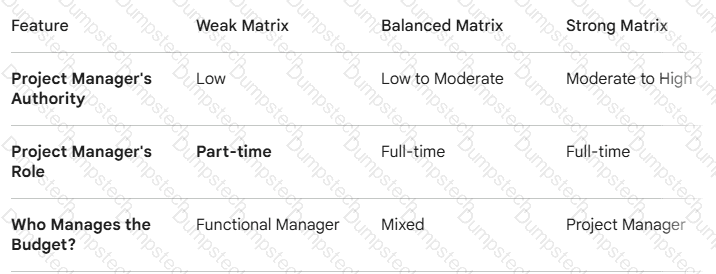
In a Weak Matrix organizational structure, the project manager maintains many of the characteristics of a functional organization.
Role Definition: The project manager ' s role is typically part-time. They often function more as a Project Expediter or Project Coordinator rather than a true manager.
Authority: Their authority is very low to non-existent. The functional manager retains most of the power, including control over the budget and resources.
Staffing: The project team members also work part-time on the project, with their primary loyalty and reporting line remaining with their functional department.
B. full-time: This is a characteristic of a Strong Matrix or a Projectized organization. In these structures, the project manager is a designated professional with a full-time commitment to the project and significant authority.
C. occasional: While a project manager in a weak matrix has limited hours, " occasional " is not a formal PMI term used to describe the role. The standard designation is " part-time. "
D. unlimited: This is incorrect in any organizational structure. All project managers operate within defined constraints of authority, budget, and schedule as outlined in the Project Charter.
Which tool or technique is used in Close Procurements?
Options:
Contract plan
Procurement plan
Closure process
Procurement audits
According to the PMBOK® Guide, specifically within the Close Procurements process (Closing Process Group), Procurement audits are a primary tool and technique.
Definition: A procurement audit is a structured review of the procurement process from the Plan Procurement Management process through Control Procurements.
Purpose: The objective of a procurement audit is to identify successes and failures that warrant recognition in the preparation or administration of other procurement contracts on the project, or on other projects within the performing organization. It helps in capturing " lessons learned " specifically related to the vendor relationship and the legal/contractual aspects of the project.
Context in Closing: During Close Procurements, the project manager or a designated procurement administrator uses these audits to ensure all deliverables were accepted, all aspects of the contract were met, and to finalize any open claims or disputes before formal closure.
Analysis of Other Options:
A. Contract plan: This is not a standard PMI term; the relevant document is the Contract itself or the Procurement Management Plan.
B. Procurement plan: This is an input to the procurement processes (the Procurement Management Plan), not a tool/technique for closing them.
C. Closure process: This is a general description of the phase or activity, but it is not a specific tool or technique defined within the PMBOK® framework for this process.
In complex projects/ initiating processes should be completed:
Options:
Within a work package.
In each phase of the project.
To estimate schedule constraints.
To estimate resource allocations.
According to the PMBOK® Guide, specifically in the sections regarding the Project Life Cycle and the Initiating Process Group, the application of processes is iterative.
Phase-Gate Approach: In large or complex projects, the project is often divided into phases (such as Feasibility, Design, Build, and Test) to provide better management control.
Re-validation of Business Need: The Initiating Process Group is performed at the start of each phase. This ensures that the project is still aligned with the original business case, the project charter is still valid, and the high-level objectives remain relevant.
Stakeholder Identification: Because stakeholders can change or their influence can shift as the project progresses from design to execution, the Identify Stakeholders process (part of Initiating) must be revisited in each phase to ensure the engagement strategy remains effective.
Authorization to Proceed: Completing the initiating processes in each phase acts as a formal " go/no-go " point, ensuring that the organization does not continue to invest in a phase that no longer meets strategic goals.
Comparison with other options:
A. Within a work package: A work package is the lowest level of the Work Breakdown Structure (WBS) and is associated with the Executing and Monitoring and Controlling process groups, not the formal initiation of the project or phase.
C and D. To estimate schedule/resource constraints: While these estimates are developed during the early stages, they are technically part of the Planning Process Group (e.g., Estimate Activity Durations or Estimate Activity Resources), rather than the defining purpose of the Initiating Process Group.
A project manager read the initial contract when a project was started. The contract states a house has to be built in one year, and the foundation has to be completed in 30 days. What should the project manager do?
Options:
Add the milestones to the risk register, as time is short.
Add the two milestones to the project plan, as they are mandatory.
Calculate the duration of the two milestones stated in the contract.
Start the project as soon as possible, as time is short.
According to the PMBOK® Guide, specifically within the Develop Project Management Plan and Define Activities processes, requirements stipulated in a contract are considered Project Constraints.
Contractual Obligations: A contract is a legally binding document. If the contract specifies a final completion date (one year) and a specific interim deadline (foundation in 30 days), these are classified as Milestones.
Milestones vs. Activities: A milestone is a significant point or event in a project. Unlike activities, milestones have zero duration. Because these specific dates are " Hard " constraints dictated by the contract, they must be incorporated into the Milestone List and the Project Management Plan.
Mandatory Nature: The project manager does not have the discretion to ignore these dates. They form the basis of the Schedule Baseline. Once these milestones are added to the plan, the project manager will then sequence the necessary activities to ensure these deadlines are met.
Analysis of other options:
Option A: While the tight timeline represents a risk, milestones are primarily schedule components. You would record the risk of missing the deadline in the register, but you must first put the actual dates into the project plan to manage them.
Option C: This is a technical distractor. Milestones, by definition, have zero duration. They represent a point in time (the completion of the foundation), so there is no duration to calculate for the milestone itself—only for the activities leading up to it.
Option D: " Starting as soon as possible " is a proactive sentiment, but it is not a formal project management procedure. Proper planning (adding the constraints to the plan) must occur to ensure the " fast start " is actually directed toward the correct goals.
Per PMI standards, any date or requirement explicitly mentioned in a legal contract is a Constraint that must be documented in the Project Management Plan and tracked as a milestone to ensure compliance.
Which process involves defining, preparing, and coordinating all subsidiary plans and integrating them into a comprehensive plan?
Options:
Direct and Manage Project Work
Develop Project Management Plan
Plan Quality Management
Monitor and Control Project Work
According to the PMBOK® Guide and the Standard for Project Management, the process of defining, preparing, and coordinating all subsidiary plans and integrating them into a comprehensive project management plan is Develop Project Management Plan.
As per PMI standards, this process is part of the Project Integration Management Knowledge Area and occurs within the Planning Process Group. The Project Management Plan is the primary document used to manage the project. Key characteristics of this process include:
Integration: It consolidates all subsidiary management plans (e.g., Scope, Schedule, Cost, Quality, Resource, Communications, Risk, Procurement, and Stakeholder Management Plans) and baselines (Scope, Schedule, and Cost baselines) into a unified whole.
Consolidation: It defines how the project is executed, monitored, controlled, and closed.
Baselines: It establishes the performance measurement baselines against which project execution will be measured.
Updates: The Project Management Plan is a " living document " that is updated and revised through the Perform Integrated Change Control process as the project progresses.
The other options are incorrect based on the following PMI process definitions:
Direct and Manage Project Work: This is an Executing process. It involves leading and performing the work defined in the project management plan and implementing approved changes to achieve the project ' s objectives.
Plan Quality Management: This is a Planning process, but it is a " subsidiary " process. It focuses specifically on identifying quality requirements and standards; its output (the Quality Management Plan) is an input to the Develop Project Management Plan process.
Monitor and Control Project Work: This is a Monitoring and Controlling process. It involves tracking, reviewing, and reporting the overall progress to meet the performance objectives defined in the project management plan.
As per the PMI Lexicon of Project Management Terms, the Develop Project Management Plan process ensures that all aspects of the project are aligned and that the project manager has a clear, integrated roadmap for success.
In which Knowledge Area is the project charter developed?
Options:
Project Cost Management
Project Scope Management
Project Time Management
Project Integration Management
According to the PMBOK® Guide and the Standard for Project Management, the project charter is developed within the Project Integration Management Knowledge Area. Specifically, this occurs during the Develop Project Charter process, which is the very first process in the Initiating Process Group.
As per PMI standards, Project Integration Management includes the processes and activities to identify, define, combine, unify, and coordinate the various processes and project management activities. The Project Charter is a critical element of this Knowledge Area because:
Authorization: It is the document issued by the project initiator or sponsor that formally authorizes the existence of a project and provides the project manager with the authority to apply organizational resources to project activities.
Alignment: It establishes a direct link between the project and the strategic objectives of the organization.
High-Level Boundaries: It documents high-level information such as the project purpose, measurable objectives, high-level requirements, overall project risk, and summary milestone schedule.
The other options are incorrect based on the following PMI Knowledge Area definitions:
Project Cost Management: This Knowledge Area is concerned with planning, estimating, budgeting, financing, funding, managing, and controlling costs so that the project can be completed within the approved budget. It uses the charter as an input, but does not create it.
Project Scope Management: This area focuses on ensuring the project includes all the work required, and only the work required. Like Cost Management, it uses the high-level boundaries defined in the charter to begin the Plan Scope Management and Collect Requirements processes.
Project Time Management: (Now referred to as Project Schedule Management) This area focuses on the timely completion of the project. It relies on the summary milestone schedule found in the project charter to develop the detailed schedule.
As per the PMI Lexicon of Project Management Terms, the Develop Project Charter process is essential for ensuring that the project manager and the performing organization are officially recognized and empowered to begin the planning phase.
Which Process Group and Knowledge Area include the Sequence Activities process?
Options:
Executing Process Group and Project Time Management
Executing Process Group and Project Cost Management
Planning Process Group and Project Time Management
Planning Process Group and Project Cost Management
In accordance with the PMBOK® Guide (Process Groups and Knowledge Areas Mapping), the Sequence Activities process is the process of identifying and documenting relationships among the project activities.
Knowledge Area: This process belongs to Project Schedule Management (referred to as Project Time Management in earlier versions of the PMBOK® Guide). It focuses on the logical sequencing of work to achieve the greatest efficiency given all project constraints.
Process Group: It is a critical component of the Planning Process Group. After the activities are defined (in the Define Activities process), they must be sequenced using logical relationships (Finish-to-Start, Start-to-Start, etc.) to create a network diagram, which eventually leads to the development of the project schedule.
Key Purpose: The primary benefit of this process is that it defines the logical sequence of work to achieve the greatest efficiency given all project constraints.
Analysis of Distractors:
A and B (Executing Process Group): The Executing Process Group involves carrying out the work defined in the project management plan. Sequencing is a foundational planning activity that must occur before execution begins.
B and D (Project Cost Management): Project Cost Management is concerned with budgeting, estimating, and controlling costs (e.g., Determine Budget, Control Costs). While the sequence of activities affects the cash flow, the process itself is a function of schedule (Time) management.
Which of the following is an output of the Conduct Procurements process?
Options:
Project statement of work
Selected sellers
Risk register updates
Teaming agreements
According to the PMBOK® Guide, the Conduct Procurements process is the process of obtaining seller responses, selecting a seller, and awarding a contract. It is the execution phase of procurement management.
Selected Sellers: This is a primary output. These are the sellers who have been judged to be in a competitive range based upon the outcome of the proposal or bid evaluation. The process culminates in the finalization of the contract and the official selection of the vendor(s) who will provide the goods or services.
Other Key Outputs of Conduct Procurements:
Agreements: The formal documents (contracts) signed between the buyer and seller.
Resource Calendars: Documentation showing when the contracted resources (people or equipment) will be available.
Change Requests: Proposals to modify parts of the project management plan or its subsidiary plans based on the terms of the new agreement.
Project Management Plan Updates: Specifically to the cost baseline, schedule baseline, and procurement management plan.
Analysis of Other Options:
A. Project statement of work (SOW): This is now commonly referred to as the Procurement Statement of Work. It is an input to the Conduct Procurements process (created during Plan Procurement Management) to tell the sellers what is required.
C. Risk register updates: While the risk register can be updated during many processes, it is a secondary update and not the primary defining output of the selection process itself. Option B is the definitive direct output.
D. Teaming agreements: These are legal contractual agreements between two or more entities to form a joint venture or partnership. These are typically established before or during the Plan Procurement Management phase or as an input, rather than being the final output of the selection process.
What estimating technique is used when there is limited information?
Options:
Analogous estimating
Parametric estimating
Bottom-up estimating
Three-point estimating
According to the PMBOK® Guide, Analogous Estimating is a technique for estimating the duration or cost of an activity or a project using historical data from a similar activity or project.
Limited Information: It is the most appropriate technique when there is a limited amount of detailed information about the project (e.g., in the early phases of a project). It uses the values of parameters—such as scope, cost, budget, and duration—or measures of scale from a previous, similar project as the basis for estimating the same parameter or measure for a current project.
Accuracy vs. Speed: While it is generally less costly and time-consuming than other techniques, it is also generally less accurate. It is most reliable when the previous projects are similar in fact and not just in appearance, and the project team members preparing the estimates have the needed expertise.
Analysis of other options:
Parametric Estimating (Option B): This uses a statistical relationship between historical data and other variables (e.g., square footage in construction) to calculate an estimate. It requires a higher level of data and a reliable mathematical model.
Bottom-up Estimating (Option C): This is a method of estimating project duration or cost by aggregating the estimates of the lower-level components of the WBS. It is the most accurate but requires a high level of detail, which is not available when information is limited.
Three-point Estimating (Option D): This uses three estimates (most likely, optimistic, and pessimistic) to define an approximate range for an activity ' s cost or duration. While it helps account for uncertainty, it still requires enough detail to form those three distinct perspectives.
Per PMI standards, Analogous Estimating is often used to provide a " Rough Order of Magnitude " (ROM) estimate during the initiating or early planning stages of a project life cycle.
A project manager is reviewing the change requests for project documents, deliverables, and the project plan. In which project management process does this review belong?
Options:
Monitor and Control Project Work
Direct and Manage Project Work
Close Project or Phase
Perform Integrated Change Control
According to the PMBOK® Guide, the Perform Integrated Change Control process is the specific process conducted from project inception through completion to review all change requests, approve changes, and manage changes to deliverables, project documents, and the project management plan.
Centralized Responsibility: This process is where the project manager and, in many cases, a Change Control Board (CCB), evaluate the impact of a requested change across all knowledge areas (Scope, Schedule, Cost, Quality, Risk, etc.).
Key Activities:
Reviewing, evaluating, and approving or rejecting change requests.
Ensuring that only approved changes are incorporated into a revised baseline.
Maintaining the integrity of the baselines by releasing only approved changes into the project work.
Documenting the complete impact of change requests in the Change Log.
The Workflow: A change request is typically generated in Monitor and Control Project Work or Direct and Manage Project Work, but it is officially reviewed and decided upon only within the Perform Integrated Change Control process.
Analysis of Other Options:
A. Monitor and Control Project Work: This process involves tracking, reviewing, and reporting the overall progress to meet the performance objectives defined in the project management plan. While it may identify the need for a change, the actual review and approval happens in Integrated Change Control.
B. Direct and Manage Project Work: This is an Executing process where the team performs the work defined in the project plan. If a change is approved, this is the process where that change is actually implemented.
C. Close Project or Phase: This process involves finalizing all activities for the project, phase, or contract. It occurs at the end of the project life cycle and does not involve the ongoing review of change requests for deliverables or plans.
A few project team members are having issues understanding the requirements as described. Which action should be taken to resolve this issue?
Options:
Review the requirements traceability matrix and set up a meeting with the business analyst and key stakeholders.
Review the requirements traceability matrix, the business analysis communications management plan, and set up a meeting with the business analyst and key stakeholders.
Review the business analysis communications management plan and set up a meeting with the business analyst and key stakeholders.
Review the project management plan and set up a meeting with the project manager and key stakeholders.
According to the PMBOK® Guide and the PMI Guide to Business Analysis, resolving misunderstandings regarding requirements requires a combination of reviewing formal documentation and facilitating targeted communication.
Requirements Traceability Matrix (RTM): This document links requirements to their origins (business needs, stakeholder requests) and follows them through the project lifecycle. Reviewing the RTM helps the team understand the context and the source of the requirements, which often clarifies " why " a requirement exists and " what " it is intended to achieve.
Business Analysis Communications Management Plan: While the general Project Communications Management Plan handles high-level project info, the business analysis version specifically outlines how requirements-related information is shared, which stakeholders are responsible for clarifying them, and the established protocols for communication between the Business Analyst (BA) and the team.
Stakeholder and BA Collaboration: The Business Analyst is the specialist responsible for requirements elicitation and analysis. Setting up a meeting with the BA and the Key Stakeholders (who originally provided the requirements) ensures that any ambiguities are resolved directly by the people who understand the business need best. This aligns with the " Conflict Management " and " Facilitation " power skills a project manager must employ.
Analysis of other options:
Option A: This is a strong choice, but it omits the Communications Management Plan. Without looking at the plan, the project manager might not be following the agreed-upon protocol for how requirements issues should be escalated or discussed.
Option C: This focuses only on communication protocols but ignores the RTM, which contains the actual technical data and " traceability " needed to understand the requirement ' s logic.
Option D: The Project Management Plan is too broad. While it contains the scope and communication plans, a specific issue with requirement understanding needs the granular detail found in business analysis artifacts. Additionally, the PM is already involved; the " missing link " for the team is usually the BA and the stakeholders.
Per PMI standards, when team members struggle with requirement clarity, the project manager must facilitate a deep dive into the Requirements Management artifacts and bring the right subject matter experts together to ensure a shared understanding.
Which of the following are three inputs to the risk register?
Options:
Risk register updates, stakeholder register, and quality management plan
Communication management plan, enterprise environmental factors, and activity duration estimates
Risk management plan, activity cost estimates, and project documents
Project scope statement, organizational process assets, and scope baseline
According to the PMBOK® Guide, the Identify Risks process is where the Risk Register is initially created. To identify risks effectively, the project manager must look at various components of the project management plan and other project artifacts.
Risk Management Plan: This is a vital input because it provides the " how-to " for risk activities. It defines the roles and responsibilities, the budget for risk activities, and the categories of risk (often found in the Risk Breakdown Structure or RBS).
Activity Cost Estimates: These are reviewed to identify risks associated with the financial aspects of the project. If an estimate is particularly aggressive or based on volatile market prices, it represents a potential risk that needs to be captured in the register.
Project Documents: This is a broad category that includes the requirements documentation, schedule, and other logs. These documents provide the specific details of what the project is trying to achieve, which allows the team to identify specific threats or opportunities related to those goals.
Other Key Inputs:
Scope Baseline: Used to identify potential risks to the project ' s boundaries.
Schedule Management Plan: Used to identify risks related to timelines and milestones.
Analysis of Other Options:
A. Risk register updates: This is an output of many risk-related processes (like Perform Qualitative Risk Analysis or Plan Risk Responses), not an input to the creation of the initial register.
B. Communication management plan: While communication is important, it is not listed as a primary input specifically used to identify technical or project risks for the register.
D. Project scope statement / Scope baseline: While these are valid inputs, Organizational Process Assets (OPAs) are general environmental factors or historical templates, and this grouping is less comprehensive than option C in terms of the specific project data needed for risk identification.
How can a project manager determine if the project activities comply with organizational and project policies, processes, and procedures?
Options:
Look at the quality metrics.
Validate the scope.
Review the quality checklist.
Conduct a quality audit.
According to the PMBOK® Guide (6th Edition), the primary tool used to determine if project activities comply with organizational and project policies, processes, and procedures is a Quality Audit. This is a key tool and technique of the Manage Quality process (often referred to as Quality Assurance).
A quality audit is a structured, independent process used to determine if project activities comply with organizational and project policies, processes, and procedures. The objectives of a quality audit include:
Identifying all good and best practices being implemented.
Identifying all nonconformity, gaps, and shortcomings.
Sharing good practices introduced or implemented in similar projects in the organization and/or industry.
Proactively offering assistance in a positive manner to improve the implementation of processes to help the team raise productivity.
Highlighting contributions of each audit in the lessons learned repository of the organization.
Analysis of Distractors:
A (Look at the quality metrics): Quality metrics are an input or a measurement standard (e.g., number of defects, on-time performance). While they tell you what to measure, simply looking at them does not constitute a formal review of " compliance with policies and procedures. "
B (Validate the scope): This is a Monitoring and Controlling process focused on the formalized acceptance of the completed project deliverables by the customer or sponsor. it is about the " correctness " of the deliverable relative to the scope, not process compliance.
C (Review the quality checklist): A quality checklist is a structured tool used to verify that a set of required steps has been performed. While it helps in maintaining consistency, it is a component used during the work. A formal determination of overall organizational compliance is handled by the broader " Audit " function.
Which type of analysis would be used for the Plan Quality process?
Options:
Schedule
Checklist
Assumption
Cost-Benefit
According to the PMBOK® Guide, specifically in the Plan Quality Management process, the project manager must determine the standards and requirements for the project and its deliverables. One of the primary data analysis techniques used to achieve this is Cost-Benefit Analysis.
Cost-Benefit Analysis in Quality: This technique involves comparing the cost of the quality level (the investment in quality activities) against the expected benefit. The primary benefits of meeting quality requirements include less rework, higher productivity, lower costs, increased stakeholder satisfaction, and increased profitability.
The Goal of the Process: The analysis helps the project manager and team determine if the planned quality activities are cost-effective. In project management, the " optimal " level of quality is reached when the marginal improvement in benefits equals the marginal cost to achieve that improvement.
Cost of Quality (COQ): Closely related to cost-benefit analysis, COQ consists of all costs incurred over the life of the product by investment in preventing nonconformance to requirements, appraising the product or service for conformance to requirements, and failing to meet requirements (rework).
Decision Support: By performing this analysis during the planning phase, the team ensures that the project does not " over-engineer " a solution where the costs of high quality outweigh the actual business value, while also ensuring that the project does not " under-engineer " and incur high failure costs.
Comparison with other options:
A. Schedule: While schedule constraints affect quality planning, " Schedule Analysis " is a technique used in Develop Schedule or Control Schedule, not a specific tool for defining quality standards.
B. Checklist: A checklist is a data gathering tool used to verify that a set of required steps has been performed. While used in Manage Quality and Control Quality, the question asks for a " type of analysis " used for planning.
C. Assumption: Assumption and constraint analysis is a technique typically used during Identify Risks or Define Scope to explore the validity of assumptions and their impact on the project. It is not the primary analysis tool for quality planning.
Assigned risk ratings are based upon:
Options:
Root cause analysis.
Risk probability and impact assessment.
Expert judgment.
Revised stakeholders ' tolerances.
According to the PMBOK® Guide and the Standard for Risk Management in Portfolios, Programs, and Projects, risk ratings are the primary output of the Perform Qualitative Risk Analysis process.
The assignment of these ratings is fundamentally based on the following two dimensions:
Risk Probability Assessment: Investigates the likelihood that a specific risk will occur.
Risk Impact Assessment: Investigates the potential effect on a project objective (such as schedule, cost, quality, or performance) if the risk occurs.
By combining these two variables, typically through a Probability and Impact Matrix, the project team can calculate a Risk Score (Probability $\times$ Impact). This score determines the risk ' s priority level (e.g., Low, Medium, High), which is the " assigned risk rating. "
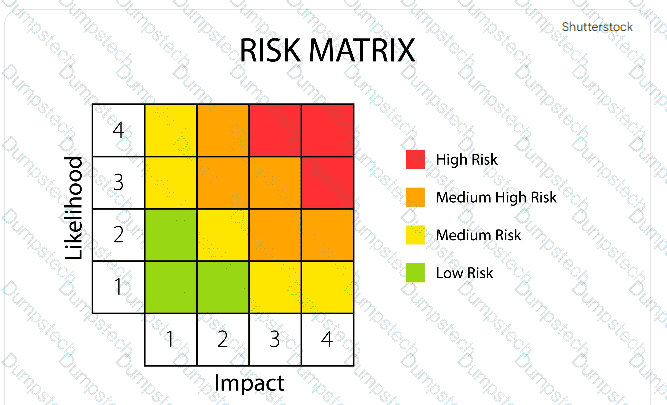
Choice A (Root cause analysis) is a tool used in Identify Risks to understand why a risk might happen, but it does not provide the numerical or qualitative rating itself.
Choice C (Expert judgment) is a tool/technique used to help determine the values, but the ratings themselves are formally based on the assessment of probability and impact.
Choice D (Revised stakeholders ' tolerances) influences the thresholds (what is considered " High " or " Low " ), but the individual risk rating remains a product of its specific probability and impact.
Fast tracking is a schedule compression technique used to shorten the project schedule without changing project scope. Which of the following can result from fast tracking?
Options:
The risk of achieving the shortened project time is increased.
The critical path will have positive total float.
Contingency reserves are released for redeployment by the project manager.
Duration buffers are added to maintain a focus on planned activity durations.
According to the PMBOK® Guide, specifically within the Develop Schedule process, Fast Tracking is a schedule compression technique used to shorten the project duration without reducing the project scope.
Mechanism: Fast tracking involves performing activities in parallel that would normally be done in sequence. For example, starting the construction of a building ' s foundation before the final architectural drawings are 100% complete.
Impact on Risk and Rework: Because activities are performed out of their natural or logical sequence, fast tracking often results in increased risk and a higher probability of rework. If the drawings change after the foundation is poured, the work may need to be corrected.
Comparison with Crashing: Unlike Crashing (which adds resources and increases costs), Fast Tracking primarily impacts the risk profile and does not necessarily increase costs, though the potential for rework can lead to indirect cost increases later.
Analysis of Other Options:
B. The critical path will have positive total float: Incorrect. The critical path, by definition, has zero or negative total float. Compressing the schedule aims to meet a target date, but it does not create " slack " or positive float on the critical path itself.
C. Contingency reserves are released: Incorrect. Since fast tracking increases project risk, the project manager would likely need to maintain or even increase contingency reserves rather than release them.
D. Duration buffers are added: This describes Critical Chain Method, not fast tracking. In fast tracking, the focus is on overlapping existing activities rather than adding specific buffers to the schedule.
A project manager managing a cross-cultural virtual project team across several time zones should be concerned about the impacts of which communication technology factor?
Options:
Urgent information need
Sensitivity of information
Project environment
Ease of use
In accordance with the PMBOK® Guide (Project Communications Management), specifically within the Plan Communications Management process, the project manager must consider various factors when selecting communication technology. When a team is cross-cultural, virtual, and spread across several time zones, the primary concern is the Project Environment.
The project environment factor includes:
Geographic Distribution: The physical location of team members across different countries.
Time Zones: The challenge of scheduling synchronous communication (meetings) when team members ' working hours do not overlap.
Cultural Diversity: Differences in communication styles, languages, and social norms that affect how information is perceived and processed.
Connectivity: Ensuring that all virtual members have the necessary technological infrastructure to participate equally.
According to PMI standards, the project manager must adapt the communication technology to fit this specific environment (e.g., using asynchronous tools like email or shared portals for routine updates and carefully timed video conferencing for critical decision-making).
Analysis of Distractors:
A. Urgent information need: While urgency dictates the speed of the technology (e.g., phone call vs. letter), it is a situational factor rather than the fundamental challenge posed by a global, virtual team structure.
B. Sensitivity of information: This relates to security and confidentiality requirements (e.g., encryption). While important, it is not the defining challenge of managing a cross-cultural, multi-timezone team.
D. Ease of use: This refers to the " user-friendliness " of the tools. While a factor in technology adoption, it does not address the core environmental complexities of virtual, global project management.
Make-or-buy analysis is a tool and technique of which process?
Options:
Conduct Procurements
Plan Procurement Management
Analyze Procurements
Control Procurements
According to the PMBOK® Guide, Make-or-Buy Analysis is a specific tool and technique used during the Plan Procurement Management process. This analysis is fundamental to determining whether particular work can best be accomplished by the project team or should be purchased from outside sources.
Plan Procurement Management: This is the process of documenting project procurement decisions, specifying the approach, and identifying potential sellers. Since the decision to " make " or " buy " dictates the entire procurement strategy, it must occur during the planning phase.
The Analysis: It involves evaluating the risks, costs (both direct and indirect), and organizational capacity. For example, while it might be cheaper to " buy " a software solution, the organization might decide to " make " it to retain intellectual property or ensure long-term support.
Output: The results of this analysis lead to Make-or-Buy Decisions, which are formal documented decisions that influence the procurement statement of work and the procurement strategy.
Analysis of other options:
A. Conduct Procurements: This process focuses on obtaining seller responses, selecting a seller, and awarding a contract. The decision to buy has already been made by this stage.
C. Analyze Procurements: This is not a formal PMI process name. While analysis occurs throughout procurement, it is not a categorized process in the PMBOK® Guide.
D. Control Procurements: This process involves managing procurement relationships, monitoring contract performance, and making changes/corrections. It occurs during the monitoring and controlling phase, long after the initial make-or-buy decision.
In the PMI framework, the Make-or-Buy Analysis ensures that the project manager and the performing organization optimize resources by choosing the most cost-effective and least risky path for deliverable production.
Modal title
